
MANGO MYRTLE

- Botanical name
- Syzygium luehmannii
- Also known as
- Riberry, Small-leaved Lilly Pilly, Cherry Satinash, Cherry Alder, Clove Lilli Pilli
- Main flavour compound
- Citral
- Part used
- Dried fruit (small bright pink-red berry)
- Method of cultivation
- Medium-sized coastal rainforest tree of the Myrtaceae family, native to the eastern Australian coast from the Macleay River in northern NSW up to near Cairns in tropical Queensland. The tree grows 8–15 metres tall, with small narrow shiny leaves and clusters of small bright pink-red berries that ripen in summer. Cultivated commercially as a bushfood on a small scale since the early 1980s. Also a popular ornamental tree across subtropical Australia.
- Commercial preparation
- Berries are hand-picked at full colour, washed, and either freeze-dried or low-temperature dehydrated. Some commercial product is sold fresh, frozen, or processed into syrups and jams.
- Non-culinary uses
- Bushfood market — jams, syrups, sauces, confectionery; the fruit is rich in antioxidants, folate and vitamin E and has been positioned as a "superfood"; ornamental tree.
Mango Myrtle — Syzygium luehmannii, more commonly known as Riberry — is a medium-sized coastal rainforest tree of the Myrtaceae family, native to the eastern Australian coast from the Macleay River in northern NSW up to near Cairns in tropical Queensland. The tree grows 8–15 metres tall, with small narrow shiny leaves and clusters of bright pink-red berries about the size of a small pea, ripening in summer. The fruit has a tart-cranberry character with a distinctive clove-spice aftertaste — sometimes described as "cranberry meets rose" — that has made it one of the most recognisable Australian native fruits. [source] The name "Mango Myrtle" is a marketing variant; "Riberry" is the more widely-used common name.
Whole dried berry
The standard form — slow extraction in cool maceration.
Powdered
Faster extraction; loses character within months.
Region of cultivation
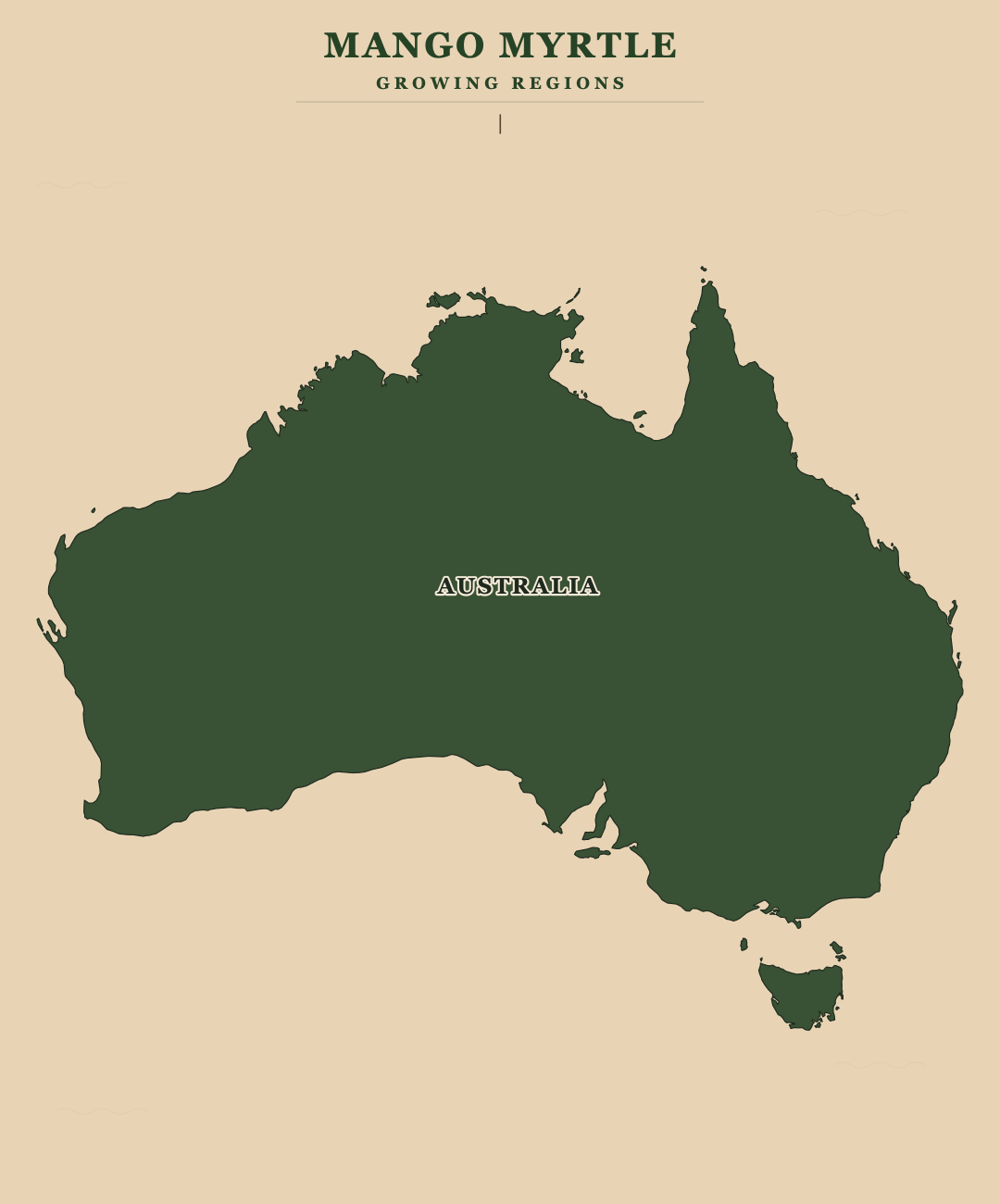
Mango Myrtle is native to Australia, Australia — coastal eastern Queensland and northern NSW (Macleay River to Cairns), with secondary growing regions in Small-scale bushfood plantation cultivation across subtropical eastern Australia. |
Spice Story
Riberry has been a traditional bushfood for the First Nations peoples of its rainforest range for tens of thousands of years. Commercial cultivation began in the early 1980s, when bushfood pioneers introduced the fruit to Australian chefs and food retailers. [source] Today riberry appears across modern Australian native cuisine in jams, sauces, syrups, confectionery and increasingly in craft cocktails. In gin, mango myrtle / riberry provides a distinctively Australian native-fruit character — tart-cranberry-clove — that no imported botanical can replicate.
Gin Creativity
Mango Myrtle brings tart-cranberry brightness with a distinctive clove-spice undercurrent and visual pink colour. A full sachet pushes a gin into clearly native-fruit territory; a half-sachet provides bright fruit complexity that integrates with juniper. Pair with lemon myrtle for layered native character, or with pepperberry and anise myrtle for a fully bush-spice profile.
Blending Science
Main flavour compounds
 Citrallemon-bright
 Limoneneclean citrus lift
 Eugenolclove-like, warming
 Anthocyanins—
Pairs well with
Citral layers a bright lemon-citrus aromatic. Limonene adds general citrus body. Eugenol is the surprise — present in significant concentration and providing the characteristic clove-spice undertone that distinguishes riberry from other native fruits. Anthocyanins are the non-volatile pigments responsible for the deep pink-red colour, sensitive to heat. Cool extraction preserves the bright fruit character and pigment.
Food Partners
- Riberry jam — the canonical bushfood preserve.
- Game-meat reductions — riberry-gin glaze over kangaroo or venison.
- Cool stone-fruit desserts — riberry over peach or apricot.
- Soft fresh cheese — chèvre with riberry coulis.
- Sparkling wine garnishes — riberry in champagne cocktails.
Cocktails To Try

- Australian Spritz — mango myrtle gin, prosecco, soda, riberry garnish.
- Native Negroni — mango myrtle gin, Campari, sweet vermouth.
- Riberry Sour — mango myrtle gin, lemon, honey, egg white.
Release The Flavour
- Cool extraction — preserves the bright fruit and pigment.
- Brief contact — 2–6 hours captures the tart-clove character.
- Chop coarsely — exposes the fruit interior.
- Source matters — small-batch eastern Australian bushfood production is the standard.
Discover more
Pairs well with
Same flavour family
Surprise me

Sources & Citations
- scientific_name (Syzygium luehmannii, Myrtaceae):en.wikipedia.org/wiki/Syzygium_luehmannii
- native_range (Macleay River NSW to Cairns Qld):en.wikipedia.org/wiki/Syzygium_luehmannii
- flavour_profile (cranberry-clove-rose):naturallynative.au/blogs/resources/what-is-riberry
- commercial_bushfood_since_1980s:en.wikipedia.org/wiki/Syzygium_luehmannii
- common_names (Riberry, Lilly Pilly):en.wikipedia.org/wiki/Syzygium_luehmannii
- main_flavour_compounds (CSV-sourced):inputs/source.csv — Mango Myrtle row
