
CINNAMON MYRTLE

- Botanical name
- Backhousia myrtifolia
- Also known as
- Grey Myrtle, Carrol, Neverbreak, Iron Wood
- Main flavour compound
- Methyl eugenol
- Part used
- Dried leaf (whole or ground)
- Method of cultivation
- A small-to-tall rainforest tree of the myrtle family (Myrtaceae), growing in the subtropical rainforests of eastern Australia and reaching up to 30 metres in the wild, with ovate-to-elliptic leaves 4–7 cm long and small star-shaped snow-white flowers. It is hardy in cultivation, tolerating drought, periods of inundation and repeated root disturbance.
- Commercial preparation
- The aromatic leaves are harvested and gently dried, then sold whole or milled to a ground spice; the leaf is also steam-distilled for its cinnamon-scented essential oil. The oil yield runs from about 0.5% to 2.2% of the fresh leaf weight depending on the form and growing conditions.
- Non-culinary uses
- The leaf oil carries a natural cinnamon-like fragrance and has been reported to show antibacterial and antifungal activity.
Cinnamon Myrtle — Backhousia myrtifolia — is a rainforest tree of the myrtle family, a cousin of Lemon Myrtle and Anise Myrtle, growing up to 30 metres tall in the subtropical rainforests of eastern Australia. [source] Its leaves are ovate to elliptic and 4–7 cm long, and in season it carries small, star-shaped, snow-white flowers across the canopy. [source] It is a quietly tough plant, untroubled by drought, by periods of flooding, or by repeated disturbance at the root — the kind of resilience you would expect from a tree that has weathered the wet-and-dry swings of an east-coast rainforest. [source]
Whole dried leaf
The everyday form — crack or crush just before use, or macerate in spirit to draw out the warm cinnamon character.
Ground
Faster extraction and easy to dose; ground spice fades quicker, so buy in small amounts.
Region of cultivation
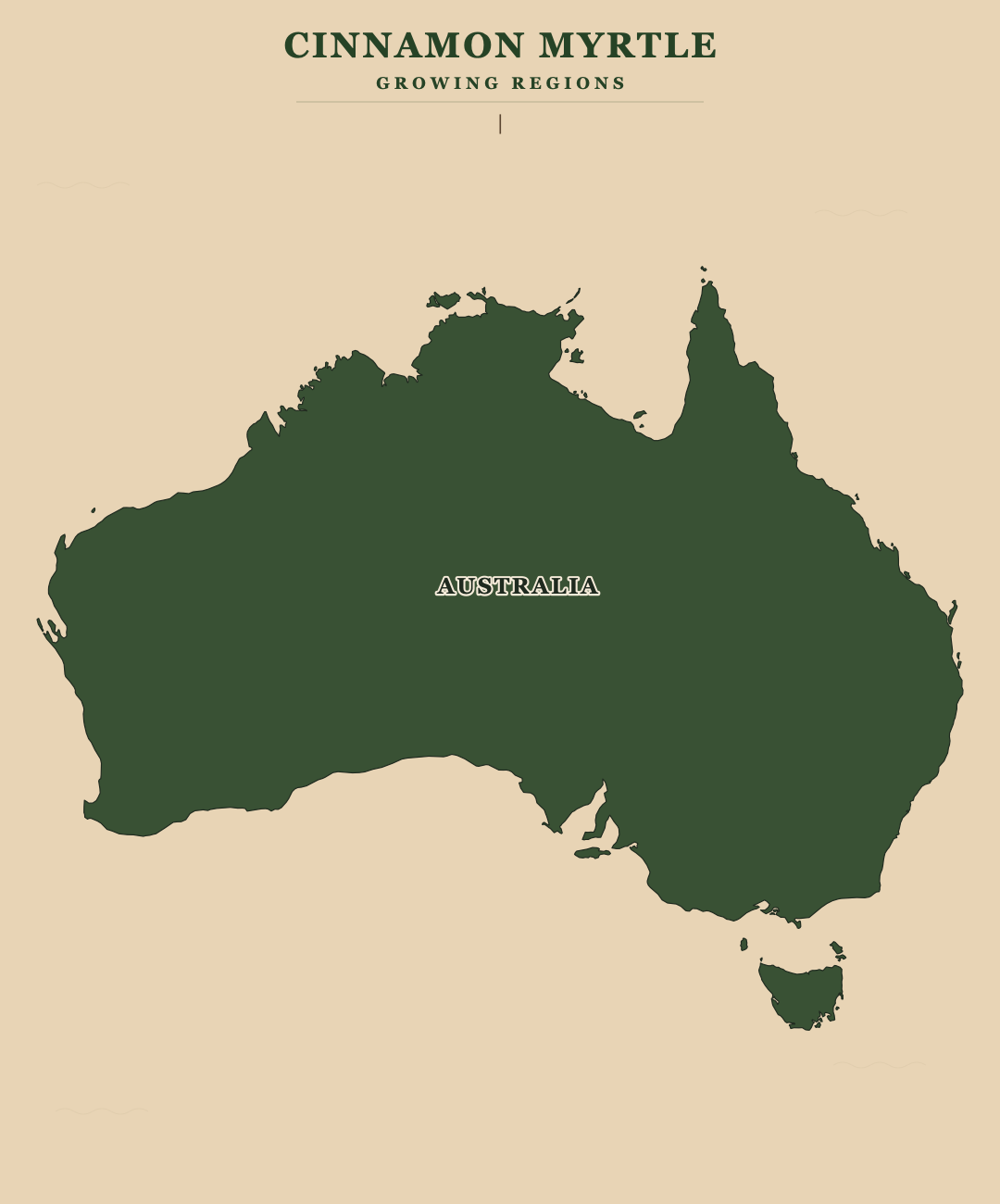
Cinnamon Myrtle is native to Australia, Australia — subtropical rainforest, east-coast NSW & QLD, with secondary growing regions in Bega NSW south coast (southern limit), Fraser Island QLD (northern limit). |
Spice Story
Where most of its myrtle relatives lean citrus or aniseed, this one goes the other way entirely — the leaf carries a pleasant, spicy, cinnamon-like aroma and flavour, which is exactly how it earned its name. [source] It is also known by older settler names — carrol, neverbreak, iron wood and grey myrtle — a reminder that its timber was prized long before its leaf reached the spice rack. [source] Indigenous Australians used the leaf as a spice in cooking, and in the late 1980s it was rediscovered and popularised within the modern Australian bushfood movement, finding its way into biscuits, stews, desserts, confectionery and herbal teas. [source] It is a native spice that behaves like a pantry classic — warm, sweet and instantly familiar.
Gin Creativity
(GinSchool's own view.) Cinnamon Myrtle is a warming, sweet-spice botanical — think of it as the native answer to cassia or clove. It pushes a gin toward the cosy end of the spectrum: mulled, festive, dried-fruit warmth that sits beautifully behind juniper rather than fighting it. A little goes a long way, so treat it as seasoning, not as a headline. It loves company from the other native myrtles — a touch of Lemon Myrtle for lift, Anise Myrtle for sweetness — and the classic warm-spice partners of cardamom and coriander seed. Reach for it when you want a gin that tastes like the end of the year.
Blending Science
Main flavour compounds
 Methyl eugenolclove-like, warming
 Elemicin—
 (E)-Methyl isoeugenolclove-like, warming
 (E)-Isoelemicin—
Pairs well with
Cinnamon Myrtle is chemically unusual among the myrtles: instead of the bright monoterpenes you find in most of the family, its leaf oil is built almost entirely from aromatic ethers — the warm, spicy phenylpropanoids — with the terpenes pushed right into the background. [source] The plant exists as four distinct chemotypes, each dominated by a single ether: a methyl eugenol form (the ether reaching around 86% of that oil), an elemicin form (up to ~92%), an (E)-methyl isoeugenol form (~74%) and an (E)-isoelemicin form (~78%). [source] Methyl eugenol brings a warm clove-spice tone, while elemicin — the same sweet, nutmeg-associated molecule found in nutmeg and mace — supplies that rounded, baked-spice warmth. [source] The practical upshot for a distiller: which leaf source you use genuinely changes the spice signature, and the whole-leaf oil sits at a modest 0.5–2.2% of fresh weight, so expect a botanical that is potent but finite. [source]
Food Partners
- Spiced biscuits and baking: its natural home — a native stand-in for cinnamon in shortbread and spice biscuits. [source]
- Custards and desserts: warm sweet-spice through panna cotta, rice pudding and baked custard. [source]
- Stewed and dried fruit: lifts apples, pears and dried fruit the way a cinnamon stick would.
- Slow-cooked stews: a savoury warmth in long-simmered dishes. [source]
- Herbal teas: steeped alone or blended, for a sweet, spicy cup. [source]
Cocktails To Try

(Serve ideas — GinSchool's own framing.)
- Native Negroni: build the classic equal-parts gin, sweet vermouth and Campari around a cinnamon-myrtle gin, and the bitter-orange backbone turns warm, mulled and autumnal — the native spice reads like the end of the year in a glass.
- Cinnamon Hanky Panky: the old Savoy classic of gin, sweet vermouth and a dash of Fernet-Branca, given a native twist — the leaf's clove-and-nutmeg warmth meets the Fernet's herbal bitterness like a digestif by the fire.
- Spiced elevated G&T: pour a cinnamon-myrtle gin over plenty of ice with a crisp Indian tonic and a long twist of orange — the warm sweet-spice lifts the whole serve into grown-up, festive territory.
Release The Flavour
(GinSchool's own tips.)
- Heat: keep extraction gentle — the aromatic ethers are the whole point, and hard heat will coarsen that warm cinnamon top note.
- Alcohol: a good solvent for these phenylpropanoids; macerate the dried leaf in your base spirit before distilling to draw the spice out.
- Time: dried leaf gives up its character steadily — allow a longer, patient maceration than you would a citrus peel.
- Less is more: it is a warm seasoning, not a soloist; use it to round and lengthen, letting juniper keep the lead.
Discover more
Pairs well with
Same flavour family
Surprise me

Sources & Citations
- scientific_name (Backhousia myrtifolia Hook. & Harv., Myrtaceae):GBIF Backbone Taxonomy, usageKey 3185104 (Backhousia myrt...
- common names (carrol, neverbreak, iron wood, grey myrtle, cinnamon myrtle):en.wikipedia.org/wiki/Backhousia_myrtifolia
- plant_form (rainforest tree to 30 m; ovate-elliptic leaves 4–7 cm; star-shaped snow-white flowers; Myrtaceae):en.wikipedia.org/wiki/Backhousia_myrtifolia
- distribution (subtropical rainforest E Australia; Bega NSW to Fraser Island QLD):en.wikipedia.org/wiki/Backhousia_myrtifolia
- hardiness (tolerates drought, inundation, root disturbance):tasteaustralia.biz/bushfood/cinnamon-myrtle/
- flavour (pleasant spicy cinnamon-like aroma and flavour; leaf used as spice):tasteaustralia.biz/bushfood/cinnamon-myrtle/
- culinary_uses (biscuits, stews, desserts, confectionery, herbal teas):tasteaustralia.biz/bushfood/cinnamon-myrtle/
- bushfood_history (popularised as a bushfood in the late 1980s; long Indigenous use):tasteaustralia.biz/bushfood/cinnamon-myrtle/
- oil (natural cinnamon-like fragrance; antibacterial and antifungal activity reported):tasteaustralia.biz/bushfood/cinnamon-myrtle/
- leaf_oil_chemistry (four chemotypes, each dominated by ONE aromatic ether: methyl eugenol ~86%, elemicin ~92%, (E)-methyl isoeugenol ~74%, (E)-isoelemicin ~78%; terpenes minor; oil yield 0.5–2.2% fresh wt):Review of the Leaf Essential Oils of the Genus Backhousia...
- elemicin_character (sweet/warm, nutmeg-associated phenylpropanoid):PubChem CID 10248 (Elemicin) — pubchem.ncbi.nlm.nih.gov/c...
- compound_cids (PubChem):PubChem CIDs — methyl eugenol 7127, elemicin 10248, (E)-methyl isoeugenol 637776, (E)-isoelemicin 5318557
- gin_applewood (Applewood Distillery Myrtle Gin — lemon, anise & cinnamon myrtle 'holy trinity' of native myrtles over juniper):www.applewooddistillery.com.au/products/myrtle-gin
- hero_image:iStock royalty-free licence (asset 1353577076)
