
LEMON MYRTLE

- Botanical name
- Backhousia citriodora
- Also known as
- Lemon Ironwood, Sweet Verbena Tree, Sweet Verbena Myrtle
- Main flavour compound
- Citral (neral + geranial — 90-98% of oil)
- Part used
- Dried leaf (whole or cracked)
- Method of cultivation
- Tall rainforest tree of the Myrtaceae family, endemic to the subtropical coastal rainforests of central and south-eastern Queensland, with natural distribution from Mackay south to Brisbane. In the wild can grow 10–20 metres tall; in plantation typically maintained as a 3–8 metre shrub by regular harvesting. The species contains the highest natural concentration of citral of any plant — typically 90–98% of the leaf essential oil — giving it the most intense lemon aroma in the botanical world.
- Commercial preparation
- Leaves are harvested mechanically in plantation (from the top and sides of hedged trees) several times per year, then gently dried at low temperature to preserve the volatile citral content. Queensland and northern NSW dominate commercial production.
- Non-culinary uses
- Essential oil for food flavouring, perfumery, natural cleaning products, aromatherapy and natural health products; one of the most widely-exported Australian native foods globally.
Lemon Myrtle — Backhousia citriodora — is a tall rainforest tree of the Myrtaceae family, endemic to the subtropical coastal rainforests of central and south-east Queensland. In its native rainforest the tree grows 10–20 metres tall, with glossy dark green lance-shaped leaves and clusters of creamy white flowers in late spring. The defining characteristic is the leaf's essential-oil chemistry: 90–98% citral, the highest natural concentration of citral of any plant on Earth. [source] Crush a single leaf and the air fills with the most intensely lemon-scented compound imaginable.
Whole dried leaf
The standard form — crumble lightly to release the citral.
Cracked or ground
Faster extraction; loses character within months.
Region of cultivation
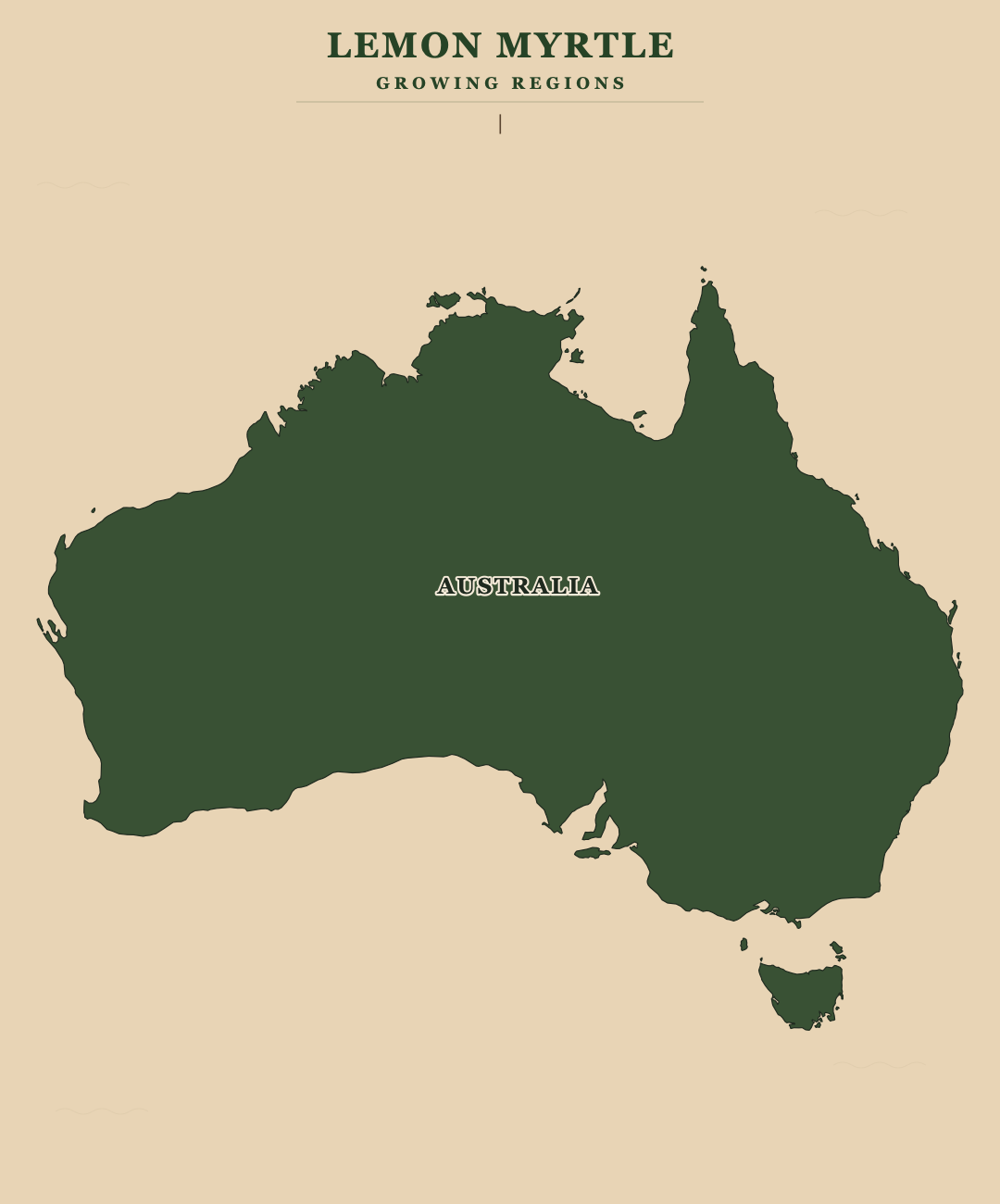
Lemon Myrtle is native to Australia, Australia — central and south-east Queensland coastal rainforest (Mackay to Brisbane), with secondary growing regions in Plantation cultivation in northern NSW and SE Queensland. |
Spice Story
Lemon Myrtle has been a traditional bushfood for the First Nations peoples of its rainforest range for tens of thousands of years. Modern commercial plantation cultivation began in the 1990s and has grown rapidly — Lemon Myrtle is now one of the most internationally celebrated Australian native foods, exported worldwide for use in food flavouring, beverages, cosmetics and aromatherapy. In gin, Lemon Myrtle has become a signature contemporary Australian native botanical, present in nearly every Australian craft gin that leans on native character.
Gin Creativity
Lemon Myrtle delivers the most intense lemon character available from any natural ingredient. A full sachet pushes a gin firmly into intensely native-lemon territory; a half-sachet provides the cleanest lemon brightness available, integrating beautifully with juniper. Pair with Anise Myrtle for a layered Australian native profile, or with Pepperberry and Wattle Seed for a bush-spice gin.
Blending Science
Main flavour compounds
 Citral (neral + geranial — 90-98% of oil)lemon-bright
 Citronellallemon-rosy
 Linaloolfloral, soft
Pairs well with
Citral — the combination of neral and geranial isomers — dominates at 90–98% of the leaf oil, the highest natural concentration of citral in any plant. [source] Citral provides the bright, sharp, instantly-recognisable lemon character. Citronellal layers a softer rose-citrus note. Linalool contributes a quiet floral lift. Cool extraction preserves the bright citral; warm extraction can flatten it.
Food Partners
- Native fish and seafood — Lemon Myrtle and prawns is a chef's classic.
- Asian-Australian fusion — Lemon Myrtle in stir-fries and curries.
- Lemon-and-honey desserts — Lemon Myrtle syrup over panna cotta.
- Spice rubs for grilled meat — Lemon Myrtle in a rub with pepperberry and salt.
- Cool sorbets and ice creams — Lemon Myrtle is exceptional in frozen desserts.
Cocktails To Try

- Australian G&T — Lemon Myrtle gin, native tonic, fresh Lemon Myrtle leaf.
- Native Gimlet — Lemon Myrtle gin, lime cordial, lemon-myrtle peel.
- Bushland Spritz — Lemon Myrtle gin, prosecco, soda, fresh leaf garnish.
Release The Flavour
- Cool extraction — preserves the citral.
- Brief contact — 1–4 hours captures the brightness.
- Crumble lightly — exposes the volatile oils.
- Less is more — Lemon Myrtle is intensely concentrated; a half-leaf in a small batch is plenty.
Discover more
Pairs well with
Same flavour family
Surprise me

Sources & Citations
- scientific_name (Backhousia citriodora, Myrtaceae):en.wikipedia.org/wiki/Backhousia_citriodora
- native_range (central-south-east Queensland rainforest):en.wikipedia.org/wiki/Backhousia_citriodora
- citral_content (90-98% of oil — highest natural concentration):pmc.ncbi.nlm.nih.gov/articles/PMC8305781/
- commercial_plantation_qld_nsw:en.wikipedia.org/wiki/Backhousia_citriodora
- tree_height_wild_vs_cultivation:www.viriar.com/blogs/tree-encyclopedia/backhousia-citriodora
- main_flavour_compounds (CSV-sourced):inputs/source.csv — Lemon Myrtle row
