
WATTLE SEED

- Botanical name
- Acacia victoriae (most common commercial species)
- Also known as
- Elegant Wattle, Prickly Wattle, Gundabluey, Bramble Wattle
- Main flavour compound
- Pyrazines (toasted-nutty Maillard products)
- Part used
- Roasted dried seed (ground or whole)
- Method of cultivation
- Small tree of the Fabaceae (legume) family, native to arid and semi-arid mainland Australia (SA, NT, WA, Vic, NSW, Qld). The plant grows naturally in hot, low-rainfall country (125–500 mm annual rainfall) on a broad range of soil types and is tolerant of frost, drought, soil lime and salinity. Trees start flowering at 2–4 years old and produce pods containing the small dark seeds harvested for the wattleseed trade.
- Commercial preparation
- Mature seed pods are gathered, threshed, the seeds extracted and roasted (the roasting step is essential — it develops the characteristic coffee-chocolate-hazelnut aromatic compounds through Maillard chemistry). Roasted seeds are typically ground for ease of use.
- Non-culinary uses
- Foundational native Australian bushfood — the seeds are a high-protein traditional food source (17% protein, 41% carbohydrate, 29% fibre); wattleseed flour for baking; commercial coffee substitute ("wattleseed coffee" — particularly popular in Australian native cafés); ornamental drought-tolerant garden plant.
Wattle Seed — primarily from Acacia victoriae (Elegant Wattle), though other Australian acacia species are also used — is a foundational native Australian bushfood. The plant is a small tree of the Fabaceae (legume) family, native to arid and semi-arid mainland Australia, tolerant of frost, drought and salinity. [source] What's used is the dried seed — small, dark, hard — which is always roasted before use. The roasting step is critical: it develops the characteristic toasted-coffee-chocolate-hazelnut aromatic compounds through Maillard chemistry. Unroasted wattle seed has very little of the famous wattleseed character.
Whole roasted seed
Less common — most product is sold pre-ground.
Roasted ground wattle seed
The standard form — distinctive dark-brown powder.
Region of cultivation
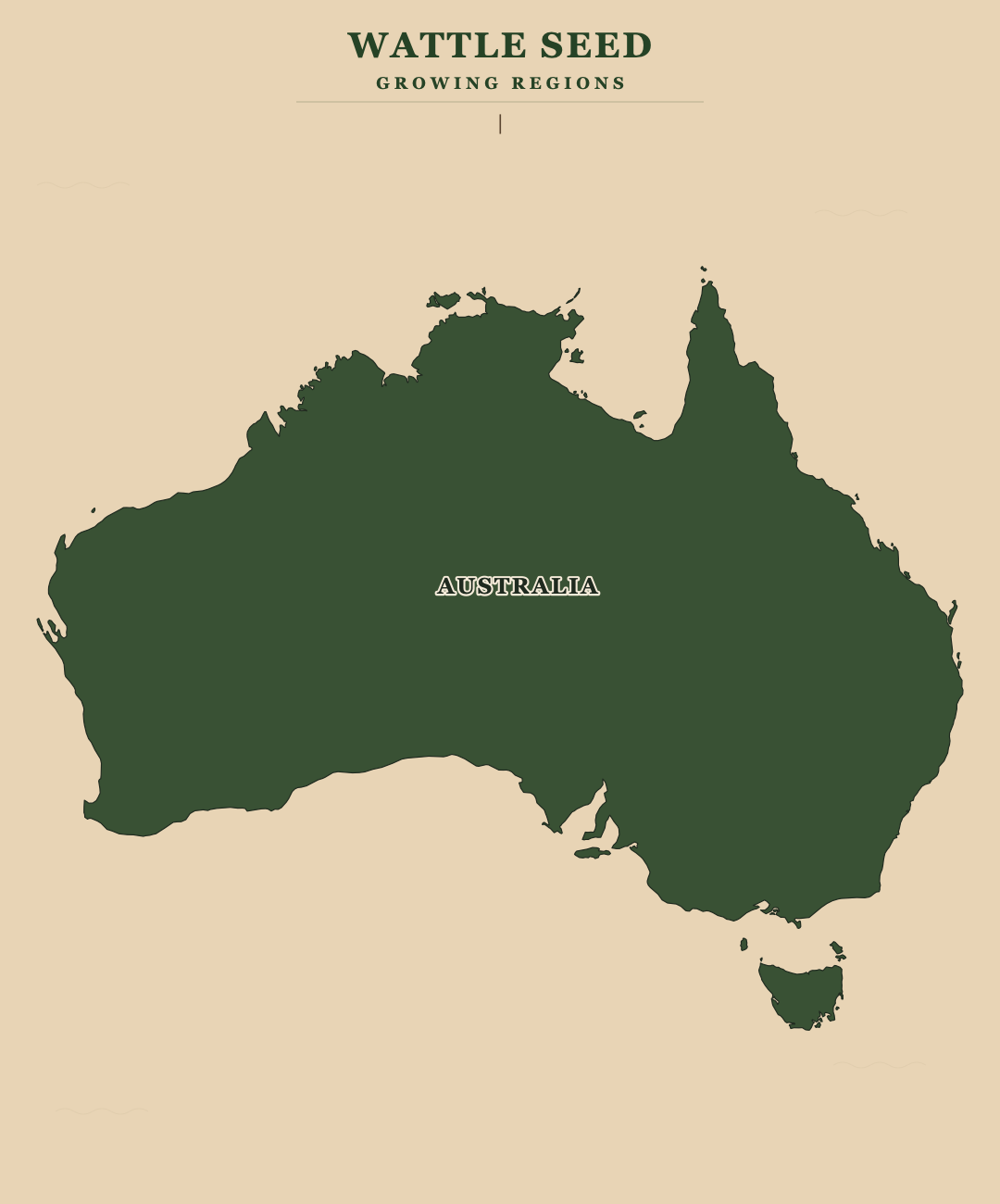
Wattle Seed is native to Australia, Australia — arid and semi-arid inland country (SA, NT, NSW, Qld), with secondary growing regions in Cultivated commercially across inland Australia. |
Spice Story
Wattle seed has been a foundational traditional bushfood across arid Australia for tens of thousands of years — roasted on coals and ground for adding to damper bush bread, used as a high-protein staple food (17% protein content) in dry country where other reliable food sources are scarce. Modern commercial cultivation began in the 1980s with the broader Australian native-food movement, and roasted wattle seed has become one of the most internationally-celebrated Australian native ingredients — particularly through its use as a coffee substitute. [source] In gin, wattle seed provides distinctive toasted-coffee-chocolate-hazelnut character that no imported botanical replicates.
Gin Creativity
Wattle Seed brings rich toasted-coffee-chocolate-hazelnut character with a soft Maillard depth. A full sachet pushes a gin firmly into clearly toasted-native-bush territory; a half-sachet provides quiet roasted-warm depth that integrates with juniper. Pair with cacao nibs and vanilla for a dessert profile, or with Lemon Myrtle and Anise Myrtle for a fully native bush-spice blend.
Blending Science
Main flavour compounds
 Pyrazines (toasted-nutty Maillard products)roasted, nutty
 Furanonescaramel, sweet
 Diketopiperazines (coffee-like)coffee, bitter-roasted
Pairs well with
The character is dominated by pyrazines (Maillard-reaction products developed during roasting — the same compounds that give coffee and cacao their roasted character). Furanones add sweet caramel notes. Diketopiperazines contribute the coffee-like depth that distinguishes wattle seed from other nut and seed botanicals. The roasted seed contains no significant volatile aromatic if unroasted — roasting is essential. Long warm extraction develops the full character.
Food Partners
- Wattleseed bread (damper) — traditional Aboriginal bush bread.
- Wattleseed-and-chocolate desserts — wattleseed brownies and cakes.
- Coffee-style preparations — wattleseed-and-milk Australian café classic.
- Slow-braised native meats — wattleseed in kangaroo and emu reductions.
- Aged cheese with native honey — Cape Grim cheese with wattleseed dust.
Cocktails To Try

- Wattleseed Old Fashioned — wattleseed gin, demerara, orange bitters.
- Australian Espresso Martini — wattleseed gin, espresso, coffee liqueur.
- Bush Negroni — wattleseed-and-pepperberry gin, Campari, vermouth.
Release The Flavour
- Long warm extraction — develops the toasted character.
- Use roasted only — unroasted wattle seed has little flavour.
- Filter carefully — fine powder can cloud the spirit.
- Source matters — Aboriginal-owned and -operated wattleseed production is the ethical premium grade.
Discover more
Pairs well with
Same flavour family

Surprise me

Sources & Citations
- scientific_name (Acacia victoriae, Fabaceae):en.wikipedia.org/wiki/Wattleseed
- arid_australian_range:www.bushfoodaustralia.com/wattleseed/
- coffee_chocolate_hazelnut_flavour:warndu.com/blogs/recipes/wattleseed-the-perfect-alternati...
- nutritional_protein_17_percent:www.australianseed.com/shop/item/acacia-victoriae
- 2-4_year_flowering_age:www.australianseed.com/shop/item/acacia-victoriae
- main_flavour_compounds (CSV-sourced):inputs/source.csv — Wattle Seed row
