
HONEY MYRTLE

- Botanical name
- Melaleuca teretifolia
- Also known as
- Banbar (Noongar), Lemon Myrtle's cousin
- Main flavour compound
- Citral (neral + geranial — 65-70%)
- Part used
- Dried leaf and twig (the soft white flowers are sometimes included)
- Method of cultivation
- Small-to-medium shrub of the Myrtaceae family, native to the swampy and seasonally-wet depressions of south-west Western Australia. The plant tolerates harsh environmental conditions — poor soil, drought — thanks to a deep root system. Selected high-citral chemotypes have been cultivated since 2002 by Western Australian growers, with the leaves and young twigs harvested annually (typically January) and processed immediately for essential oil. Honey Myrtle is unusual among the Melaleucas for its very high citral content — typically 65–70% — the highest in the entire Melaleuca family.
- Commercial preparation
- Leaves, twigs and flowers are cut at peak season, dried gently, and either sold whole/cracked or steam-distilled for essential oil. The citral-rich profile makes it distinct from common tea tree (Melaleuca alternifolia).
- Non-culinary uses
- Essential oil for natural cosmetics and aromatherapy; lemon-scented household products; some traditional Indigenous medicinal use; the plant is also valued by beekeepers (honey myrtle is a major nectar source in south-west WA, hence the common name).
Honey Myrtle — Melaleuca teretifolia — is a small-to-medium shrub of the Myrtaceae family, endemic to the swampy and seasonally-wet country of south-west Western Australia. The plant grows 2–3 metres tall in cultivation, with narrow needle-like leaves, soft white flowers (which attract significant bee activity — the source of the common name), and an extensive deep root system that allows it to tolerate the dry summers and saline soils of its native range. The defining feature is the unusually high citral content of the essential oil — 65–70% — which is the highest of any species in the entire Melaleuca (tea-tree) family. [source]
Whole dried leaf and twig
Crumble lightly to release the citral oils.
Cracked
Faster extraction.
Region of cultivation
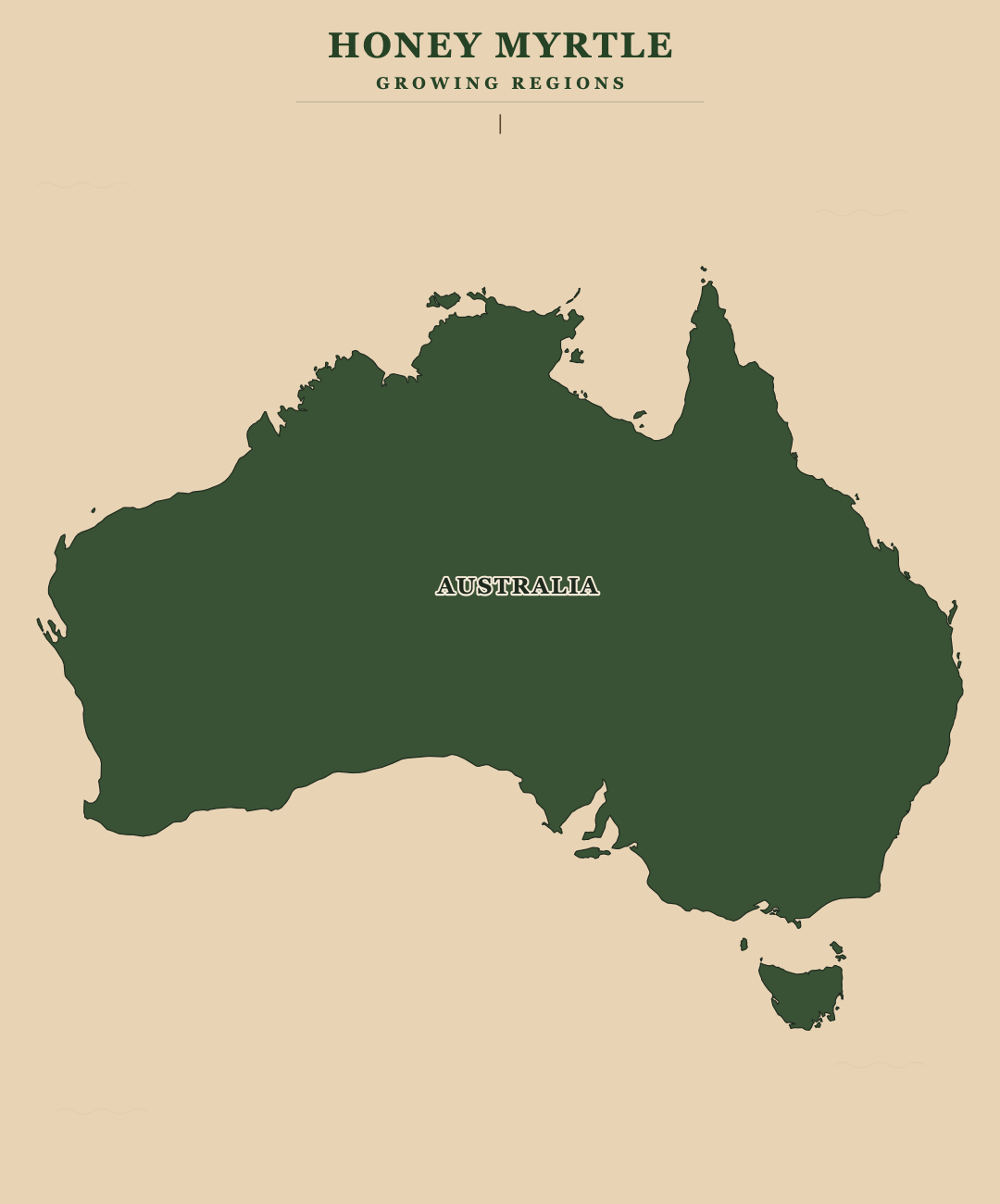
Honey Myrtle is native to Australia, Australia — south-west Western Australia (swampy and seasonally-wet country), with secondary growing regions in Plantation cultivation in south-west WA since 2002. |
Spice Story
Honey Myrtle was largely a regional Western Australian curiosity until the early 21st century, when essential-oil pioneers in WA — the same network of growers who developed Fragonia — began commercial cultivation of selected high-citral chemotypes in 2002. The plant is harvested annually (typically January) and the leaves processed immediately to preserve the volatile citral content. In gin, Honey Myrtle is a contemporary native Australian botanical providing the brightest lemon character of any common Australian Myrtaceae — even brighter than lemon myrtle for some chemotypes.
Gin Creativity
Honey Myrtle brings intense lemon-citral brightness with a soft floral background. A full sachet pushes a gin firmly into native-citrus territory; a half-sachet adds clean lemon lift that integrates with juniper. Pair with lemon myrtle for doubled citral, or with pepperberry and anise myrtle for a fully native bush-spice profile.
Blending Science
Main flavour compounds
 Citral (neral + geranial — 65-70%)lemon-bright
 Limoneneclean citrus lift
 Linaloolfloral, soft
Pairs well with
Citral — the combination of neral and geranial — dominates at 65–70% of the essential oil, the highest concentration in the Melaleuca family. [source] Citral provides the bright lemon character and is the same compound that defines lemon myrtle and lemongrass. Limonene layers a citrus brightness. Linalool adds a soft floral lift. Cool extraction preserves the bright top; warm extraction tends to flatten the citral.
Food Partners
- Lemon-glazed fish — Honey Myrtle reduction over grilled white fish.
- Native bush rubs — Honey Myrtle in a citrus-and-pepperberry rub.
- Honey-and-citrus desserts — Honey Myrtle syrup over lemon tart.
- Roasted root vegetables — Honey Myrtle-gin glaze.
- Light summer dressings — Honey Myrtle vinaigrette.
Cocktails To Try

- Native G&T — Honey Myrtle gin with native tonic and fresh lemon myrtle leaf.
- Australian Gimlet — Honey Myrtle gin, lime cordial.
- Bush Sour — Honey Myrtle gin, wattle-seed syrup, lemon, egg white.
Release The Flavour
- Cool extraction — preserves the citral.
- Brief contact — 1–4 hours captures the brightness.
- Source matters — high-citral chemotype from 2002+ cultivation is the standard.
- Pair generously — Honey Myrtle layers beautifully with other citrus-leaning botanicals.
Discover more
Pairs well with
Same flavour family
Surprise me

Sources & Citations
- scientific_name (Melaleuca teretifolia, Myrtaceae):www.essentially.com.au/pages/honey-myrtle-essential-oil
- native_range (south-west WA swampy country):www.essentially.com.au/pages/honey-myrtle-essential-oil
- citral_content_65-70_percent (highest among Melaleuca):australianessentialoils.com.au/product/honey-myrtle-melal...
- commercial_cultivation_since_2002:www.essentially.com.au/pages/honey-myrtle-essential-oil
- drought_tolerance_and_deep_roots:www.essentially.com.au/pages/honey-myrtle-essential-oil
- main_flavour_compounds (CSV-sourced):inputs/source.csv — Honey Myrtle row
