
GRAPEFRUIT

- Botanical name
- Citrus × paradisi
- Also known as
- Pomelo-orange hybrid, Forbidden fruit (historical, Barbados)
- Main flavour compound
- Limonene
- Part used
- Dried peel (white or pink-fleshed cultivars)
- Method of cultivation
- Cultivated citrus of the Rutaceae family — a natural hybrid of sweet orange (*Citrus × sinensis*) and pomelo (*C. maxima*) that arose in Barbados in the early 18th century. Trees grow 5–10 metres, with large dark-green leaves and clusters of bright pink-yellow fruit ripening on the tree through winter and spring. Major commercial cultivation in China, USA (Florida, Texas, California), Mexico, South Africa and Turkey.
- Commercial preparation
- Fruit is hand- or mechanically picked, the peel removed and dried, with the white pith mostly excluded from premium grades. Pink and red-fleshed cultivars contain higher lycopene; white cultivars typically have higher nootkatone content.
- Non-culinary uses
- Perfumery (grapefruit oil is a signature "modern citrus" base, distinct from orange or lemon); cosmetics; nootkatone is also studied for insect repellent applications.
Grapefruit — Citrus × paradisi — is a relatively young citrus, only about 300 years old as a commercial fruit. It originated in Barbados in the early 18th century as a natural hybrid of sweet orange (Citrus × sinensis) and pomelo (C. maxima), both of which had been introduced to the Caribbean from Asia. [source] The Welsh naturalist Reverend Griffith Hughes documented it in 1750, calling it "forbidden fruit"; in 1830 the Scottish botanist James Macfadyen formally named the Jamaican variety Citrus paradisi. The tree grows 5–10 metres tall, with dark glossy leaves and bunched yellow-pink fruit hanging in characteristic "grape-like" clusters — which is what gave the fruit its English common name.
Dried peel chips
The standard form — adds clear citrus brightness in a cool maceration.
Powdered
Faster extraction but loses character within months.
Region of cultivation
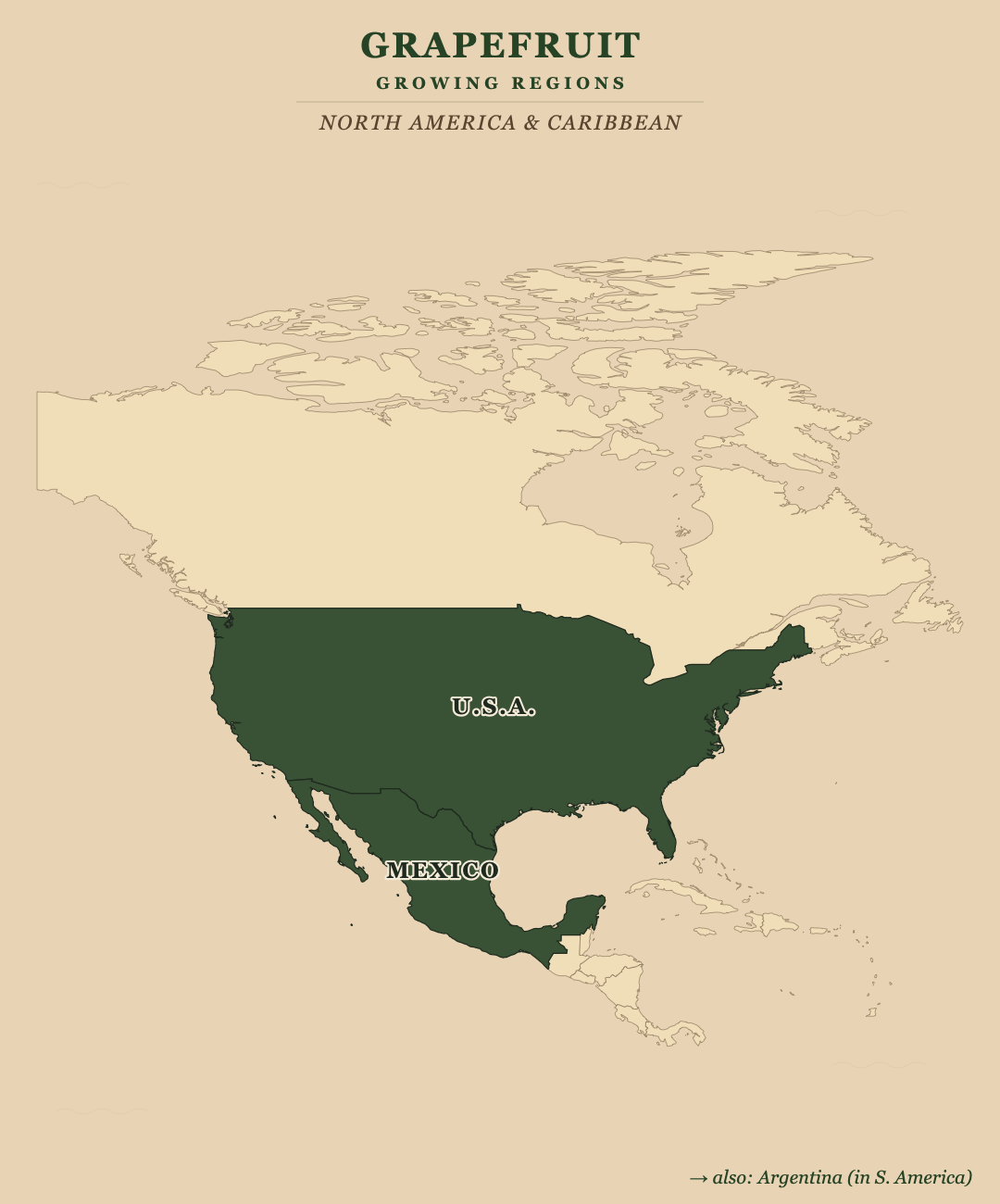
Grapefruit is primarily cultivated in China (largest producer), USA, Mexico, South Africa, with secondary growing regions in Turkey, Argentina, Israel, Cyprus, Australia.
Spice Story
Grapefruit reached the United States in 1823, when French émigré Count Odet Philippe planted the first commercial orchards in Florida. By the late 19th century it had become a major commercial citrus, and the 20th century saw the development of the pink and red-fleshed cultivars (Star Ruby, Ruby Red, Rio Red) that now dominate the table-fruit market. The white-fleshed cultivars are higher in nootkatone — the compound that gives grapefruit its distinctive bittersweet character — and remain the choice for premium juice and essential-oil production. In gin, grapefruit peel is a signature contemporary botanical, particularly in hopped gins (Cascade hop and grapefruit share thiol chemistry), in pink gins, and in Mediterranean garden-gin profiles.
Gin Creativity
Grapefruit brings a complex bittersweet citrus character distinct from orange, lemon or lime. A full sachet pushes a gin firmly into clearly grapefruit-led territory; a half-sachet adds quietly distinctive citrus brightness that integrates with juniper. Pair with Cascade hop for doubled grapefruit, or with cardamom and pink peppercorn for a contemporary modern profile.
Blending Science
Main flavour compounds
 Limoneneclean citrus lift
 Nootkatone—
 Bergaptene—
 Citrallemon-bright
Pairs well with
Limonene dominates as in all citrus. Nootkatone is the defining compound of grapefruit specifically — a sesquiterpene ketone that contributes the bittersweet bite and "woody-citrus" character that distinguishes grapefruit from orange. [source] Bergaptene (a furanocoumarin) provides bitter astringency and is responsible for the well-known grapefruit-drug interaction effects. Citral adds lemon-leaning brightness. Cool extraction preserves the bright top; warm extraction emphasises the nootkatone bitterness.
Food Partners
- Bitter salad leaves — chicory, radicchio, watercress; grapefruit and bitter find each other.
- Salmon and oily fish — grapefruit cuts richness across cured and grilled salmon.
- Avocado salads — Florida-style with citrus.
- Dark chocolate desserts — bittersweet on bittersweet.
- Cocktails with Italian aperitif liqueurs — Campari, Aperol, Suze.
Cocktails To Try

- Paloma (gin) — grapefruit gin, grapefruit soda, lime, salt rim.
- Pink Grapefruit Spritz — grapefruit gin, Aperol, prosecco, soda.
- Hemingway Daiquiri (gin variant) — grapefruit gin, maraschino, lime, sugar.
Release The Flavour
- Cool extraction — preserves the bright top.
- Brief contact — 2–6 hours; longer extractions emphasise bitterness.
- White cultivar peel — gives the strongest nootkatone for cocktail-grade gin.
- Strain finely — peel fragments leach bitter compounds in storage.
Discover more
From the same region
Pairs well with
Same flavour family
Surprise me

Sources & Citations
- scientific_name (Citrus × paradisi):en.wikipedia.org/wiki/Grapefruit
- hybrid_origin (sweet orange × pomelo, Barbados ~1750):en.wikipedia.org/wiki/Grapefruit
- name_origin (forbidden fruit, Hughes 1750):en.wikipedia.org/wiki/Grapefruit
- florida_introduction (Count Odet Philippe 1823):en.wikipedia.org/wiki/Grapefruit
- nootkatone_distinctive_compound:link.springer.com/chapter/10.1007/978-3-662-30369-6_9
- main_flavour_compounds (CSV-sourced):inputs/source.csv — Grapefruit row
