
MACE

- Botanical name
- Myristica fragrans
- Also known as
- Nutmeg aril, Javitri (Hindi)
- Main flavour compound
- Myristicin
- Part used
- Dried aril (the crimson lacy covering around the nutmeg seed)
- Method of cultivation
- Same tree as Nutmeg — *Myristica fragrans* — an evergreen tropical tree of the Myristicaceae family, native to the Banda Islands of Indonesia's Maluku archipelago (the Spice Islands). The tree produces a fleshy fruit; inside the fruit, the dark brown nutmeg seed is wrapped in a bright crimson lacy aril — that aril is mace. One fruit produces both spices: nutmeg from the seed, mace from the aril. Also cultivated in Grenada (Caribbean), Penang (Malaysia) and Kerala (India). Trees take 7–9 years to first harvest; full production reaches at 20 years.
- Commercial preparation
- When ripe, the fruit splits to reveal the crimson aril wrapped around the seed. The aril is carefully removed by hand, flattened, and sun-dried for 10–14 days during which it loses some of its bright red colour and becomes a more orange-amber dried product.
- Non-culinary uses
- Perfumery (the aril essential oil is used for warm-spice accords); traditional medicine across Ayurvedic, Unani and European systems; foundational Christmas-spice ingredient across Northern Europe.
Mace and nutmeg come from the same tree — Myristica fragrans, the nutmeg tree, native to the Banda Islands of Indonesia's Maluku archipelago (the Spice Islands). [source] The fruit, when it ripens and splits open, reveals a dark brown seed wrapped in a bright crimson lacy aril — the aril is mace, the seed is nutmeg. Mace and nutmeg share much of the same chemistry but in different proportions: mace is more delicate and floral, nutmeg is deeper and warmer. The two spices have been traded together throughout history, but mace fetches a higher price by weight because only a small amount of aril is produced per fruit.
Whole dried mace blade (the lace-like aril piece)
The standard form — holds character better than ground.
Ground
Faster extraction but loses character within months.
Region of cultivation
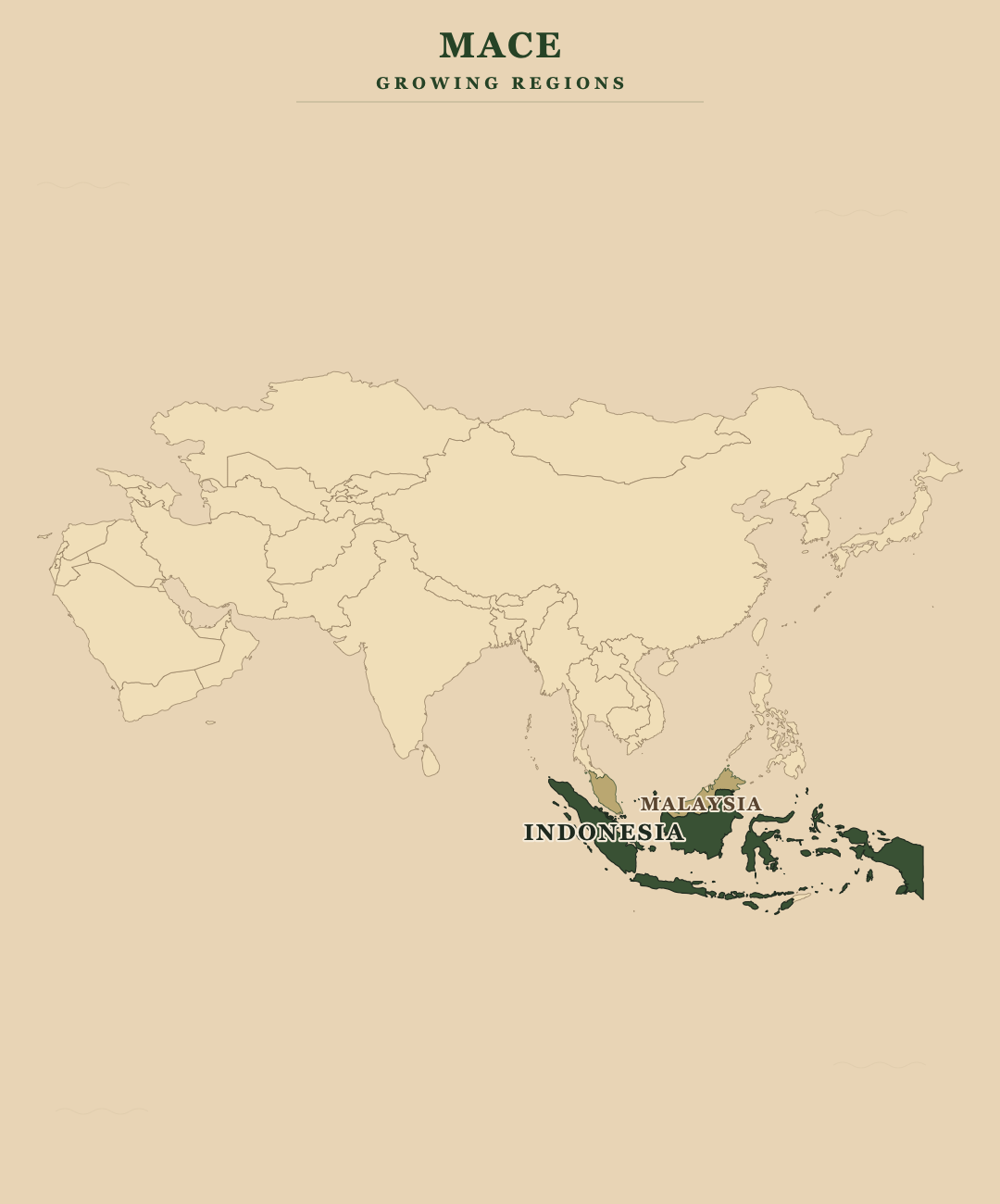
Mace is primarily cultivated in Indonesia (Banda Islands, Maluku), with secondary growing regions in Grenada (Caribbean), Malaysia (Penang), India (Kerala).
Spice Story
Mace shares the broader Maluku Islands spice history with nutmeg. The Banda Islands were the only commercial source until the 17th century, when Dutch monopoly enforcement eventually broke down and the trees were transferred to Grenada (1843), where the Caribbean island became known as "the Isle of Spice" and remains a major producer alongside Indonesia. The 10–14 day sun-drying process is what transforms the bright crimson fresh aril into the orange-amber dried mace of commerce. In gin, mace is a relatively uncommon but historically authentic botanical, particularly in Christmas-spice and old-style London Dry expressions where the warm-floral character pairs beautifully with juniper.
Gin Creativity
Mace is more delicate than nutmeg — softer, more floral, less aggressive. A full sachet adds clear warm-floral spice; a half-sachet provides quiet aromatic depth that integrates with juniper. Pair with nutmeg for layered effect, or with cinnamon and orange peel for a Christmas-spice blend.
Blending Science
Main flavour compounds
 Myristicin—
 Sabinenepepper, warming
 Alpha-Pinenefresh pine, top note
 Eugenolclove-like, warming
Pairs well with
Myristicin is the defining compound shared with nutmeg (named after the genus). Sabinene layers a sharp peppery edge — present in higher concentration in mace than in nutmeg, contributing the brighter, more floral character. Alpha-pinene adds a resinous backbone that bridges to juniper. Eugenol contributes a soft clove-warm depth. Heat-stable; vapour and warm maceration both work.
Food Partners
- Béchamel sauce — mace is the classic French finishing spice in white sauces.
- Christmas baking — mace in fruitcake and gingerbread.
- Mulled wine — mace alongside nutmeg, cinnamon and clove.
- Slow-braised meats — mace in winter stews.
- Custards and milk puddings — mace-infused crème anglaise.
Cocktails To Try

- Spiced Old Fashioned — mace-and-cinnamon gin, demerara, orange bitters.
- Christmas Negroni — mace gin, Campari, sweet vermouth.
- Eggnog (with mace gin) — mace gin in classic eggnog.
Release The Flavour
- Whole blade, not ground — holds character much longer.
- Heat is friendly — both vapour and warm maceration work.
- Time — 24–48 hours for full development.
- Less is more — mace is delicate; small amounts integrate beautifully.
Discover more
From the same region
Same flavour family
Surprise me

Sources & Citations
- scientific_name (Myristica fragrans, Myristicaceae):en.wikipedia.org/wiki/Myristica_fragrans
- native_range (Banda Islands, Maluku):en.wikipedia.org/wiki/Myristica_fragrans
- mace_is_the_aril_not_a_separate_plant:en.wikipedia.org/wiki/Nutmeg
- 10-14_day_drying_process:en.wikipedia.org/wiki/Nutmeg
- 7-9_years_first_harvest:en.wikipedia.org/wiki/Nutmeg
- main_flavour_compounds (CSV-sourced):inputs/source.csv — Mace row
