
NUTMEG


- Botanical name
- Myristica fragrans
- Also known as
- Pala (Indonesian), Jaiphal (Hindi)
- Main flavour compound
- Myristicin
- Part used
- Dried seed (the brown kernel inside the crimson aril called mace)
- Method of cultivation
- Evergreen tropical tree of the Myristicaceae family, native to the Banda Islands in Indonesia's Maluku archipelago (the Spice Islands). The tree grows 10–20 metres tall, taking 7–9 years to bear its first fruit and reaching full production at about 20 years. Each fruit yields two spices: nutmeg (the dark brown seed) and mace (the crimson aril wrapping the seed). Modern production: Indonesia (75–80% of world supply, mainly Maluku), Grenada (about 15% after Dutch transfers in the 18th century), with smaller production in Kerala (India) and elsewhere in the tropics.
- Commercial preparation
- Ripe fruits are split open to reveal the crimson aril wrapped around the dark brown seed; the aril is removed and dried separately as mace, and the seed shell is dried until it can be cracked to release the nutmeg kernel. Nutmeg kernels are then graded by size and sold whole — pre-ground nutmeg loses character within months.
- Non-culinary uses
- Perfumery (warm-spice base note); traditional medicine across Ayurvedic, Unani, Indonesian and European systems for digestion and sleep; foundational Christmas-spice ingredient across Northern Europe and the Caribbean; historically a status spice that drove Dutch and Portuguese colonial expansion.
Nutmeg — Myristica fragrans — is an evergreen tropical tree of the Myristicaceae family, native to the Banda Islands in Indonesia's Maluku archipelago (the Spice Islands). The tree grows 10–20 metres tall, takes 7–9 years to bear first fruit, and remains productive for many decades. Each fruit splits open to reveal the dark brown nutmeg seed wrapped in a bright crimson lacy aril (the aril is the spice mace — a separate commercial product). [source] Indonesia produces 75–80% of global nutmeg supply, almost all from the original Banda Islands and surrounding Maluku territory.
Whole dried seed
The standard form — grate or crush just before use for the freshest aromatic.
Ground
Convenient but loses character within months.
Region of cultivation
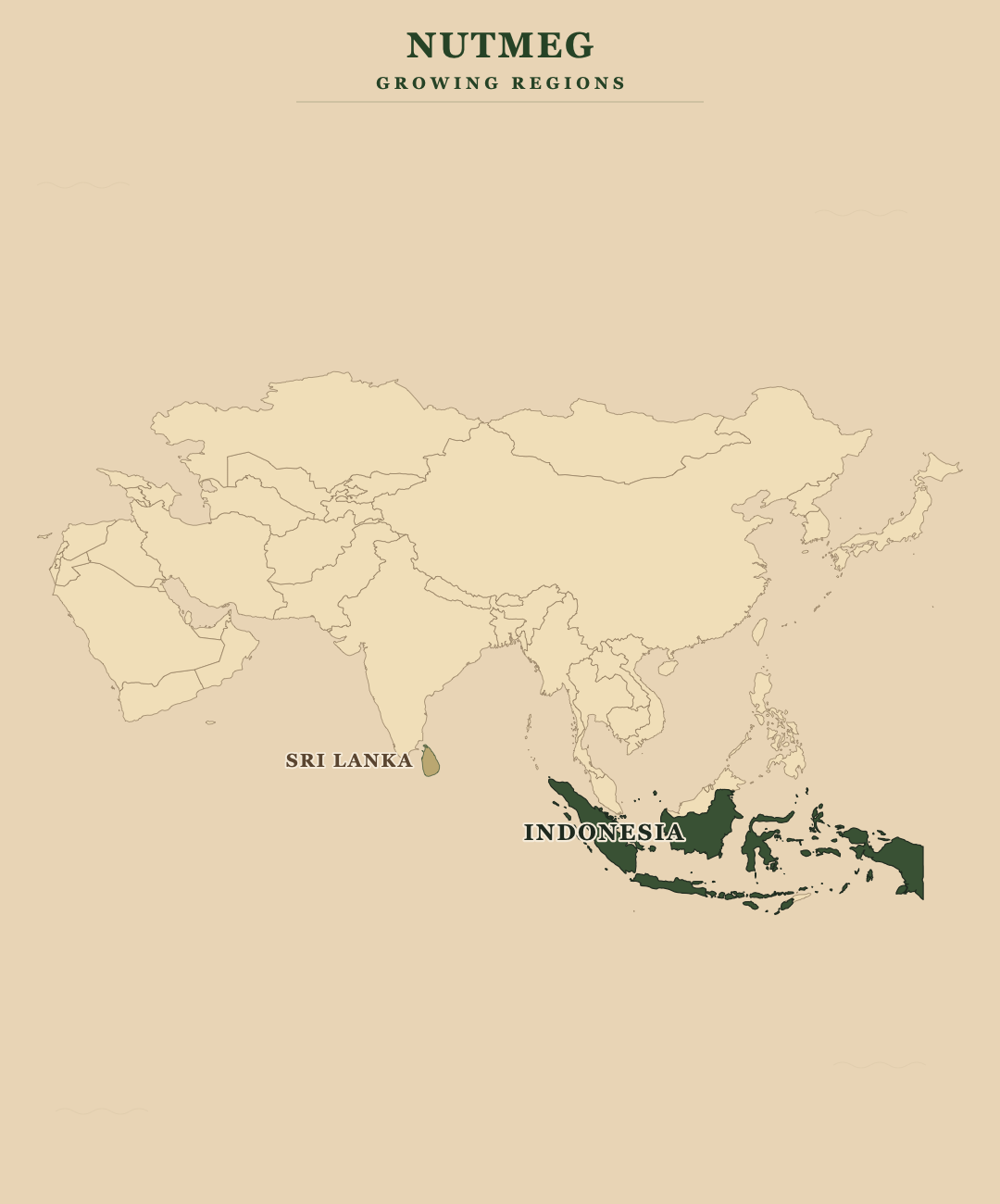
Nutmeg is primarily cultivated in Indonesia (Banda Islands, Maluku — 75-80% world supply), with secondary growing regions in Grenada (15%), India (Kerala), Sri Lanka, Madagascar.
Spice Story
Nutmeg was one of the most economically and politically important spices in human history. For centuries the Banda Islands were the only source — Arab and Asian traders dominated the early trade, then Portuguese explorers reached the islands in 1512, then the Dutch East India Company (VOC) established a brutal monopoly through the 17th century that included military campaigns, forced labour and the sterilisation of nutmeg seeds for export to prevent cultivation elsewhere. [source] The British eventually broke the monopoly with seed transfers to Grenada, Mauritius and Zanzibar — and Grenada now produces about 15% of global supply. In gin, nutmeg is a foundational warming-spice botanical, particularly in Christmas-style and old London Dry expressions.
Gin Creativity
Nutmeg brings warm-resinous spice with a faint bitter edge. A full sachet pushes a gin firmly into spiced-winter territory; a half-sachet provides quiet warm depth that integrates with juniper. Pair with cinnamon and clove for a Christmas-spice profile, or with mace for layered effect (mace is more delicate than nutmeg, but they share most of their chemistry).
Blending Science
Main flavour compounds
 Myristicin—
 Sabinenepepper, warming
 Alpha-Pinenefresh pine, top note
 Eugenolclove-like, warming
Pairs well with
Myristicin is the defining compound — named after the genus Myristica. It provides the deep, slightly heady warming character. Sabinene layers a sharp peppery edge. Alpha-pinene contributes a resinous backbone that bridges to juniper. Eugenol adds a soft clove-warm depth. Heat-stable; both vapour and warm maceration work cleanly. (Note: high doses of nutmeg are well-documented to produce psychoactive effects from myristicin — this is not relevant at culinary or gin-botanical concentrations.)
Food Partners
- Béchamel sauce — nutmeg in white sauce is the classical French use.
- Christmas baking — fruitcake, gingerbread, eggnog.
- Mulled wine — nutmeg alongside cinnamon and clove.
- Custards and rice puddings — nutmeg-infused milk is foundational.
- Slow-braised meats — nutmeg in traditional French pot roasts.
Cocktails To Try

- Eggnog (with nutmeg gin) — the canonical Christmas cocktail.
- Spiced Old Fashioned — nutmeg gin, demerara, orange bitters.
- Christmas Negroni — nutmeg and cinnamon gin, Campari, vermouth.
Release The Flavour
- Grate fresh — pre-ground nutmeg loses character within months.
- Heat-friendly — both vapour and warm maceration work.
- Time — 24–48 hours for full development.
- Less is more — nutmeg dominates a blend quickly.
Discover more
From the same region
Same flavour family
Surprise me

Sources & Citations
- scientific_name (Myristica fragrans, Myristicaceae):en.wikipedia.org/wiki/Myristica_fragrans
- banda_islands_origin:spice.alibaba.com/spice-basics/where-does-nutmeg-come-from
- indonesia_grenada_global_production_split:doi.org/10.1098/rspb.2025.1734
- tree_first_harvest_7-9_years:en.wikipedia.org/wiki/Nutmeg
- dutch_voc_monopoly_colonial_history:doi.org/10.1098/rspb.2025.1734
- main_flavour_compounds (CSV-sourced):inputs/source.csv — Nutmeg row
