
FRAGONIA

- Botanical name
- Agonis fragrans
- Also known as
- Coarse Tea Tree, Fragrant Agonis
- Main flavour compound
- 1,8-Cineole
- Part used
- Dried leaf and twig
- Method of cultivation
- Small evergreen shrub of the Myrtaceae family, native to the south-west of Western Australia, growing to about 2.5 metres tall with narrow elongated leaves and small white-to-pinkish flowers in clusters. The commercial Fragonia chemotype was developed by Western Australian essential-oil producers John and Peta Day, who selected the most fragrant variety of *Agonis fragrans* and have cultivated it exclusively in south-west Western Australia since 2002. "Fragonia" is technically a brand name for the selected high-grade chemotype, but it has become the standard trade name.
- Commercial preparation
- Leaves and twigs are harvested by coppicing, gently dried, and either sold whole/cracked or steam-distilled for essential oil. The oil is unusual among Australian natives for having a remarkably balanced (close to 1:1:1) ratio of monoterpenes, oxides and alcohols — said to be unique in nature.
- Non-culinary uses
- Aromatherapy (Fragonia is highly valued for its balanced essential-oil profile and gentle character); cosmetics; perfumery; meditation-style fragrance work.
Fragonia — Agonis fragrans — is a small, bushy evergreen shrub of the Myrtaceae family, endemic to the south-west of Western Australia. The plant grows to about 2.5 metres tall, with narrow elongated leaves and small white-to-pink flowers in clusters in spring. It is tolerant of drought, frost, and the sandy soils characteristic of WA's south-western heath and woodland country. Fragonia is unusual in the Australian essential-oil trade in that the commercial chemotype was deliberately selected from wild Agonis fragrans populations by a single family of growers (John and Peta Day) in the late 1990s, and has been cultivated exclusively in south-west Western Australia since 2002. [source]
Whole dried leaf and twig
Crumble lightly to expose oils.
Cracked
Faster extraction.
Region of cultivation
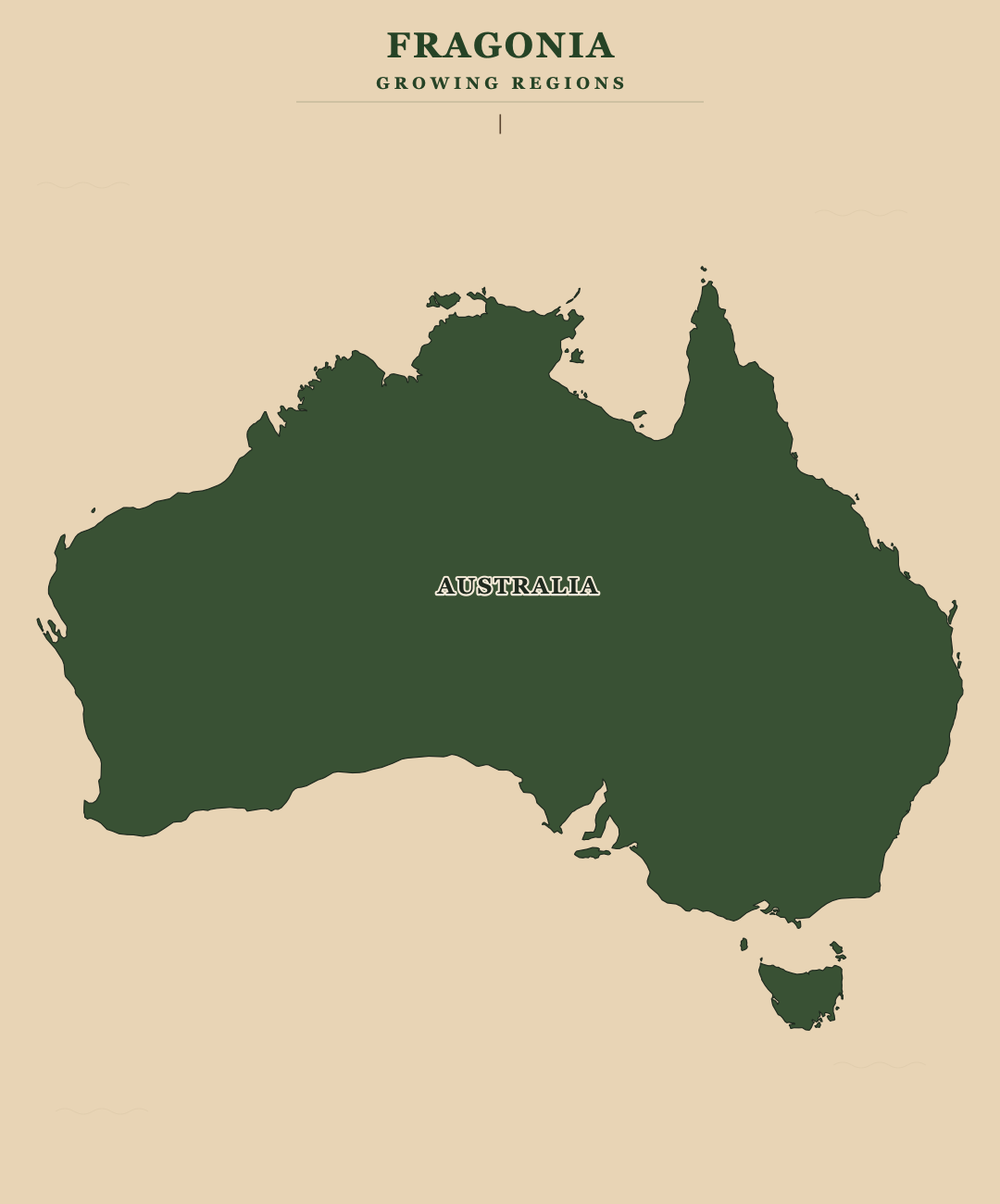
Fragonia is native to Australia, Australia — south-west Western Australia (Margaret River region and similar coastal sand-country), with secondary growing regions in Exclusive WA cultivation only. |
Spice Story
Fragonia is one of the youngest commercial Australian botanicals — the species has been known to Indigenous people of south-west WA for thousands of years, but the commercial chemotype that's sold today was developed by the Day family in the late 20th century after years of selecting for aromatic balance. The most cited claim in the Fragonia trade is that the oil has a "balanced" 1:1:1 ratio of monoterpenes, oxides and alcohols, said to be unique among commercial essential oils. [source] Aromatherapists prize Fragonia for this balance, which is said to produce a gentler, more harmonising effect than the more "sharp" eucalypt-leaning native oils. In gin, Fragonia is a contemporary native botanical with a softer, more rounded character than blue gum or other eucalypts — useful where a clearly Australian aromatic is wanted without dominant medicinal edge.
Gin Creativity
Fragonia brings a balanced, soft-resinous-floral character — neither sharp eucalypt nor aggressive pine. A full sachet adds a clearly Australian aromatic with good integration into a botanical bill; a half-sachet provides quiet rounded depth. Pair with sandalwood and Buddha Wood for a "sacred wood" Australian profile, or with lemon myrtle and pepperberry for a brighter bush-spice blend.
Blending Science
Main flavour compounds
 1,8-Cineoleeucalyptus, cool
 Alpha-Pinenefresh pine, top note
 Linaloolfloral, soft
 Alpha-Terpineol—
Pairs well with
The balanced ratio of compounds is the defining feature. 1,8-Cineole provides the eucalypt-cool backbone but at lower concentration than most Australian eucalypts. Alpha-pinene adds a pine note that bridges to juniper. Linalool layers a soft floral lift. Alpha-terpineol contributes a slightly lilac-floral depth. The balance of these compounds (rather than dominance of any one) is what gives Fragonia its characteristic harmony.
Food Partners
- Smoked meats — Fragonia's softness supports smoke.
- Native spice rubs — pair with pepperberry, lemon myrtle, native thyme.
- Dark honey desserts — leatherwood and Fragonia share resinous depth.
- Roasted root vegetables — Fragonia-gin reduction over parsnip and carrot.
- Aged cheese — Fragonia gin in a cheese reduction.
Cocktails To Try

- Western Australian G&T — Fragonia gin, native tonic, fresh native garnish.
- Bush Negroni — Fragonia and pepperberry gin, Campari, vermouth.
- Soft Sour — Fragonia gin, honey, lemon, egg white.
Release The Flavour
- Crumble gently — exposes oils without bitterness.
- Heat-friendly — survives both vapour and warm maceration.
- Time — 24–48 hours for full balance to develop.
- Source matters — the Day-family chemotype is the standard; verify supplier provenance.
Discover more
Pairs well with
Same flavour family
Surprise me

Sources & Citations
- scientific_name (Agonis fragrans, Myrtaceae):oshadhi.co.uk/kb/all-about-fragonia-essential-oil/
- cultivation_history (Day family, exclusively from 2002, south-west WA):raedunphy.ca/products/fragonia-agonis-fragrans-convention...
- balanced_oil_profile (1:1:1 ratio of monoterpenes/oxides/alcohols):oshadhi.co.uk/kb/all-about-fragonia-essential-oil/
- plant_size (up to 2.5m bushy shrub):raedunphy.ca/products/fragonia-agonis-fragrans-convention...
- main_flavour_compounds (CSV-sourced):inputs/source.csv — Fragonia row
