
CASCADE HOP

- Botanical name
- Humulus lupulus 'Cascade'
- Also known as
- Cascade hops, American Cascade
- Main flavour compound
- Myrcene
- Part used
- Dried female flower cone (lupulin-rich strobile)
- Method of cultivation
- Perennial climbing vine of the Cannabaceae family — the same family as cannabis — grown commercially as the foundational bittering and aromatic ingredient in beer. The Cascade cultivar was developed by the USDA breeding program at Oregon State University, first released in 1972, and is now the most widely grown American "aroma" hop. The female plants produce cone-shaped flowers ("strobiles") rich in resinous yellow lupulin glands.
- Commercial preparation
- Cones are harvested in late summer at peak ripeness, kiln-dried gently to under 10% moisture, and either left whole, compressed into pellets, or processed into hop extracts. For gin botanical use, whole dried cones or pellets are preferred — they extract cleanly in cold maceration.
- Non-culinary uses
- Brewing (the defining and dominant commercial use globally); pillow stuffings (a traditional folk remedy for sleeplessness); the essential oil is occasionally used in perfumery for green-bitter accords; the lupulin glands are studied for their phytoestrogenic compounds.
Cascade hop — Humulus lupulus 'Cascade' — is a cultivar of the common European hop, developed in the late 1960s by USDA researchers at Oregon State University as the first widely successful American aroma hop. [source] It is a backcross hybrid of English and Russian hop varieties, released commercially in 1972, and is now the most widely planted hop variety in American craft brewing. The plant itself is a fast-growing climbing perennial — vigorous bines twine clockwise up trellises, leaves are deeply lobed and rough-textured, and the female plants produce pendulous cone-shaped flowers (strobiles) packed with the resinous yellow lupulin glands that contain everything brewers and distillers care about.
Whole dried cone
The most visually appealing form — slow but clean extraction in cool maceration.
Pellets
Processed cones compressed into small pellets; faster extraction, more efficient use of space.
Region of cultivation
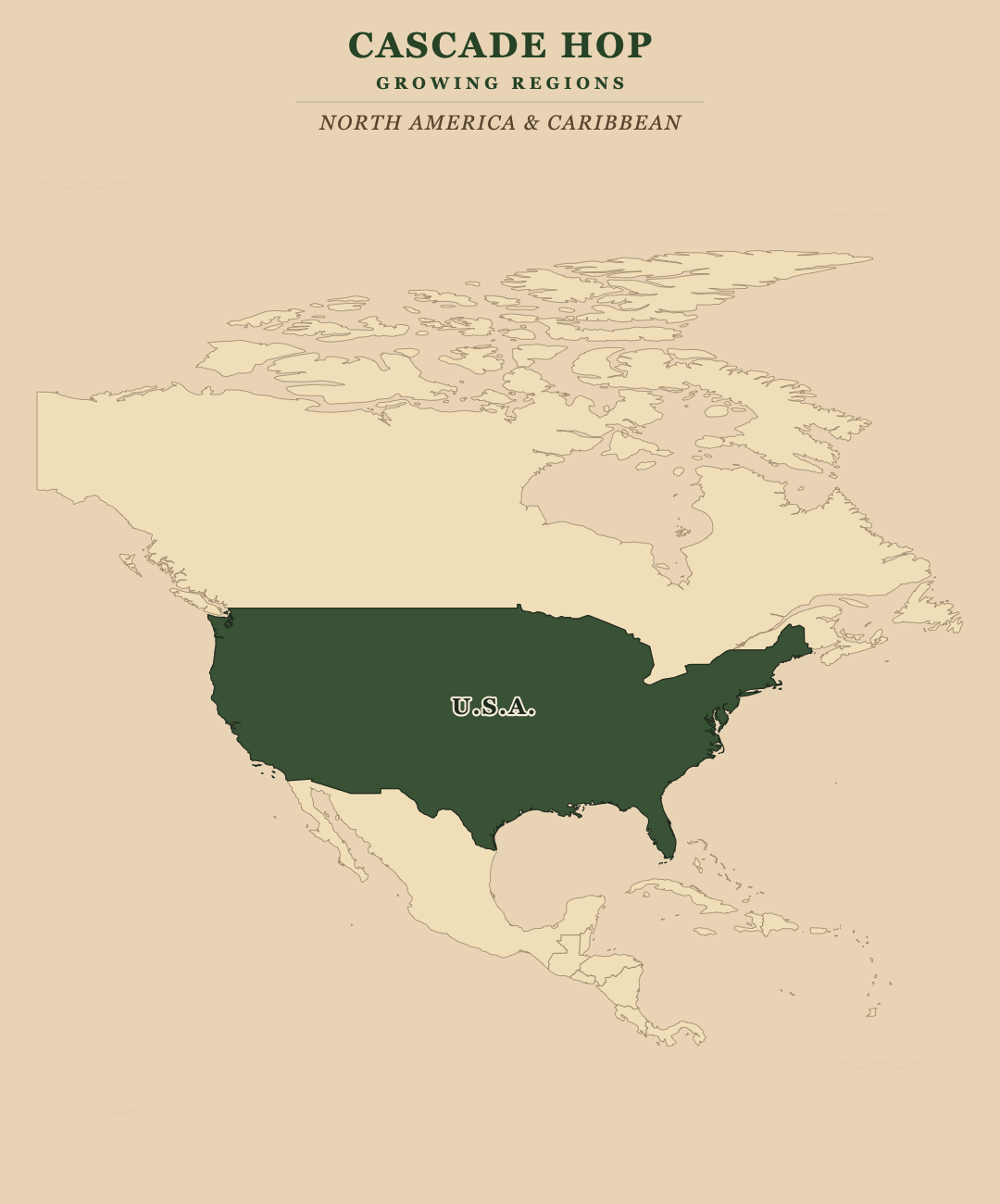
Cascade Hop is primarily cultivated in USA — Pacific Northwest (Yakima Valley, Willamette Valley), with secondary growing regions in Australia (Tasmania), Germany, New Zealand.
Spice Story
Hops have been used in beer brewing for over a thousand years — the Cistercian monasteries of medieval Germany were the first to standardise the practice — but Cascade specifically is a very modern arrival, defining the citrus-forward American Pale Ale style that emerged in the 1970s and 1980s and reshaped craft beer worldwide. The cultivar's distinctive grapefruit-pine character was the foundation of Sierra Nevada Pale Ale and a hundred American craft beers that followed. The use of hops in gin is much older — through the historic ties between distilling and brewing, hops have been added to gin (especially post-distillation, in "hopped gin" style) for centuries [source] — but Cascade specifically arrived in gin only in the 2010s, riding the craft-cocktail wave and the cross-pollination between craft brewers and craft distillers. Today it appears in gins from American, Australian and European producers chasing a clearly modern, hop-forward profile.
Gin Creativity
Cascade hop is one of the most distinctive contemporary botanicals — it brings unmistakable grapefruit-citrus and a clean bitter backbone that no other gin botanical can match. A full sachet pushes a gin firmly into hopped-gin territory and pairs naturally with fresh grapefruit peel for a doubled-citrus profile. A half-sachet adds a quieter bitter-citrus complexity that integrates with juniper as a contemporary supporting note. It works particularly well alongside coriander seed (the two share linalool) or pink peppercorn for a confident modern blend. Avoid combining with very heavy sweet floral botanicals — the bitter character competes rather than complements.
Blending Science
Main flavour compounds
 Myrcenegreen, hoppy body
 Cohumulone—
 Humulenehops, woody-spice
 Linaloolfloral, soft
 Geraniolrose, soft floral
Pairs well with
Cascade's character is built around a distinctive blend of compounds in the lupulin glands. Myrcene (45–60% of the oil) is the dominant aromatic, contributing the green-herbaceous body that hops share with juniper. Humulene (8–13%) adds a slightly woody-floral depth. Cohumulone (33–40%) is one of the alpha acids responsible for hops' famous bitter character — it's the compound that survives beer fermentation as the dominant bittering agent. [source] Linalool and geraniol add soft floral notes that lift the bitter base. The defining grapefruit-citrus character of Cascade comes from a thiol compound (4-mercapto-4-methylpentan-2-one, sometimes called "cat-piss thiol" in technical brewing circles) present at parts-per-trillion concentrations. Cool extraction preserves the bright citrus aromatic; long warm extraction emphasises the bitter alpha-acid character.
Food Partners
- Pale ales and IPAs: Drink the inspiration alongside the gin — Cascade gin and Cascade pale ale.
- Grilled white fish: Cascade's citrus brightness lifts simple grilled fish.
- Citrus-glazed pork: Cascade-gin reduction in a grapefruit glaze for slow-roasted pork.
- Strong cheese: Especially cheddar and washed-rind cheeses where the bitter character cuts richness.
- Bitter green salads: Cascade-gin vinaigrette over chicory, radicchio and watercress.
Cocktails To Try

- Hopped Gin & Tonic: Cascade-gin with a citrus-leaning tonic and a wedge of fresh grapefruit.
- IPA Sour: Cascade-gin, lemon, sugar, egg white — beer-cocktail influence in a gin sour.
- Bitter Negroni: Cascade-rich gin, Campari, sweet vermouth — bitterness on bitterness.
Release The Flavour
- Cool extraction only: Heat draws bitter alpha-acids out of balance with the citrus aromatics.
- Brief contact: 30 minutes to 2 hours is enough; longer extraction goes assertively bitter.
- Whole cones: Hold up better than pellets in cool maceration; less mess to strain.
- Storage: Hop volatiles degrade quickly — buy small quantities, store cold and airtight.
Discover more
From the same region



Pairs well with

Same flavour family
Surprise me

Sources & Citations
- scientific_name and family (Humulus lupulus, Cannabaceae):www.gardenia.net/plant/humulus-lupulus-cascade
- development (USDA / OSU breeding program, released 1972):naturehills.com/products/cascade-hops-plant
- parentage (English and Russian backcross hybrid):naturehills.com/products/cascade-hops-plant
- flavour_profile (grapefruit citrus, floral):www.gardencentermarketing.com/plantName/Humulus-lupulus-C...
- oil_composition (myrcene 45-60%, cohumulone 33-40%, humulene 8-13%):naturehills.com/products/cascade-hops-plant
- gin_use (post-distillation flavouring; "hopped gins"):theginisin.com/botanicals-list/hops/
- main_flavour_compounds (CSV-sourced):inputs/source.csv — Cascade Hop row
