
STAR ANISE

- Botanical name
- Illicium verum
- Also known as
- Chinese star anise, Bā jiǎo (八角, Chinese — "eight horns"), Đại hồi (Vietnamese)
- Main flavour compound
- Trans-anethole (dominant)
- Part used
- Dried fruit (the eight-pointed star-shaped seed pod)
- Method of cultivation
- Small evergreen tree of the Schisandraceae family (different from the unrelated true anise *Pimpinella anisum*), native to south-east China and Vietnam. The main cultivation regions are Funing and Pingbian counties in China's Yunnan Province and Lạng Sơn Province in Vietnam. The tree grows 8–15 metres tall and produces clusters of distinctive eight-pointed star-shaped fruit pods that ripen and are picked just before they would naturally split open. *Important note:* Chinese star anise (*Illicium verum*) is safe and culinary; the Japanese star anise (*Illicium anisatum*) is toxic and visually similar — they must not be confused.
- Commercial preparation
- Fruit pods are picked just before maturation, sun-dried until firm and brown, and either sold whole or ground. The whole star is preferred for cooking and gin — visually striking and slower-extracting.
- Non-culinary uses
- Foundational ingredient in Chinese five-spice powder and many South-East Asian spice blends; the fruits are the primary natural source of shikimic acid, the chemical precursor to the antiviral drug oseltamivir (Tamiflu); the essential oil is widely used in confectionery, perfumery and aromatherapy.
Star Anise — Illicium verum — is a small evergreen tree of the Schisandraceae family, native to south-east China and Vietnam. Despite sharing the dominant aromatic compound (trans-anethole) with European true anise (Pimpinella anisum), Star Anise is botanically completely unrelated — in fact in an entirely different plant order. [source] The tree produces clusters of unmistakable eight-pointed star-shaped seed pods that ripen, are picked just before splitting open, and are dried to produce the foundational Chinese and South-East Asian spice. Important safety note: Chinese star anise (I. verum) is safe and culinary; the closely-related Japanese star anise (I. anisatum) is toxic and visually similar — buy from reputable suppliers.
Whole dried star
The standard form — visually distinctive, slow-extracting.
Ground
Faster extraction; loses character within months.
Region of cultivation
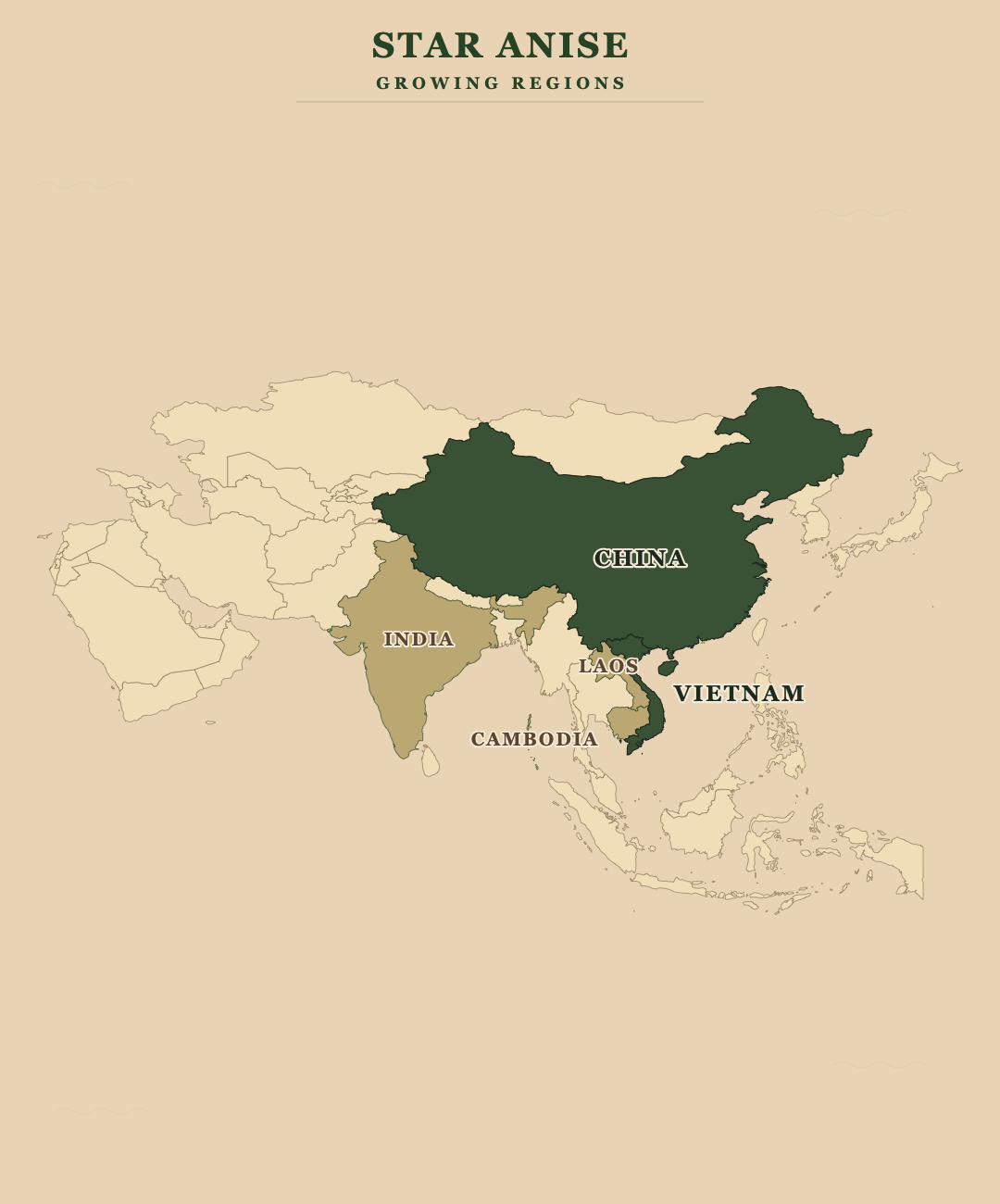
Star Anise is primarily cultivated in China (Yunnan, Guangxi provinces), Vietnam (Lạng Sơn), with secondary growing regions in Limited cultivation in Laos, Cambodia, India.
Spice Story
Star Anise has been cultivated and traded for over a thousand years across south-east Asia. It is foundational to Chinese cuisine (the defining spice of Chinese five-spice powder), Vietnamese cooking (essential in phở broth), and broader South-East Asian spice traditions. The fruits are the primary natural source of shikimic acid — the chemical precursor used in the synthesis of the antiviral drug Tamiflu (oseltamivir). Star Anise prices spiked dramatically during the 2005 avian flu and 2009 swine flu outbreaks, before fermentation-based industrial synthesis displaced the natural-source supply. [source] In gin, Star Anise is one of the most foundational warming-spice botanicals.
Gin Creativity
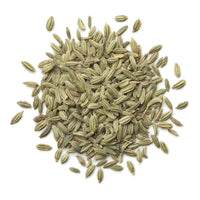
Star Anise brings deep sweet-anise character with warming spice complexity. A full sachet pushes a gin firmly into anise-warming territory; a half-sachet provides quiet warm-anise depth that integrates with juniper. Pair with Aniseed and Fennel seed for layered anise (all three share trans-anethole), or with cinnamon and cardamom for a Christmas-spice profile.
Blending Science
Main flavour compounds
 Trans-anethole (dominant)anise, sweet
 Estragoletarragon, anise-sweet
 Limoneneclean citrus lift
 Alpha-Pinenefresh pine, top note
Pairs well with
Trans-anethole dominates the essential oil at very high concentration — the same compound that defines aniseed, fennel and other anise-flavoured plants. Estragole layers a slightly basil-leaning note. Limonene adds citrus brightness. Alpha-pinene contributes resinous backbone. The oil crystallises at low temperatures due to the high trans-anethole content (melting point about 21°C). Heat-stable; both vapour and warm maceration work cleanly.
Food Partners
- Chinese five-spice dishes — star anise is the dominant member.
- Vietnamese pho — star anise is essential to authentic broth.
- Mulled wine and spiced winter drinks — star anise as warming-spice base.
- Spiced poaching liquid — pears and apples with star anise.
- Anise-flavoured confections — star anise sweets across Asia.
Cocktails To Try

- Anise Old Fashioned — star anise gin, demerara, orange bitters.
- Mulled Gin — star anise, cinnamon, clove, orange peel gin warmed gently.
- Pho-Inspired Bloody Mary — star anise gin, tomato, fish sauce, lime.
Release The Flavour
- Whole star — slow-extracts cleanly; ground loses character fast.
- Crack lightly — exposes more surface.
- Heat-friendly — survives vapour and maceration.
- Verify identity — distinguish Illicium verum from toxic Illicium anisatum.
Discover more
From the same region
Pairs well with

Same flavour family
Surprise me

Sources & Citations
- scientific_name (Illicium verum, Schisandraceae):en.wikipedia.org/wiki/Illicium_verum
- native_china_vietnam:en.wikipedia.org/wiki/Illicium_verum
- not_related_to_pimpinella_anisum_true_anise:en.wikipedia.org/wiki/Illicium_verum
- shikimic_acid_tamiflu_precursor:en.wikipedia.org/wiki/Illicium_verum
- japanese_star_anise_toxicity_warning:en.wikipedia.org/wiki/Illicium_verum
- main_flavour_compounds (CSV-sourced):inputs/source.csv — Star Anise row
