
EUCALYPTUS BLUE MALLEE

- Botanical name
- Eucalyptus polybractea
- Also known as
- Blue Mallee, Blue-leaved Mallee
- Main flavour compound
- 1,8-Cineole
- Part used
- Dried leaf and terminal branchlets
- Method of cultivation
- Small mallee-form eucalyptus of the Myrtaceae family, endemic to central New South Wales (especially around West Wyalong) and central Victoria (between Stawell and Bendigo). The "mallee" growth form means multiple stems emerge from a single underground lignotuber, ideal for repeat coppice harvesting. The species is the world's primary commercial cineole-rich eucalypt — blue mallee contains 88–92% 1,8-cineole, one of the highest concentrations of any eucalyptus species.
- Commercial preparation
- Plantations are planted at around 5,000 trees per hectare and harvested on an 18-month rotation, with whole shoots cut and steam-distilled for essential oil. Oil yield from fresh leaves and terminal branchlets is 1.5–2.5%, giving roughly 140–200 kg of oil per hectare per harvest cycle.
- Non-culinary uses
- Commercial eucalyptus oil production (the dominant high-cineole species); pharmaceuticals; cleaning products; aromatherapy.
Eucalyptus Blue Mallee — Eucalyptus polybractea — is a small mallee-form eucalypt endemic to a tiny range of inland south-east Australia. The "mallee" form is a survival adaptation to fire and drought: multiple stems emerge from a single underground woody lignotuber, allowing the plant to regenerate rapidly after fire or coppicing. Blue Mallee is the world's primary commercial source of 1,8-cineole-rich eucalyptus oil — the species contains 88–92% cineole, one of the highest single-compound concentrations of any commercial essential oil. [source]
Whole dried leaf
Crumble lightly to expose oils before extraction.
Cracked leaf
Faster extraction.
Region of cultivation
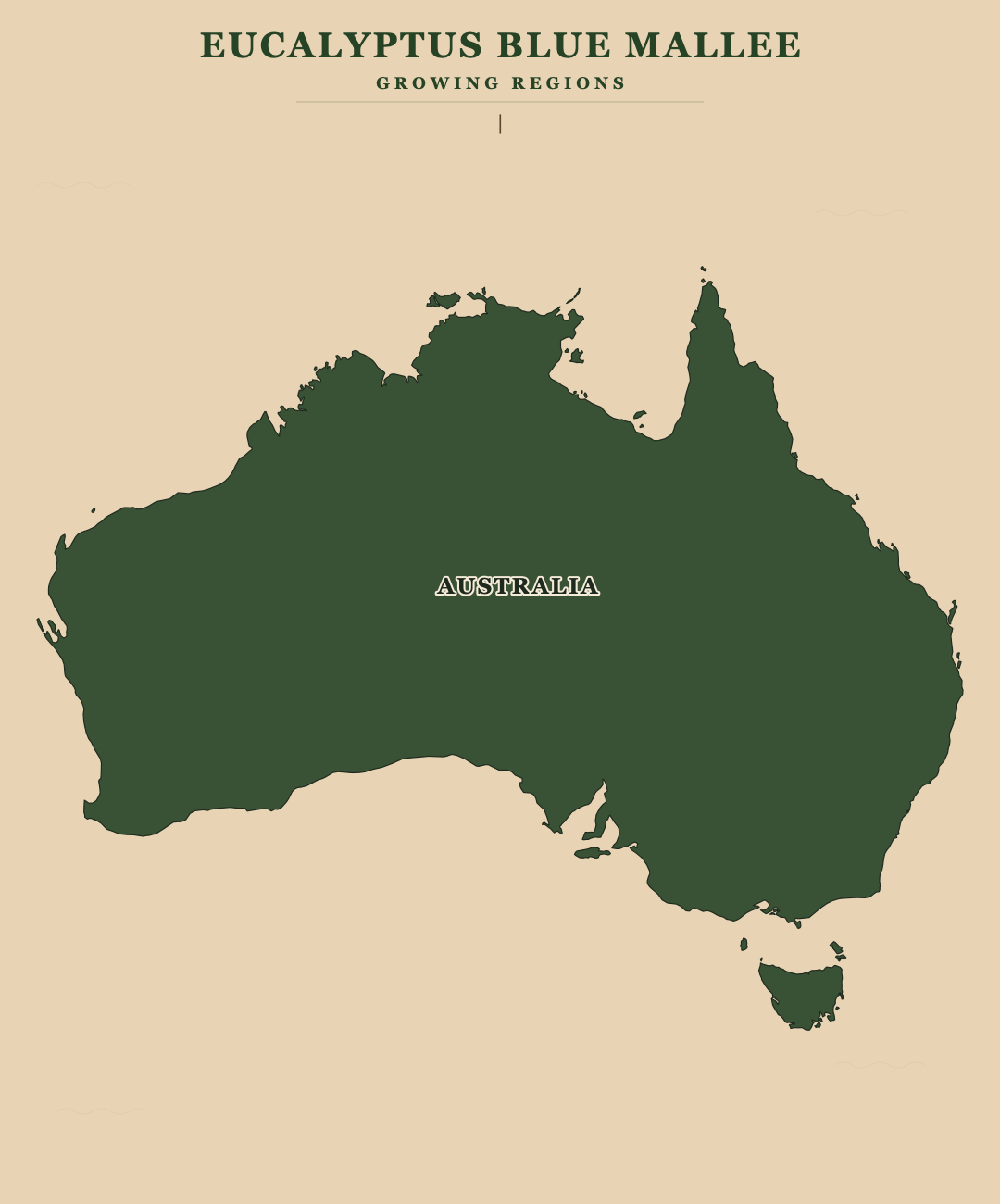
Eucalyptus Blue Mallee is native to Australia, Australia — central NSW (West Wyalong area), central Victoria (Stawell-Bendigo), with secondary growing regions in Some plantation cultivation in Spain and Portugal. |
Spice Story
Blue Mallee has built much of the agricultural economy of West Wyalong, NSW over the past century. Commercial cultivation began in the early 1900s when distillers recognised the unusually high cineole content; today plantations of around 5,000 trees per hectare are harvested on 18-month rotations, with the shoots cut and steam-distilled into oil that supplies Australian, European and Asian markets. [source] In gin, Blue Mallee is less commonly used than Blue Gum or Australiana (most distillers source by species name rather than chemotype), but where used it provides the cleanest, purest cineole expression — almost a "reference standard" for Australian eucalypt character.
Gin Creativity
Blue Mallee is the purest commercial cineole. A full sachet pushes a gin firmly into medicinal-eucalypt territory; a quarter to half sachet adds the cleanest Australian eucalypt lift available. Pairs naturally with lemon myrtle and juniper for a native gin; avoid combining with other strong cineole-rich botanicals (bay, blue gum) — the result is one-note.
Blending Science
Main flavour compounds
 1,8-Cineoleeucalyptus, cool
 Alpha-Pinenefresh pine, top note
 Para-Cymene—
Pairs well with
Almost all character comes from 1,8-cineole at 88–92% concentration — far purer than Blue Gum (70–85%) or Australiana (60–75%). [source] Alpha-pinene provides a faint pine backbone; para-cymene adds a hint of citrusy depth. Heat-stable; vapour and maceration both work.
Food Partners
- Eucalypt-glazed roast lamb — Australian classic.
- Hot toddy-style winter drinks — cineole and honey.
- Roasted root vegetables — eucalypt-gin reduction over parsnip, beetroot.
- Smoked-eucalypt desserts — Heston Blumenthal-style smoke-and-flavour pairings.
- Spiced tea — Blue Mallee gin in chai-style drinks.
Cocktails To Try

- Native G&T — Blue Mallee gin with native tonic and eucalypt leaf garnish.
- Forest Sour — Blue Mallee-gin, eucalypt honey, lemon.
- Cineole Negroni — Blue Mallee gin, Campari, vermouth.
Release The Flavour
- Crumble gently — exposes oils without bitterness.
- Heat is friendly — cineole survives all extraction.
- Less is more — Blue Mallee is the purest cineole; one leaf can dominate.
- Source matters — look for West Wyalong-origin product for highest grade.
Discover more
Pairs well with
Same flavour family
Surprise me

Sources & Citations
- scientific_name (Eucalyptus polybractea):en.wikipedia.org/wiki/Eucalyptus_polybractea
- native_range (West Wyalong NSW; Stawell-Bendigo Victoria):en.wikipedia.org/wiki/Eucalyptus_polybractea
- cineole_content (88-92% — one of the highest):www.eucalyptusoil.com/eucalyptus-oils/eucalyptus-polybractea
- plantation_density_5000_per_hectare:www.sciencedirect.com/science/article/abs/pii/S0926669098...
- 18_month_harvest_rotation:www.eucalyptusoil.com/eucalyptus-oils/eucalyptus-polybractea
- main_flavour_compounds (CSV-sourced):inputs/source.csv — Eucalyptus Blue Mallee row
