
WASABI

- Botanical name
- Eutrema japonicum
- Also known as
- Japanese horseradish, Hon-wasabi (本山葵 — "true wasabi")
- Main flavour compound
- Allyl Isothiocyanate (AITC)
- Part used
- Dried rhizome (very rare in dried form due to the volatile chemistry)
- Method of cultivation
- Semi-aquatic perennial herb of the Brassicaceae family (the same family as horseradish, mustard, broccoli), endemic to Japan. Wasabi is one of the most demanding crops in cultivation — it requires shaded growing conditions, continuous flow of pure cool water (10–17°C), and 18–24 months to reach harvest size. Traditional cultivation is in stream-fed terraced *sawa* (waterway) gardens; modern hydroponic cultivation in temperature-controlled greenhouses is now common.
- Commercial preparation
- Fresh wasabi rhizome is the gold standard — grated immediately before use, because the active compound (allyl isothiocyanate) begins to dissipate within 15–20 minutes of grating. Most "wasabi" outside Japan is actually a paste made from horseradish, mustard powder and green food colouring — true wasabi (*Eutrema japonicum*) is rare and expensive. Dried wasabi powder is available but loses most of its character.
- Non-culinary uses
- Foundational ingredient in Japanese cooking (especially sushi, sashimi, soba); pharmaceutical applications (allyl isothiocyanate has been studied for antimicrobial properties).
Wasabi — Eutrema japonicum — is a semi-aquatic perennial herb of the Brassicaceae family (the same family as horseradish and mustard), endemic to Japan. It is the only cultivated species in the genus Eutrema with significant economic importance. [source] The plant has been cultivated since the Heian period (794–1185) and was historically a luxury food for samurai, royalty and temple priests. Wasabi is one of the most demanding crops in cultivation — requiring shaded conditions, continuously flowing pure cool water (10–17°C) and 18–24 months to reach harvest size. Traditional sawa (stream-fed terrace) cultivation persists in mountainous Japanese regions like Shizuoka, Nagano and Iwate.
Dried wasabi powder
The standard sachet form — rehydrate briefly with cool water to activate the enzyme.
Fresh frozen rhizome
Closest to fresh; use immediately after thawing.
Region of cultivation
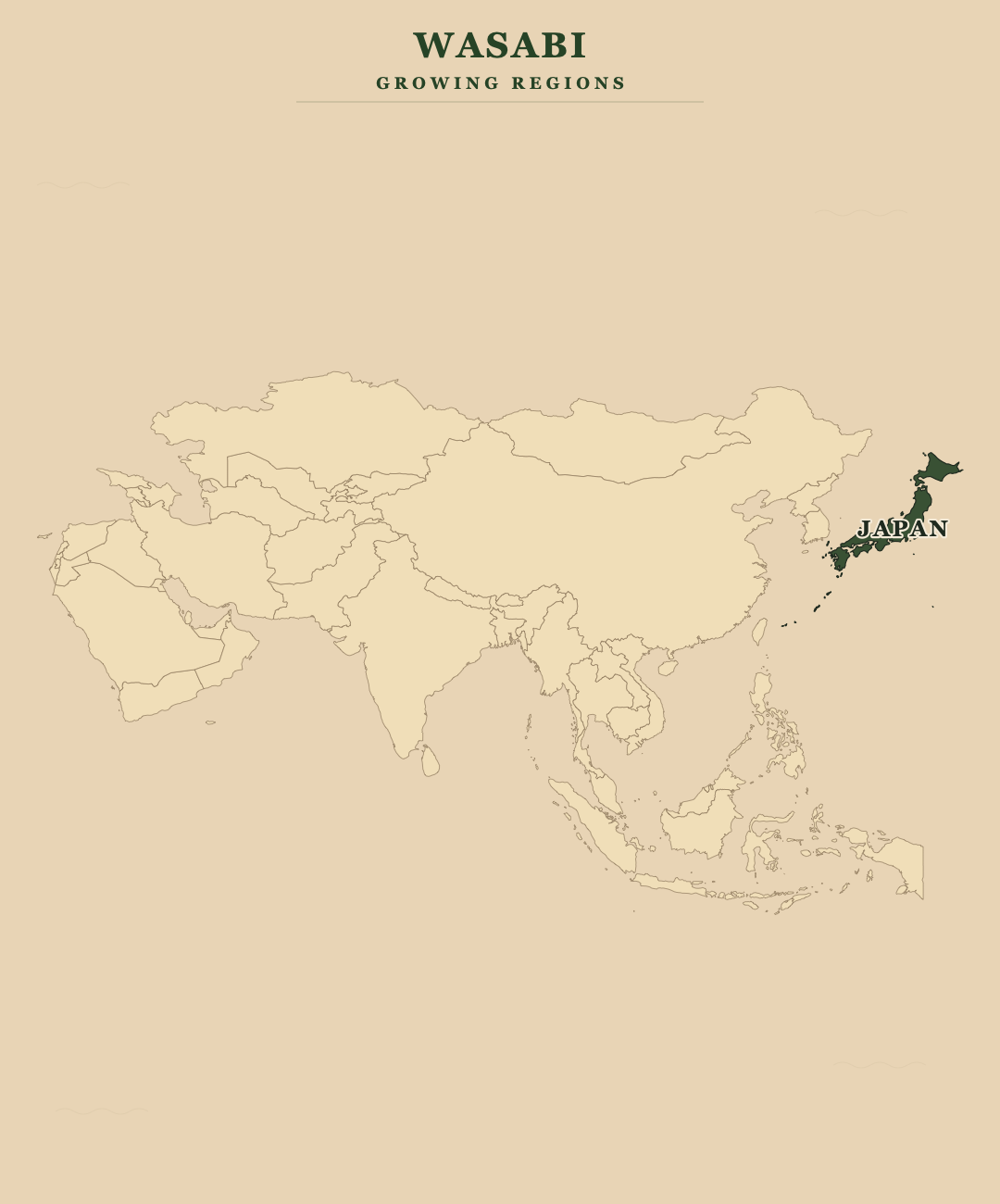
Wasabi is primarily cultivated in Japan (Shizuoka, Nagano, Iwate), with secondary growing regions in Tasmania (Australia — successful commercial cultivation), New Zealand, UK, USA (Oregon).
Spice Story
Most "wasabi" served outside Japan is not real wasabi — it is typically a paste of horseradish, mustard powder and green food colouring, manufactured to mimic the appearance of real wasabi at a fraction of the cost. True hon-wasabi (本山葵) is rare and expensive, and is dramatically more complex in flavour than horseradish-based substitutes: real wasabi has a brief, intense, sinus-clearing pungency that dissipates within 30 seconds, followed by sweet, almost vegetal undertones. Tasmania (in Australia) has become a notable non-Japanese commercial wasabi grower, with cool clear stream water and shaded valleys providing suitable conditions. In gin, real wasabi is an unusual and challenging contemporary botanical — the volatile AITC is hard to preserve in spirit form.
Gin Creativity
Wasabi brings sharp pungent character similar to horseradish but with more complex back-palate notes. A quarter to half sachet is plenty. Pair with horseradish for layered sharp-pungent character, or with lime peel and ginger for a Japanese-fusion profile.
Blending Science
Main flavour compounds
 Allyl Isothiocyanate (AITC)mustardy heat
 6-(Methylsulfinyl)hexyl Isothiocyanatemustardy heat
 Sinigrin (precursor)—
Pairs well with
Allyl isothiocyanate (AITC) is the dominant pungent compound — formed when sinigrin (the stable precursor) is hydrolysed by the enzyme myrosinase when cells are damaged (by grating or crushing). [source] 6-(Methylsulfinyl)hexyl isothiocyanate is a wasabi-specific compound contributing additional pungent complexity. AITC is highly volatile and degrades quickly; cool extraction in alcohol preserves it best, but the character will fade over weeks even in optimal conditions.
Food Partners
- Sushi and sashimi — the canonical Japanese pairing.
- Soba noodles — wasabi in the dipping sauce.
- Japanese pickles — wasabi in tsukemono.
- Beef tartare — Japanese-influenced versions.
- Wasabi-coloured peas and modern snacks — Japanese snack tradition.
Cocktails To Try

- Wasabi Bloody Mary — wasabi gin, tomato, lemon, soy sauce.
- Sake-Wasabi Martini — wasabi gin, sake, lime peel.
- Japanese Gimlet — wasabi-and-lime gin, lime cordial.
Release The Flavour
- Cool extraction — preserves the volatile AITC.
- Use immediately — extracted wasabi gin loses pungency over weeks.
- Verify identity — most "wasabi" products are horseradish-based; real Eutrema japonicum is rare.
- Tasmanian or Japanese source — for genuine hon-wasabi.
Discover more
From the same region
Pairs well with
Same flavour family
Surprise me

Sources & Citations
- scientific_name (Eutrema japonicum, Brassicaceae):en.wikipedia.org/wiki/Wasabi
- japanese_native_only_cultivated_eutrema:en.wikipedia.org/wiki/Wasabi
- heian_period_cultivation_history:en.wikipedia.org/wiki/Wasabi
- AITC_signature_compound_horseradish_mustard_family:en.wikipedia.org/wiki/Wasabi
- cultivated_higher_AITC_than_wild:pmc.ncbi.nlm.nih.gov/articles/PMC10570882/
- main_flavour_compounds (CSV-sourced):inputs/source.csv — Wasabi row
