
MUSTARD SEED (BROWN)

- Botanical name
- Brassica juncea
- Also known as
- Indian mustard, Brown mustard, Chinese mustard, Oriental mustard, Rai (Hindi)
- Main flavour compound
- Allyl isothiocyanate (AITC)
- Part used
- Dried seed
- Method of cultivation
- Annual herbaceous plant of the Brassicaceae (cabbage/mustard) family, one of the three commercial oilseed brassicas (alongside *Brassica nigra* black mustard and *Sinapis alba* white/yellow mustard). Brown mustard originated in Central Asia and has been cultivated in India and China for over 4,000 years. Commercial production centres on India (the dominant world producer for both seed and oil), Canada, Nepal, China and Eastern Europe.
- Commercial preparation
- Plants are harvested at full pod maturity, threshed and cleaned to extract the small dark brown-red seeds. Brown mustard seeds are sharper and more pungent than white mustard, and are the standard variety for both Indian cooking and European Dijon-style mustards.
- Non-culinary uses
- Foundational ingredient in Indian *tadka* tempering technique (mustard seeds popped in hot oil to release their oils); commercial mustard condiments (Dijon, English, Indian); seed oil for cooking across South Asia; traditional medicine.
Brown Mustard — Brassica juncea — is one of the three commercial oilseed brassicas (alongside Brassica nigra black mustard and Sinapis alba white/yellow mustard). The plant is an annual that grows about a metre tall, with broad green leaves and yellow four-petalled flowers (the characteristic Brassicaceae cruciform flower shape, from which the family name comes). Mustard seeds are small, hard, dark brown-red, with a much sharper and more pungent character than white mustard — they are the variety used in both Indian cooking and traditional Dijon mustards. [source]
Whole dried seed
The standard form — bruise lightly to release the volatile compound.
Ground (powder)
Faster extraction but loses character within months.
Region of cultivation
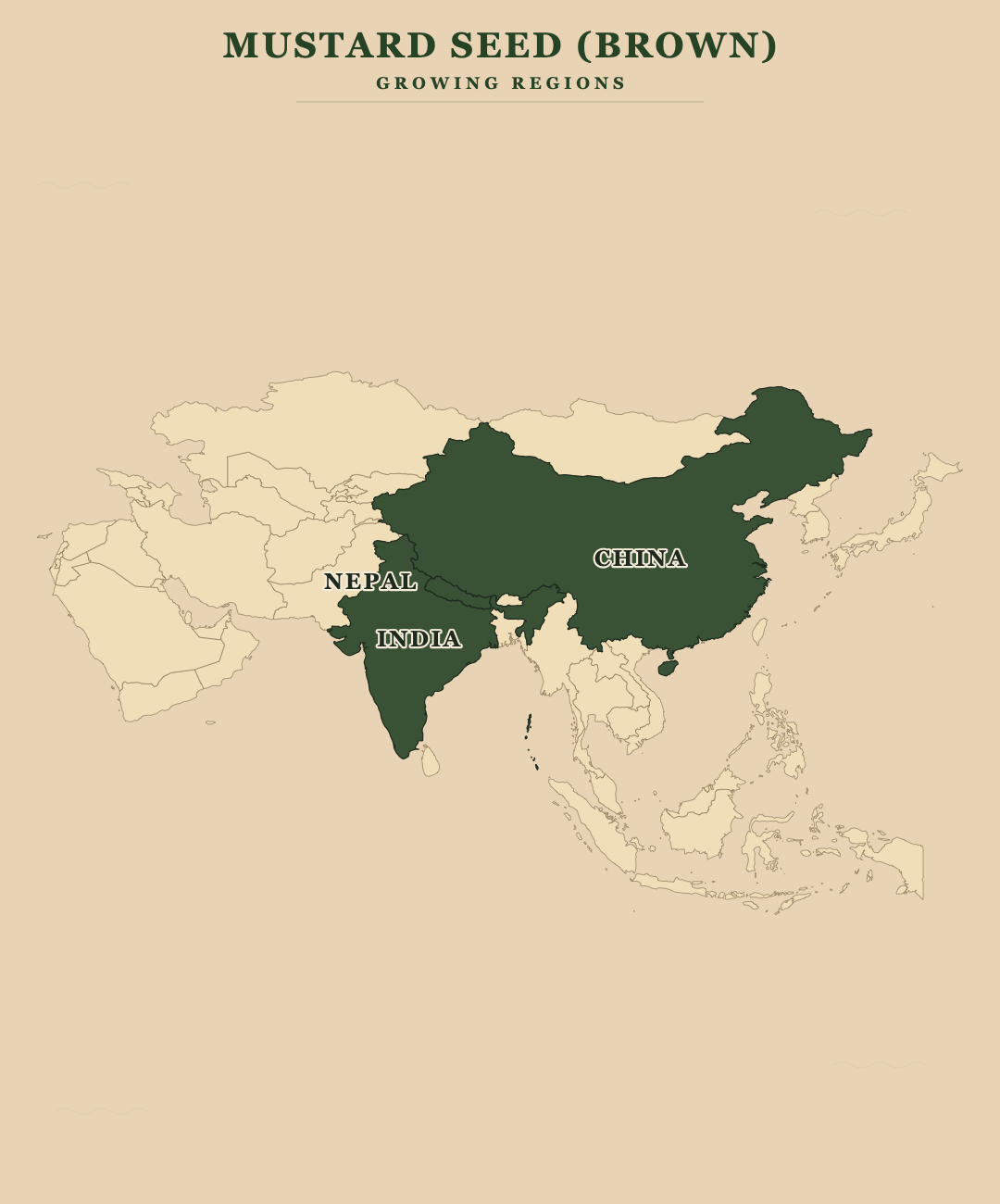
Mustard Seed (Brown) is primarily cultivated in India (dominant world producer), Canada, Nepal, China, with secondary growing regions in Eastern Europe, Ukraine, Russia, Argentina.
Spice Story
Brown mustard has been cultivated in India and China for over 4,000 years — it is one of the foundational spice and oilseed crops of South Asian agriculture. India is the dominant world producer of both seed and seed oil. The defining culinary technique is tadka — the South Indian practice of frying whole mustard seeds in hot ghee or oil until they "pop" (releasing their volatile allyl isothiocyanate), then pouring the flavoured oil over the prepared dish. In European cooking, brown mustard is the basis of Dijon mustard (the original French recipe uses brown mustard seeds combined with white wine and verjus). In gin, mustard seed is an unusual contemporary botanical providing sharp aromatic warmth.
Gin Creativity
Mustard Seed brings sharp pungent warmth with an aromatic green edge. A quarter to half sachet is plenty — full sachet use risks tipping a gin into Bloody-Mary-only territory. Pair with curry leaf and coriander for a South Indian-style profile, or with cumin and fenugreek for a deeper spice-route blend.
Blending Science
Main flavour compounds
 Allyl isothiocyanate (AITC)mustardy heat
 Sinigrin (precursor)—
 Phenolic acids—
Pairs well with
Sinigrin is the precursor compound — a glucosinolate stored stably in intact seeds. When seeds are crushed and exposed to water or alcohol, the enzyme myrosinase converts sinigrin into allyl isothiocyanate (AITC) — the same volatile compound that defines horseradish and wasabi. [source] AITC is the source of mustard's characteristic "sinus-clearing" sharp heat. Phenolic acids contribute background astringency. AITC is volatile and heat-sensitive — cool extraction preserves the sharp character; warm extraction develops a milder, more cooked-spice register.
Food Partners
- South Indian curries — mustard seed in tadka over lentils, vegetables, fish.
- Dijon and English mustards — the canonical European use.
- Pickled vegetables — mustard seed in pickling spice.
- Sausage and cured meat dishes — mustard with charcuterie.
- Cold roast beef — English mustard tradition.
Cocktails To Try

- Spice-route Bloody Mary — mustard-seed gin, tomato, lemon, curry leaf garnish.
- Indian G&T — mustard-seed-and-curry-leaf gin, tonic.
- Tadka Negroni — mustard-seed gin, Campari, vermouth.
Release The Flavour
- Cool extraction — preserves the sharp AITC.
- Bruise before use — exposes the precursor to enzyme action.
- Brief contact — 1–4 hours captures heat.
- Strain quickly — pungency builds with prolonged contact.
Discover more
From the same region
Pairs well with
Same flavour family
Surprise me

Sources & Citations
- scientific_name (Brassica juncea, Brassicaceae):www.mdpi.com/2304-8158/10/9/2089
- india_dominant_producer:plantuse.plantnet-project.org/en/Brassica_juncea_(PROTA)
- sinigrin_to_AITC_chemistry:www.hindawi.com/journals/jchem/2015/606142/
- dijon_indian_mustard_use:www.hindawi.com/journals/jchem/2015/606142/
- main_flavour_compounds (CSV-sourced):inputs/source.csv — Mustard Seed (Brown) row
