
RASPBERRY LEAF

- Botanical name
- Rubus idaeus
- Also known as
- Red raspberry leaf, European raspberry leaf
- Main flavour compound
- Ellagitannins (sanguiin H-6 primary)
- Part used
- Dried leaf
- Method of cultivation
- Deciduous perennial shrub of the Rosaceae family, native to Europe and northern Asia, naturalised and cultivated worldwide in temperate climates. The plant grows about 1.5 metres tall, with arching canes covered in small thorns, palmate compound leaves and white spring flowers followed by the familiar red raspberry fruit. Cultivation is dominated by Europe (UK, Germany, Poland, the Balkans), North America and increasingly Eastern Europe.
- Commercial preparation
- Leaves are harvested in summer from cultivated raspberry plantings (often the same plants grown for fruit), gently dried at low temperature, and either sold whole or cracked. Quality is graded on freshness, absence of mould, and brightness of green colour.
- Non-culinary uses
- Foundational European herbal-medicine ingredient — traditionally used during pregnancy and labour as a uterine tonic across European and Native American traditions for hundreds of years; modern herbal teas; minor cosmetic use.
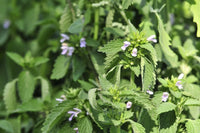
Raspberry Leaf comes from the same plant that produces the fruit — Rubus idaeus, the red raspberry, a deciduous perennial of the Rosaceae family native to Europe and northern Asia. The plant grows about 1.5 metres tall, with arching thorny canes, palmate compound leaves, white spring flowers and the familiar red summer fruit. Most commercial raspberry leaf is harvested as a by-product of fruit production. [source]
Whole dried leaf
The standard form — crumble lightly to release the oils.
Cracked tea-cut
Faster extraction.
Region of cultivation
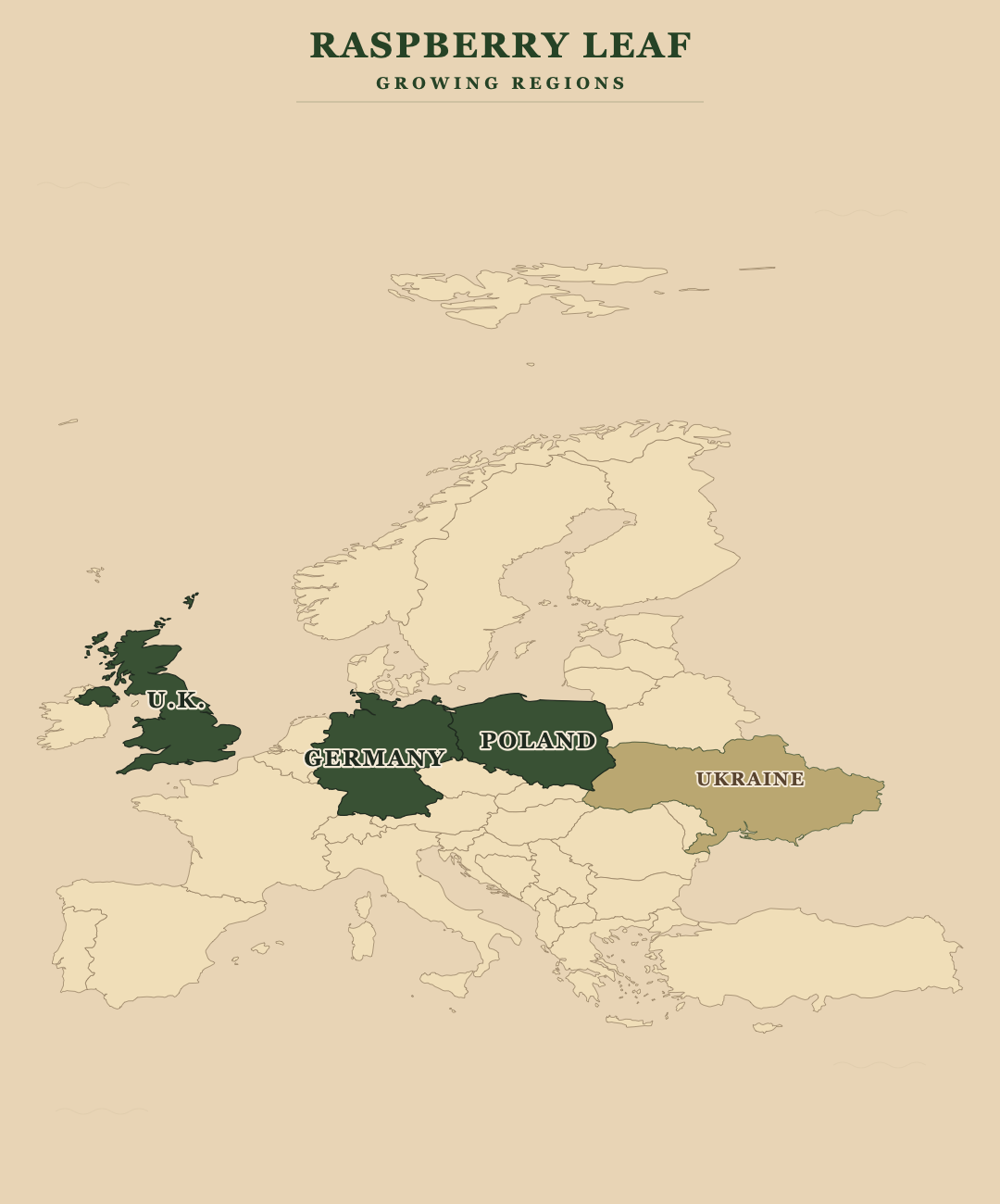
Raspberry Leaf is primarily cultivated in UK, Germany, Poland, USA, Canada, with secondary growing regions in Eastern Europe, Russia, China, Australia.
Spice Story
Raspberry leaf has been used as a women's-health herb in European and Native American traditional medicine for hundreds (probably thousands) of years — particularly as a uterine tonic during pregnancy and labour. The leaf is rich in tannins (2.6–6.9% of dried leaf mass), [source] particularly ellagitannins like sanguiin H-6 which provide the characteristic astringent character. In modern herbal commerce, raspberry leaf is a staple of women's-health tea blends. In gin, raspberry leaf is an unusual contemporary botanical providing soft tannic body and a quietly green-herbaceous character.
Gin Creativity
Raspberry Leaf brings soft tannic-green character — closer to mild tea than to fruit. A full sachet adds clear tannic depth; a half-sachet provides quiet astringent body that integrates with juniper. Pair with chamomile and rose petal for a herbal tisane profile, or with hibiscus and lemon balm for a "wellness gin" blend.
Blending Science
Main flavour compounds
 Ellagitannins (sanguiin H-6 primary)—
 Flavonoids—
 Phenolic acids—
 Vitamin C—
Pairs well with
Ellagitannins (especially sanguiin H-6) provide the characteristic astringent character — these are non-volatile compounds that contribute to the mouthfeel and finish rather than to aromatic top notes. Flavonoids add soft astringent depth. Phenolic acids contribute background body. Vitamin C is present in significant amounts. Cool extraction preserves the green character; warm extraction develops a deeper, more tea-like register.
Food Partners
- Berry desserts — raspberry leaf reinforces the raspberry character.
- Herbal tisanes — raspberry-leaf-and-chamomile tea.
- Tea-like blends — raspberry leaf as a tea substitute.
- Soft fresh cheese with berries — ricotta with raspberry coulis.
- Cold summer drinks — raspberry-leaf-and-mint iced tea.
Cocktails To Try

- Wellness Sour — raspberry leaf gin, honey, lemon, egg white.
- Garden G&T — raspberry leaf gin, tonic, fresh raspberry garnish.
- Berry Spritz — raspberry leaf gin, rosé, soda.
Release The Flavour
- Cool extraction — preserves green character.
- Brief contact — 30 minutes to 2 hours; longer extractions go astringent.
- Crumble gently — releases the volatile oils.
- Source matters — UK and German raspberry-leaf production is the European standard.
Discover more
From the same region
Pairs well with

Same flavour family
Surprise me

Sources & Citations
- scientific_name (Rubus idaeus, Rosaceae):www.traditionalmedicinals.com/blogs/herb-library/raspberr...
- ellagitannins_2.6-6.9_percent_dry_mass:pmc.ncbi.nlm.nih.gov/articles/PMC9140405/
- traditional_uterine_tonic_use:www.traditionalmedicinals.com/blogs/herb-library/raspberr...
- european_north_american_traditional_use:www.traditionalmedicinals.com/blogs/herb-library/raspberr...
- main_flavour_compounds (CSV-sourced):inputs/source.csv — Raspberry Leaf row
