
GUMBI GUMBI

- Botanical name
- Pittosporum angustifolium
- Also known as
- Gumby Gumby, Weeping Pittosporum, Native Apricot, Berrigan
- Main flavour compound
- Saponins
- Part used
- Dried leaf (the fruit is not used as food)
- Method of cultivation
- Small evergreen tree of the Pittosporaceae family, native to most of Australia except Tasmania and the Northern Territory. The plant grows 2–10 metres tall with weeping branches, narrow grey-green leaves, and small yellow tubular flowers followed by orange seed pods. Tolerates drought, frost and a wide variety of soil types from heavy clay to sand. Mostly wild-harvested; commercial plantation cultivation is small but growing.
- Commercial preparation
- Leaves are hand-picked from cultivated or sustainably wild-harvested plants, gently dried to preserve the bitter glycosides and antioxidant polyphenols, and sold whole or as coarse pieces. The dried leaf is the form used in traditional medicine and increasingly in craft botanical applications.
- Non-culinary uses
- Foundational role in many Aboriginal Australian medicinal traditions — used topically for eczema, infections and skin complaints, and internally as a tonic for coughs, colds and digestion; the leaves are also used in *Gumbi Gumbi tea* tradition; the fruit is not generally considered edible.
Gumbi Gumbi — Pittosporum angustifolium — is a small evergreen tree of the Pittosporaceae family, native to most of mainland Australia except Tasmania and the Northern Territory. The plant grows 2–10 metres tall, with characteristically weeping branches, narrow grey-green leaves and small yellow tubular flowers followed by orange seed pods. The fruit is not considered a food source; the leaves are what's used. Gumbi Gumbi is tolerant of both drought and frost, and grows across a wide variety of soil types — qualities that have helped it spread across most of the Australian rangelands. [source]
Whole dried leaf
The standard form — crumble lightly before extraction.
Cracked or chipped
Faster extraction; commonly the form sold for tea use.
Region of cultivation
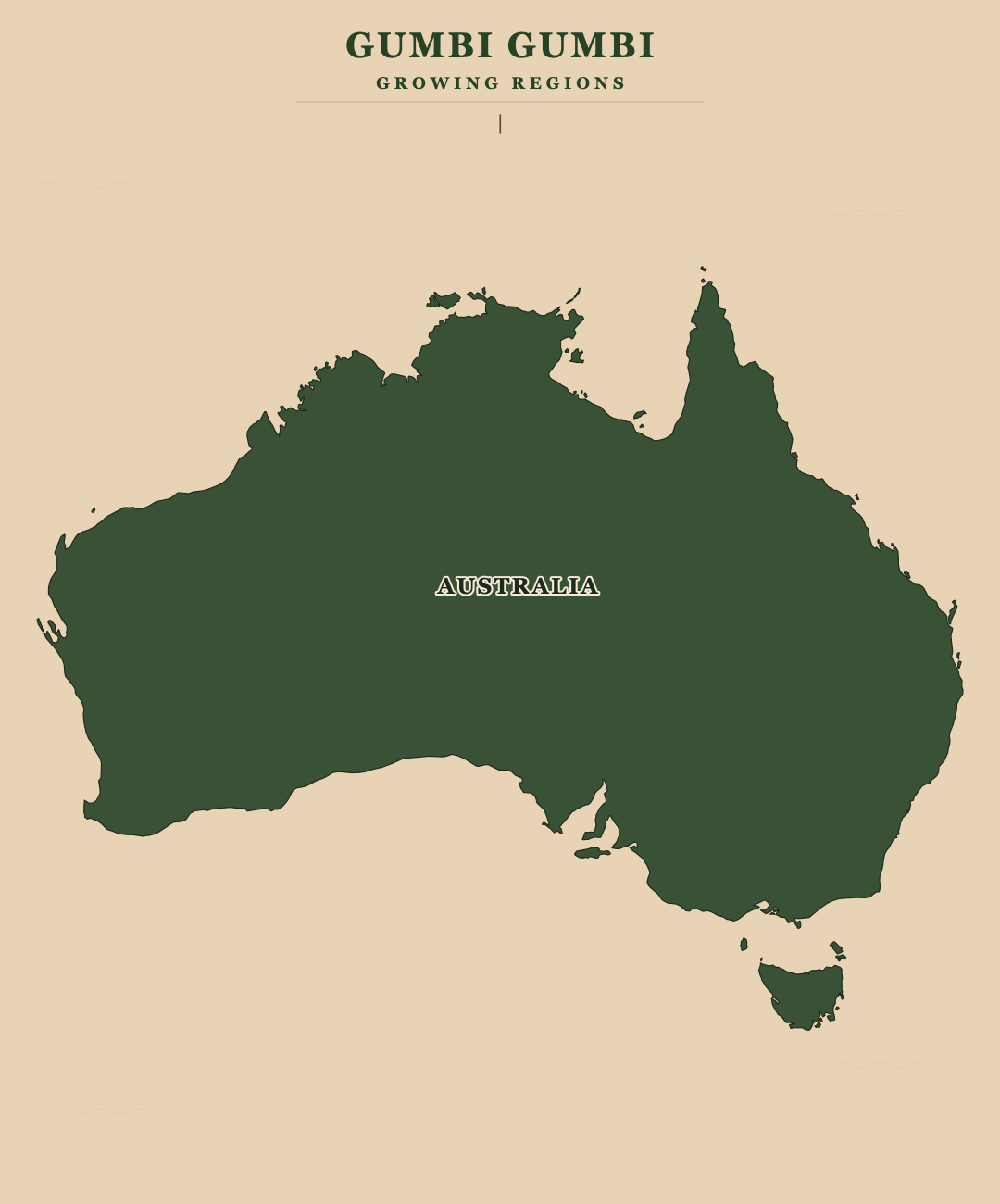
Gumbi Gumbi is native to Australia, Australia — inland and northern Queensland, NSW, SA, WA (most states except Tas and NT), with secondary growing regions in Wild populations across much of the Australian rangelands. |
Spice Story
Gumbi Gumbi is one of the most important traditional Aboriginal medicinal plants of inland Australia. Aboriginal peoples across most of the species' range have used the leaves for tens of thousands of years — topically for eczema, pruritus and skin infections, and internally as a tonic for coughs, colds and cramps. [source] Modern research has identified saponins and polyphenols as the main bioactive compounds (up to 4% by dry weight) with significant antioxidant and antimicrobial activity. Commercial use is recent and small-scale, but increasingly driven by Aboriginal-owned and -operated supply businesses. In gin, Gumbi Gumbi is a novel contemporary native botanical providing earthy-bitter depth — a clearly Australian alternative to imported gentian or wormwood-style bitters.
Gin Creativity
Gumbi Gumbi brings earthy bitterness with a slightly astringent green character. A quarter to half sachet is plenty — the saponin content can dominate quickly. Pair with pepperberry and lemon myrtle for a bush-spice profile, or with wattle seed and anise myrtle for a fully native blend. Avoid combining with very subtle florals — the bitter character buries them.
Blending Science
Main flavour compounds
 Saponins—
 Polyphenols (up to 4% by dry weight)—
Pairs well with
The chemistry is dominated by non-volatile compounds. Saponins are glycoside compounds that contribute the bitter-astringent body and the slight foaming you sometimes see in Gumbi Gumbi tea. Polyphenols (up to 4% by dry weight) are responsible for the antioxidant activity and contribute to the slight bitter depth on the palate. [source] These compounds extract slowly into alcohol; long warm extraction is needed for full development.
Food Partners
- Native spice rubs — Gumbi Gumbi adds bitter depth to red meat rubs.
- Bitter tonic mixers — Gumbi Gumbi as a native alternative to gentian-based tonics.
- Earthy lentil dishes — bitter green echo for grounded vegetable dishes.
- Game-meat reductions — Gumbi Gumbi-gin glaze over venison or kangaroo.
- Dark chocolate desserts — bitter on bitter.
Cocktails To Try

- Bush Negroni — Gumbi Gumbi gin, Campari, vermouth — bitter on bitter.
- Native Sour — Gumbi Gumbi gin, native lemon-myrtle, honey, egg white.
- Outback Old Fashioned — Gumbi Gumbi gin, wattle-seed syrup, orange bitters.
Release The Flavour
- Long extraction — 48+ hours for saponins and polyphenols to develop.
- Heat is friendly — both vapour and warm maceration work.
- Use sparingly — bitter and astringent character can dominate.
- Source matters — look for Aboriginal-owned supply businesses for genuine traditional grade.
Discover more
From the same region
Pairs well with
Same flavour family
Surprise me

Sources & Citations
- scientific_name (Pittosporum angustifolium, Pittosporaceae):en.wikipedia.org/wiki/Pittosporum_angustifolium
- distribution_australian_mainland:tuckerbush.com.au/gumbi-gumbi-pittosporum-angustifolium/
- aboriginal_medicinal_use_topical_and_internal:pmc.ncbi.nlm.nih.gov/articles/PMC7404462/
- bioactive_compounds (saponins and polyphenols up to 4% dry weight):pmc.ncbi.nlm.nih.gov/articles/PMC7404462/
- drought_and_frost_tolerance:aussiegreenthumb.com/gumbi-gumbi-pittosporum-angustifolium/
- main_flavour_compounds (CSV-sourced):inputs/source.csv — Gumbi Gumbi row
