
TEA TREE

- Botanical name
- Melaleuca alternifolia
- Also known as
- Australian Tea Tree, Narrow-leaved Paperbark, Snow-in-Summer
- Main flavour compound
- Terpinen-4-ol (≥30%)
- Part used
- Dried leaf
- Method of cultivation
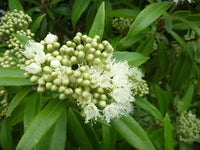
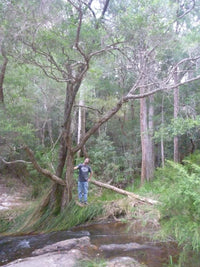
- Small tree of the Myrtaceae family, native to a small native range — the north-east coastal region of New South Wales and adjoining south-east Queensland — typically growing in swampy low-lying areas. The plant reaches 5–8 metres tall, with narrow needle-like leaves and dense bottlebrush-like cream-coloured flowers. The Australian commercial tea tree industry was reborn in the late 1970s with successful plantations growing *M. alternifolia*; the plant can be coppice-harvested multiple times per year.
- Commercial preparation
- Leaves are mechanically harvested by coppicing, steam-distilled for essential oil, or gently dried for use as a dried botanical. The Australian Standard (AS 2782-1985) requires minimum 30% terpinen-4-ol and maximum 15% 1,8-cineole for genuine commercial-grade tea tree oil.
- Non-culinary uses
- Foundational ingredient in natural cosmetics, skincare and household products (the antimicrobial properties of terpinen-4-ol are well-documented); traditional medicinal use by Bundjalung peoples of eastern Australia (the leaves were crushed and inhaled for coughs and colds — the source of the modern commercial use); aromatherapy.
Tea Tree — Melaleuca alternifolia — is a small tree of the Myrtaceae family, native to a relatively small native range on the north-east coast of NSW and adjoining south-east Queensland. [source] The plant reaches 5–8 metres tall, with narrow needle-like leaves and dense cream-coloured bottlebrush flowers. The commercial significance of M. alternifolia is its essential oil — the Australian Standard requires minimum 30% terpinen-4-ol and maximum 15% 1,8-cineole. Tea Tree is distinct from Lemon Tea Tree (Leptospermum petersonii), Manuka (Leptospermum scoparium) and Nerolina (Melaleuca quinquenervia) — these are all sometimes called "tea trees" but are different species in different genera.
Whole dried leaf
Crumble lightly to release the oils — but tea tree is potent.
Cracked
Faster extraction.
Region of cultivation

Tea Tree is native to Australia, Australia — north-east coastal NSW, south-east Queensland, with secondary growing regions in Plantation cultivation expanded across temperate eastern Australia. |
Spice Story
Tea Tree has been used by the Bundjalung people of north-east NSW for many thousands of years — the leaves crushed and inhaled for coughs and colds, or applied topically for minor skin complaints. Captain James Cook's botanist Joseph Banks recorded use of the leaves to brew a tea-like drink (which is what gave the species its English common name). Commercial tea tree oil production was largely dormant from the mid-20th century until a revival in the late 1970s saw successful plantations established. The oil is now one of the most globally-recognised Australian natural products — present in toothpaste, cosmetics, household cleaners and natural-medicine preparations worldwide. In gin, Tea Tree is uncommon as a botanical because of its strong medicinal character; it's used cautiously in some Australian native gins.
Gin Creativity
Tea Tree is intensely medicinal — a quarter sachet or less is plenty. The terpinen-4-ol character pushes a gin firmly into "antiseptic" territory if overused, and it can dominate other botanicals quickly. Pair only with other Myrtaceae botanicals (Lemon Myrtle, Honey Myrtle) and use sparingly.
Blending Science
Main flavour compounds
 Terpinen-4-ol (≥30%)woody, citrus-green
 Gamma-Terpinenefresh pine, top note
 1,8-Cineole (≤15%)eucalyptus, cool
 Alpha-Pinenefresh pine, top note
Pairs well with
Terpinen-4-ol is the defining compound — minimum 30% in commercial-grade tea tree oil. The compound is responsible for both the characteristic medicinal aroma and the well-documented antimicrobial activity. Gamma-terpinene is the precursor compound. 1,8-Cineole layers a eucalypt edge but is regulated to under 15% in commercial-grade material. Alpha-pinene contributes a resinous backbone. Cool extraction preserves the bright top.
Food Partners
- Use cautiously — tea tree is primarily medicinal rather than culinary.
- Light Australian native gin profiles — Tea Tree as a quiet supporting note alongside Lemon Myrtle.
- Smoky meat rubs — small amounts work as part of native-spice blends.
Cocktails To Try

- Native G&T — very lightly tea-tree-infused gin, native tonic, fresh lemon myrtle garnish.
- Bush Sour — minimal tea tree gin, lemon myrtle syrup, lemon, honey.
- (Tea Tree is rarely used as a primary cocktail botanical — its medicinal character dominates.)
Release The Flavour
- Use sparingly — terpinen-4-ol is potent.
- Cool extraction — brief contact.
- Verify commercial-grade quality — must meet Australian Standard for both flavour balance and safety.
- Pair carefully — Tea Tree dominates most other botanicals.
Discover more
Pairs well with
Same flavour family
Surprise me

Sources & Citations
- scientific_name (Melaleuca alternifolia, Myrtaceae):www.islandherbsandspices.com/the-tea-tree-melaleuca-alter...
- native_to_NE_NSW_SE_Qld:www.islandherbsandspices.com/the-tea-tree-melaleuca-alter...
- terpinen-4-ol_australian_standard (≥30%, ≤15% cineole):herbalistics.com.au/product/melaleuca-alternifolia-tea-tr...
- bundjalung_traditional_use:www.islandherbsandspices.com/the-tea-tree-melaleuca-alter...
- commercial_industry_late_1970s:herbalistics.com.au/product/melaleuca-alternifolia-tea-tr...
- main_flavour_compounds (CSV-sourced):inputs/source.csv — Tea Tree row
