
LEMON TEA TREE

- Botanical name
- Leptospermum petersonii
- Also known as
- Lemon-scented Teatree, Lemon Scented Tea Tree
- Main flavour compound
- Citral (70-80%)
- Part used
- Dried leaf
- Method of cultivation
- Small evergreen tree or shrub of the Myrtaceae family, endemic to eastern Australia (mostly Queensland and northern NSW). Closely related to the standard tea tree (*Melaleuca alternifolia*) but with very different chemistry — Lemon Tea Tree is citral-dominant rather than terpinen-4-ol-dominant, which gives it a clean lemon character with much less of the medicinal-camphor that defines common tea tree. Commercial plantation cultivation has expanded in the past 30 years.
- Commercial preparation
- Leaves are harvested by coppicing or selective cutting, gently dried to preserve citral, and either sold whole or steam-distilled for essential oil. The oil is 70–80% citral — one of the highest natural citral concentrations in any Myrtaceae species (second only to Lemon Myrtle).
- Non-culinary uses
- Essential oil for natural cosmetics, soap and aromatherapy; insect-repellent applications (citral has well-documented antimicrobial activity); natural cleaning products; some traditional Indigenous medicinal use.
Lemon Tea Tree — Leptospermum petersonii — is a small evergreen tree or shrub of the Myrtaceae family, endemic to eastern Australia. Despite the common name including "tea tree," it is a different genus from the common medicinal tea tree (Melaleuca alternifolia) — they are botanical cousins in the same family but with very different essential-oil chemistry. Lemon Tea Tree's leaves contain 70–80% citral, giving them a clean lemon-citral aroma far more pronounced than common tea tree's medicinal-camphor profile. [source]
Whole dried leaf
The standard form — crumble lightly to release the citral.
Cracked
Faster extraction.
Region of cultivation
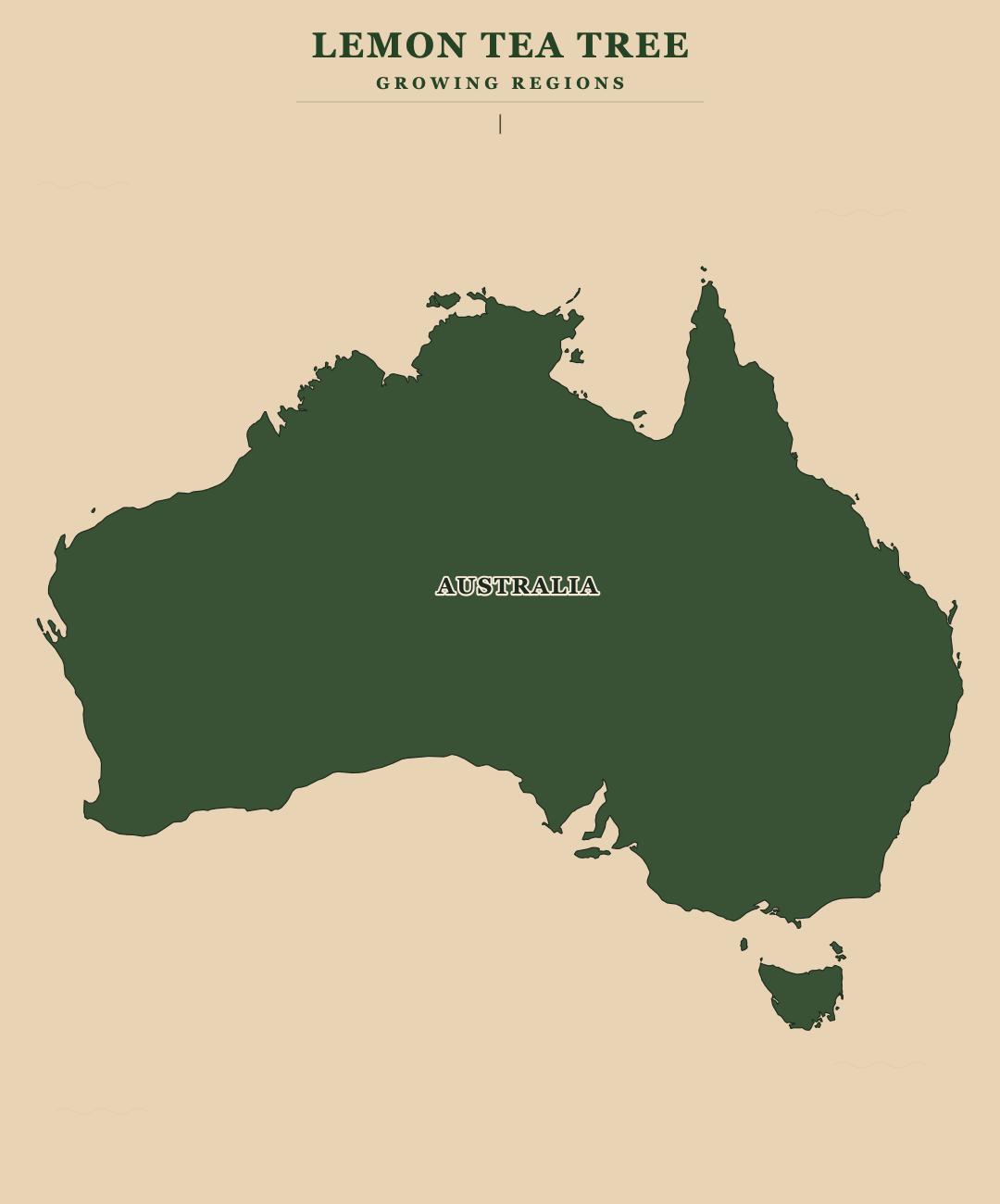
Lemon Tea Tree is native to Australia, Australia — eastern Australian coastal Queensland and northern NSW, with secondary growing regions in Plantation cultivation expanding across temperate eastern Australia. |
Spice Story
Lemon Tea Tree sits in the citral-rich Myrtaceae family of Australian native botanicals — alongside Lemon Myrtle (Backhousia citriodora) and Honey Myrtle (Melaleuca teretifolia) — three species that together make Australia the world's largest commercial source of natural citral. Lemon Tea Tree has been used by Indigenous Australians for tens of thousands of years across its eastern Australian range, and modern commercial plantation has expanded substantially over the past 30 years to meet international demand for natural lemon-aromatic ingredients. In gin, Lemon Tea Tree provides a cleaner lemon character than imported lemon and a different lemon profile from Lemon Myrtle — useful when layering native citrus botanicals.
Gin Creativity
Lemon Tea Tree brings clean lemon-citral character with a slightly more "green" leafy edge than Lemon Myrtle. A full sachet pushes a gin firmly into native-lemon territory; a half-sachet provides quiet lemon brightness that integrates with juniper. Pair with Lemon Myrtle for layered citral, or with Pepperberry and Native Lemongrass for a bush-spice profile.
Blending Science
Main flavour compounds
 Citral (70-80%)lemon-bright
 Citronellallemon-rosy
 Linaloolfloral, soft
 Pinenefresh pine, top note
Pairs well with
Citral (70–80% — neral + geranial) dominates the leaf oil, providing the bright lemon character. Citronellal layers a softer rose-citrus note. Linalool contributes a quiet floral lift. Alpha-pinene adds a faintly resinous backbone that bridges Lemon Tea Tree to juniper. Cool extraction preserves the citral.
Food Partners
- Native fish marinades — Lemon Tea Tree and lemon myrtle on grilled native fish.
- Bush spice rubs — Lemon Tea Tree with pepperberry and native thyme.
- Lemon-and-honey desserts — Lemon Tea Tree syrup over panna cotta.
- Cool sorbets — Lemon Tea Tree sorbet.
- Light dressings — Lemon Tea Tree vinaigrette.
Cocktails To Try

- Native G&T — Lemon Tea Tree gin with native tonic.
- Bush Sour — Lemon Tea Tree gin, lemon, honey, egg white.
- Australian Gimlet — Lemon Tea Tree gin, lime cordial.
Release The Flavour
- Cool extraction — preserves the citral.
- Brief contact — 1–4 hours captures the brightness.
- Crumble gently — releases the volatile oils.
- Pair with Lemon Myrtle — both citral-dominant, layer beautifully.
Discover more
Pairs well with
Same flavour family
Surprise me

Sources & Citations
- scientific_name (Leptospermum petersonii, Myrtaceae):aussiegardenia.com/lemon-scented-tea-tree-leptospermum-pe...
- native_to_eastern_australia:aussiegardenia.com/lemon-scented-tea-tree-leptospermum-pe...
- citral_content (70-80%):www.aromaweb.com/essential-oils/lemon-tea-tree-essential-...
- distinct_from_melaleuca_alternifolia:www.aromaweb.com/essential-oils/lemon-tea-tree-essential-...
- main_flavour_compounds (CSV-sourced):inputs/source.csv — Lemon Tea Tree row
