
PINEAPPLE MYRTLE

- Botanical name
- Leptospermum petersonii
- Also known as
- Leptospermum petersonii 'Variety B' (CT alpha-pinene), Pineapple Tea Tree
- Main flavour compound
- Alpha-pinene
- Part used
- Dried leaf
- Method of cultivation
- A rare cultivar of the tea-tree Leptospermum petersonii, the same size, habit and leaf as Lemon Tea Tree but grown in a distinctly different environment that produced a 'Variety B' form whose leaf carries a pineapple aroma. Plantation-grown near Byron Bay; the leaves are steam-distilled. The 'Variety B' designation is a chemotype/cultivar, not a separate species.
- Commercial preparation
- Leaves are harvested from a single Northern Rivers plantation and steam-distilled; for kitchen and distilling use the dried leaf is sold whole or cracked. A very rare, recently-developed botanical.
- Non-culinary uses
- Steam-distilled essential oil for perfumery and natural fragrance; prized for its rare fresh-pineapple top note.
Pineapple Myrtle is a rare cultivar of Leptospermum petersonii — the native tea-tree better known in its standard form as Lemon Tea Tree. Same size, same habit, the same fine leaves; but grown in a distinctly different environment, this 'Variety B' form developed a leaf that smells of fresh pineapple rather than lemon. [source: Trevena, A Guide to Australian Native Essential Oils (Essentially Australia) — Pineapple Myrtle entry] Crush a leaf and the first thing you get is bright tropical fruit — pineapple and a little banana — before any green tea-tree character arrives.
Whole dried leaf
Crumble lightly just before use to release the fresh pineapple top notes.
Cracked
Faster extraction; use promptly as the bright aroma fades.
Region of cultivation
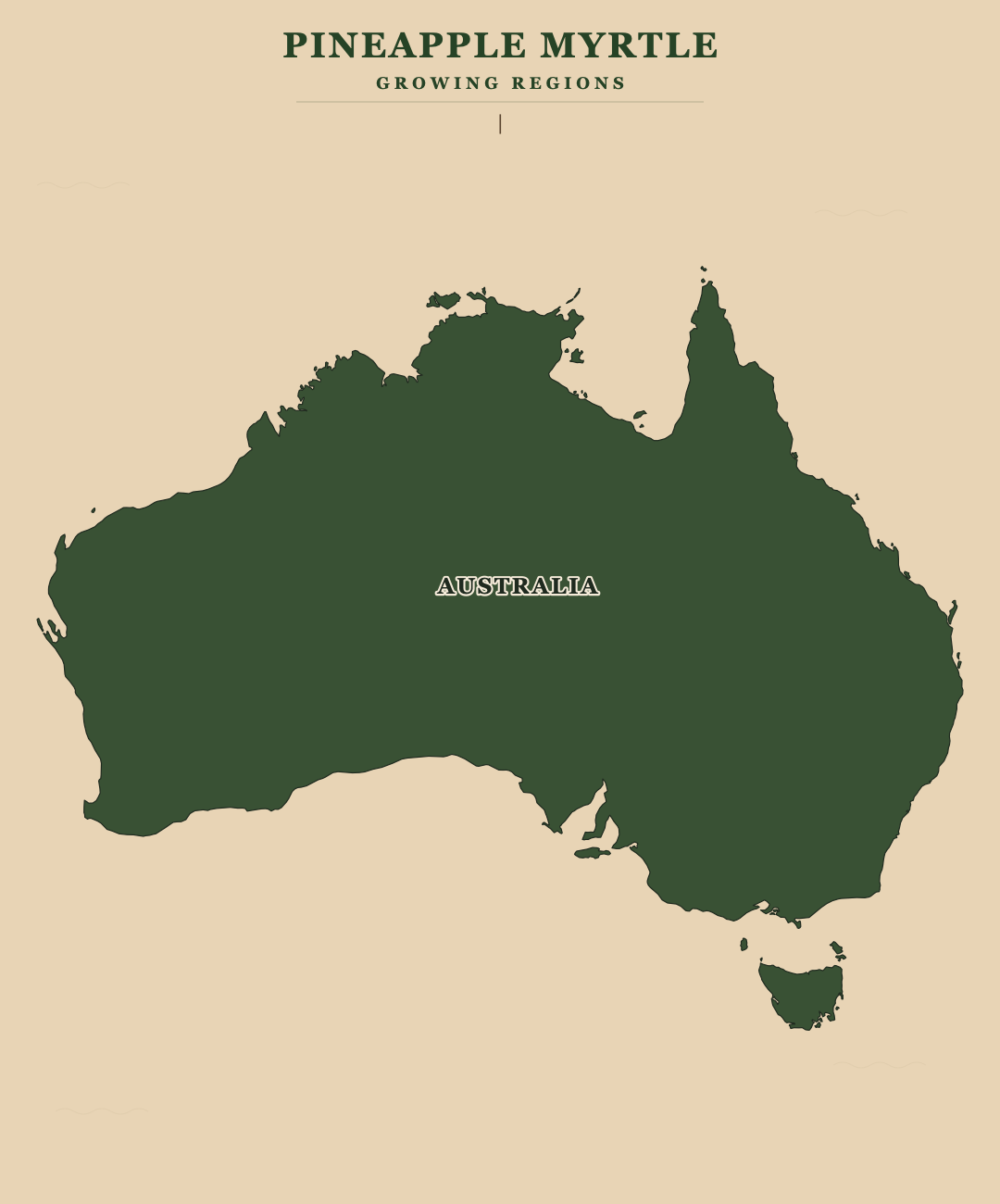
Pineapple Myrtle is native to Australia, Australia — Northern Rivers, NSW (Byron Bay district), with secondary growing regions in Single-plantation cultivar. |
Spice Story
Unlike Lemon Myrtle or Pepperberry, Pineapple Myrtle has no long bushfood history — it is one of the newest botanicals in the Australian native range. It was first located in 2014 by Greg Trevena and is grown on a single plantation in the Byron Bay district of the NSW Northern Rivers, where the leaves are steam-distilled. [source: Trevena — Pineapple Myrtle entry] The "Variety B" tag is a chemotype, not a separate species: the plant is genetically the familiar Leptospermum petersonii, but its growing environment shifted the leaf chemistry toward a distinct pineapple aroma — fresh and fruity up front, joyful citrus through the middle, then warm and lightly spicy on the finish. For a distiller it offers something genuinely uncommon: a clean tropical-fruit top note from a leaf, with none of the sugar of an actual fruit.
> Note: this entry was previously (and incorrectly) attributed to Backhousia myrtifolia — that plant is Cinnamon Myrtle, a different species with a warm cinnamon character, and belongs under its own entry.
Gin Creativity
Pineapple Myrtle is a top-note botanical — bright, fruity and volatile. A half-sachet lifts a contemporary Australian gin with a fresh tropical-fruit lead that sits naturally over juniper; a full sachet pushes firmly into fruit-forward territory. It is a close cousin of Lemon Tea Tree, so the two layer beautifully, and it pairs naturally with Finger Lime and Desert Lime for an all-native citrus-and-tropical profile. Use it for brightness, not body — long warm extractions flatten the pineapple.
Blending Science
Main flavour compounds
 Alpha-pinenefresh pine, top note
 Geranyl acetaterose-citrus, soft
 Geranial—
 Neral—
Pairs well with
Alpha-pinene is the chemotype marker — a fresh, resinous pine note that frames the fruit. [source: Trevena — Pineapple Myrtle entry] Geranyl acetate brings a sweet, fruity-floral roundness, while Geranial and Neral — the two citral isomers — supply the bright citrus lift that carries the pineapple character. (The book also notes geraniol, bicyclogermacrene, beta-pinene, myrcene, viridiflorol and terpinolene in smaller amounts.) [source: Trevena — Pineapple Myrtle entry] These are light, volatile aromatics: cool, brief extraction preserves the tropical top notes; heat drives them off.
Food Partners
- Tropical fruit salads — Pineapple Myrtle echoes and lifts fresh pineapple and mango.
- Grilled prawns and white fish — a fruity native top note over chargrill.
- Coconut desserts — Pineapple Myrtle syrup over panna cotta or rice pudding.
- Sweet-sour glazes — works in a glaze for pork or chicken.
- Sorbets and granitas — exceptional in frozen tropical desserts.
Cocktails To Try

- Northern Rivers Singapore Sling: the great tropical classic — gin, cherry, citrus, pineapple — rebuilt around a Pineapple Myrtle gin so the leaf's own fresh-pineapple-and-banana top note leads the charge. Long, fruity and golden, it lets a single Byron Bay leaf do the work a whole tin of pineapple usually does, and the warm-spice finish lands exactly where the cherry liqueur once sat.
- Pineapple Myrtle Pegu Club: the colonial-era classic of gin, orange curaçao, lime and bitters, given the native treatment — the leaf's citrus-through-warm-spice arc threads straight through the orange and lime, turning a sharp, dry sour into something tropical, aromatic and unmistakably Australian.
- Byron Gin Basil Smash: the modern classic of gin, lemon, sugar and a fistful of bruised basil, reimagined with a Pineapple Myrtle gin — the herbal basil and the leaf's pineapple-citrus lift play off each other beautifully, a vivid green-and-gold smash that tastes of a Northern Rivers summer.
Release The Flavour
- Cool extraction — preserves the volatile pineapple top notes.
- Brief contact — 1–3 hours captures the brightest fruit.
- Crumble lightly — exposes the leaf oils without bruising out the freshness.
- Use for lift, not depth — pair with a body botanical; Pineapple Myrtle works at the top of the palate.
Discover more
Pairs well with
Same flavour family
Surprise me

Sources & Citations
- scientific_name + identity correction (Leptospermum petersonii 'Variety B' CT alpha-pinene, NOT Backhousia myrtifolia):Trevena, A Guide to Australian Native Essential Oils (Essentially Australia) — Pineapple Myrtle entry
- gbif_species (Leptospermum petersonii, ACCEPTED, usageKey 3181958):GBIF Backbone Taxonomy — Leptospermum petersonii F.M.Bailey, usageKey 3181958
- history (located 2014 by the author; single Byron Bay plantation; rare cultivar):Trevena — Pineapple Myrtle entry
- aroma (pineapple + banana, then citrus, then warm-spicy):Trevena — Pineapple Myrtle entry
- main_flavour_compounds (alpha-pinene, geranyl acetate, geranial, neral, geraniol, bicyclogermacrene, beta-pinene, myrcene, viridiflorol, terpinolene):Trevena — Pineapple Myrtle entry
- hero_image:
