
FINGER LIME

- Botanical name
- Citrus australasica
- Also known as
- Caviar lime, Citrus caviar, Australian finger lime
- Main flavour compound
- Limonene
- Part used
- Dried whole fruit or dried peel; fresh "caviar" pearls are also used in cocktails but not in distilling sachets
- Method of cultivation
- Thorny understorey shrub or small tree of the Rutaceae family, native to the lowland subtropical rainforests of south-east Queensland and north-east New South Wales. The wild plant reaches up to 10 metres; in cultivation it's typically pruned to 2–4 metres for ease of harvest. Cultivars produce finger-shaped fruits 5–8 cm long in colours from green and yellow through pink and deep red, filled with juicy round vesicles that pop on the tongue like citrus caviar.
- Commercial preparation
- Fruit is hand-picked at full colour, and either sold fresh whole for the caviar-pearl trade, processed for juice or zest, or dried whole/as peel for the distilling and dried-spice market. Cultivation is plantation-based, expanding rapidly through southern Queensland and NSW over the past 25 years.
- Non-culinary uses
- Fresh-pearl caviar garnish in fine dining (the signature use); marmalades and citrus preserves; specialty perfumery; ornamental cultivation across subtropical Australia.
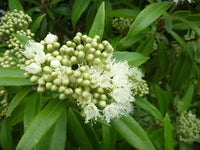
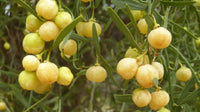
Finger Lime — Citrus australasica — is a thorny rainforest understorey shrub of the true citrus family, endemic to the subtropical lowland rainforests of the Queensland–NSW border region. The plant grows up to 10 metres in wild stands and produces remarkable fruit: cylindrical, finger-shaped, 5–8 cm long, with a thin pebbled rind in colours from green and yellow to pink and deep crimson, depending on cultivar. Inside, juice vesicles are arranged not as the soft segments of a common citrus but as discrete spherical pearls — "citrus caviar" — that pop on the tongue with sharp, aromatic lime juice. [source] No other commercial citrus has this morphology.
Dried whole fruit
Releases citrus character slowly across a cool maceration.
Dried peel chips
Concentrated peel-oil version; faster extraction.
Region of cultivation
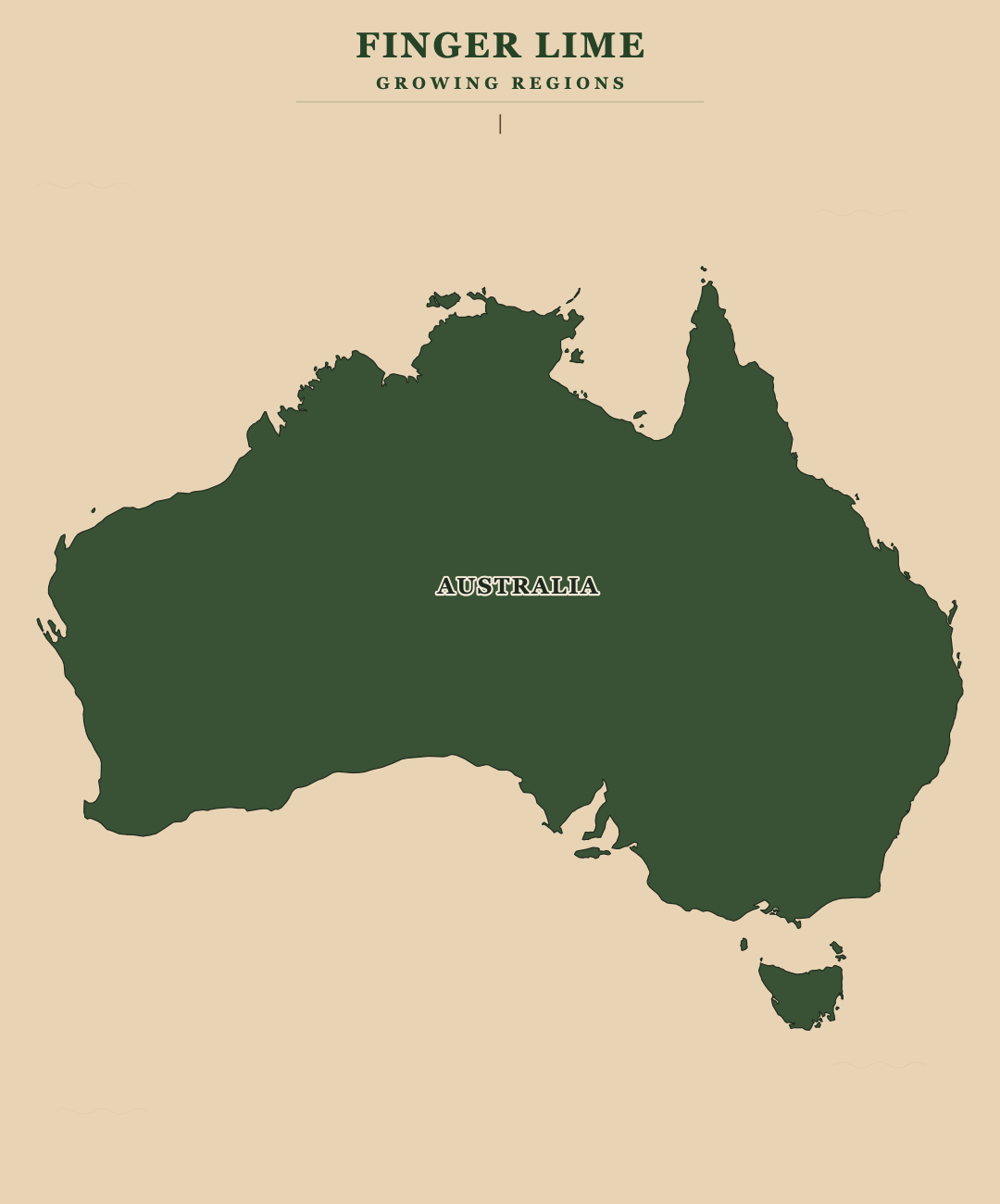
Finger Lime is native to Australia, Australia — south-east Queensland, north-east NSW, with secondary growing regions in Plantation cultivation across subtropical eastern Australia; small-scale California, Florida. |
Spice Story
Finger Lime is the great modern Australian native-food success story. The plant has been used as a traditional bush food for tens of thousands of years across the Bundjalung and Yugambeh country of the Qld-NSW border rainforest; commercial cultivation began in earnest only in the 1990s, but within twenty years finger lime had become an internationally celebrated specialty ingredient. The "citrus caviar" pearls are now featured in Michelin-starred restaurants worldwide as a garnish for seafood, sparkling wine and dessert plates. In craft gin, dried Finger Lime appears as a clearly Australian alternative to imported lime — the dried form retains the bright, slightly piney-citrus character even after the fresh-pearl effect is lost.
Gin Creativity
Finger Lime brings a distinctively bright, slightly piney lime character that no other dried citrus matches. A full sachet pushes a gin firmly into native-citrus territory; a half-sachet adds quiet citrus brightness with a faint resinous edge that bridges to juniper. Pair with lemon myrtle and pepperberry for a fully Australian native gin, or with juniper and coriander for a contemporary London Dry with native character.
Blending Science
Main flavour compounds
 Limoneneclean citrus lift
 Pinenefresh pine, top note
 Citrallemon-bright
 Bergaptene—
Pairs well with
Limonene dominates as in all citrus, but Finger Lime carries higher than usual concentration of alpha-pinene, which contributes the slightly piney-resinous edge that distinguishes it from common lime. Citral provides the bright lemon-leaning top note. Bergaptene is a furanocoumarin (similar to bergamot's bergamottin) contributing photosensitivity if used neat on skin — relevant for cosmetic but not gin use. Cool extraction preserves the brightness; warm extraction develops the resinous depth.
Food Partners
- Seafood (oysters, sashimi) — the defining international use of fresh pearls.
- Sparkling wine garnishes — Finger Lime gin in a champagne cocktail.
- Native fish ceviche — pair with lemon myrtle.
- Tropical fruit salads — Finger Lime gin glaze over mango and pineapple.
- Cool dessert glazes — yuzu-and-Finger-Lime sorbet.
Cocktails To Try

- Native G&T — Finger Lime gin, native tonic, fresh Finger Lime pearls garnish (if you can get them).
- Australian Gimlet — Finger Lime gin, lime cordial, lime peel.
- Pearl Spritz — Finger Lime gin, prosecco, soda, Finger Lime caviar garnish.
Release The Flavour
- Cool extraction — preserves the bright citrus character.
- Brief contact — 2–6 hours; longer extractions emphasise bitterness.
- Whole peel matters — most of the aromatic is in the peel.
- Source matters — different cultivars (red, green, yellow) produce slightly different gin character.
Discover more
Pairs well with
Same flavour family
Surprise me

Sources & Citations
- scientific_name (Citrus australasica, Rutaceae):en.wikipedia.org/wiki/Citrus_australasica
- native_range (Qld-NSW border lowland rainforest):en.wikipedia.org/wiki/Citrus_australasica
- caviar_pearl_morphology:uscitrusnursery.com/blogs/citrus-simplified/australian-fi...
- cultivars_colour_diversity:uscitrusnursery.com/blogs/citrus-simplified/australian-fi...
- main_flavour_compounds (CSV-sourced):inputs/source.csv — Finger Lime row
