
RIVERMINT

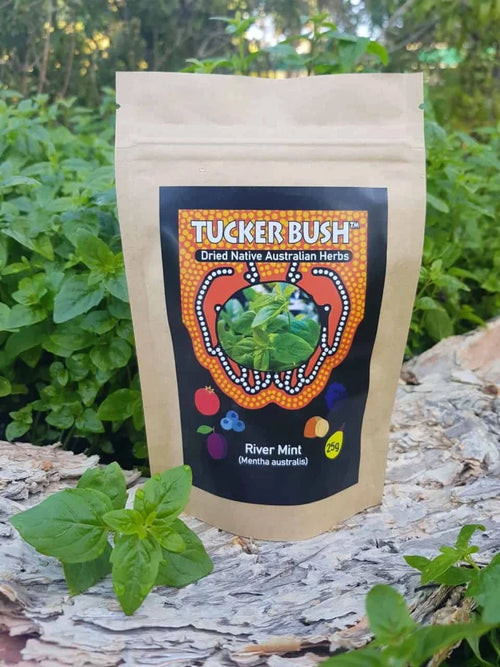
- Botanical name
- Mentha australis
- Also known as
- Native Mint, Wild Mint, Native Peppermint, Australian Mint
- Main flavour compound
- Menthone
- Part used
- Dried leaf
- Method of cultivation
- Perennial herb of the Lamiaceae (mint) family, endemic to most of mainland Australia. The plant grows up to 50 cm tall — smaller and more delicate than European peppermint or spearmint — with arrow-shaped leaves and small white-purple flowers. Like all mints, Rivermint spreads aggressively via stolons and is best grown in containers. It prefers moist, shady conditions (often growing along watercourses, hence the common name).
- Commercial preparation
- Leaves are harvested at peak season, gently dried, and either sold whole or cracked. Small-scale bushfood production.
- Non-culinary uses
- Long use in Aboriginal Australian culture as a flavoursome bushfood, an insect repellent, and a medicinal herb (for digestion and respiratory issues); modern Australian native cuisine.
Rivermint — Mentha australis — is a perennial herb of the mint family, endemic to most of mainland Australia. The plant is smaller and more delicate than European peppermint or spearmint, growing to about 50 cm tall, with arrow-shaped leaves and small white-purple flowers in summer. Like all mints, Rivermint spreads aggressively via underground stolons and prefers moist, shaded conditions — particularly along watercourses, which is where the common name comes from. [source] The flavour combines spearmint and peppermint characteristics with a faint native pepper edge.
Whole dried leaf
The standard form — crumble lightly to release the oils.
Cracked
Faster extraction.
Region of cultivation
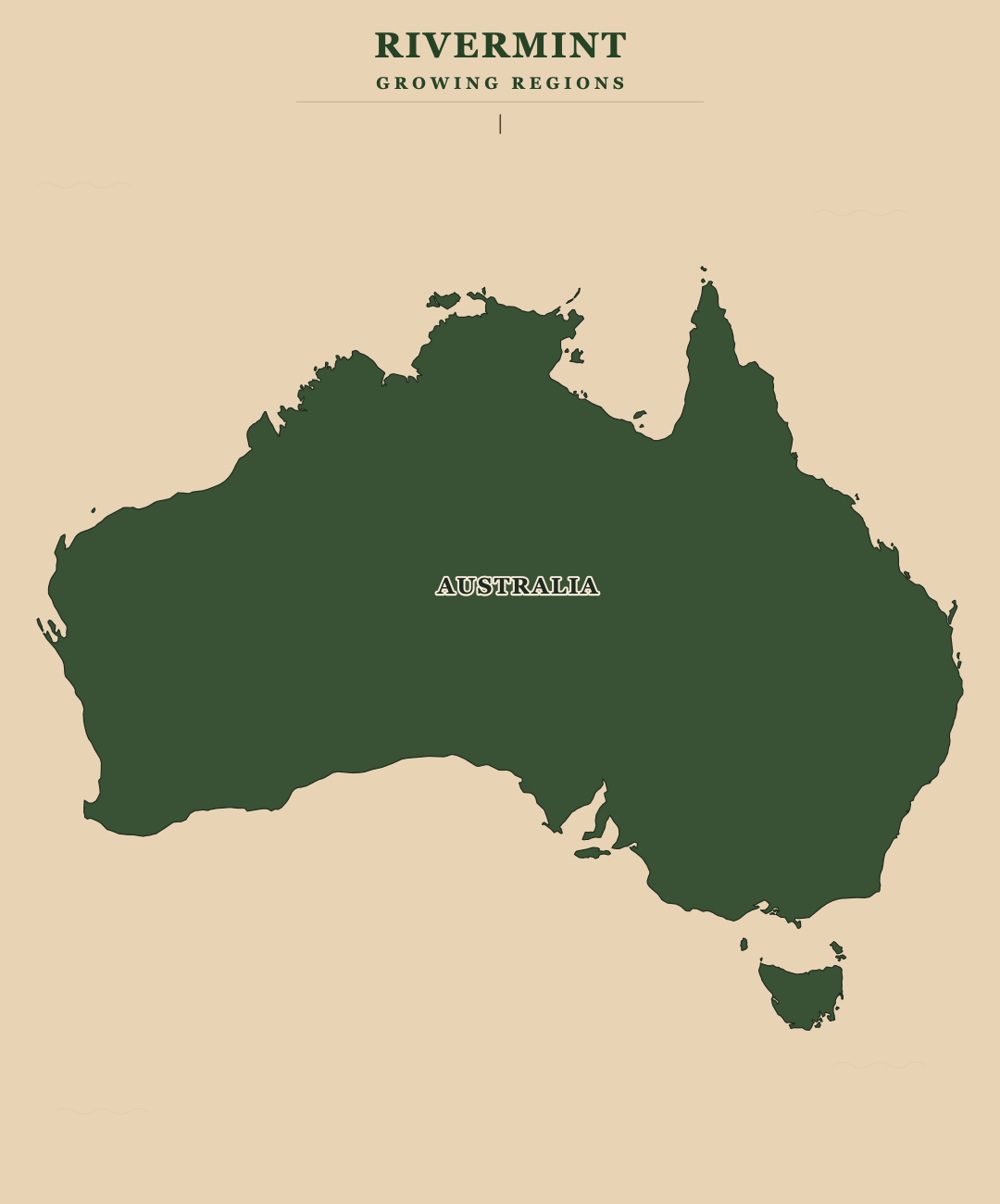
Rivermint is native to Australia, Australia — most mainland states (NSW, Vic, Qld, SA, WA, NT), with secondary growing regions in Naturalised in many cool moist habitats. |
Spice Story
Rivermint has been used by Aboriginal peoples across mainland Australia for tens of thousands of years — as a foundational bushfood, as an insect repellent, and as a medicinal herb for digestive and respiratory complaints. [source] The plant is one of the most accessible native bush herbs — it grows widely along watercourses across the continent and can be foraged sustainably. Commercial cultivation has expanded with the broader Australian native-cuisine movement. In gin, Rivermint provides a clearly Australian native alternative to imported peppermint or spearmint.
Gin Creativity
Rivermint brings spearmint-and-peppermint character with a faint native pepper edge. A full sachet pushes a gin into clearly minty territory; a half-sachet provides quiet cool depth that integrates with juniper. Pair with Lemon Myrtle and Pepperberry for a fully native profile, or with lemon balm and citrus peel for a cool-summer garden gin.
Blending Science
Main flavour compounds
 Menthone—
 Pulegone—
 Limoneneclean citrus lift
 Beta-Caryophyllenewarm woody, peppery
Pairs well with
Menthone provides the warm mint backbone (more prominent in M. australis than menthol). Pulegone layers a stronger peppery-camphor note than European mints typically have (which is what gives Rivermint its distinctive native character). Limonene contributes citrus brightness. Beta-caryophyllene adds warm woody depth. Cool extraction preserves the bright top.
Food Partners
- Native bush tea — Rivermint with lemon myrtle.
- Australian summer salads — Rivermint as a fresh garnish.
- Lamb with native mint sauce — Australian alternative to European mint sauce.
- Cool desserts — Rivermint in sorbet and panna cotta.
- Iced tea-style drinks — Rivermint cordial.
Cocktails To Try

- Native Mojito — Rivermint gin, lime, sugar, soda.
- Bush Spritz — Rivermint gin, prosecco, soda.
- Native Gimlet — Rivermint gin, lime cordial.
Release The Flavour
- Cool extraction — preserves bright mint character.
- Crumble gently — releases the volatile oils.
- Brief contact — 1–4 hours captures freshness.
- Pair with native botanicals — reinforces a clearly Australian profile.
Discover more
Pairs well with
Same flavour family
Surprise me

Sources & Citations
- scientific_name (Mentha australis, Lamiaceae):tuckerbush.com.au/native-river-mint-mentha-australis/
- native_range (most of mainland Australia):thegourmanticgarden.com/how-to-grow-river-mint-mentha-aus...
- aboriginal_traditional_use (bushfood, repellent, medicine):warndu.com/blogs/first-nations-food-guide/aussie-wild-mint
- spearmint_peppermint_hybrid_flavour:tuckerbush.com.au/native-river-mint-mentha-australis/
- main_flavour_compounds (CSV-sourced):inputs/source.csv — Rivermint row
