
PISTACHIO

- Botanical name
- Pistacia vera
- Also known as
- Persian green nut, Pesteh (Persian), Antep fıstığı (Turkish)
- Main flavour compound
- Oleic acid
- Part used
- Roasted dried kernel
- Method of cultivation
- Small deciduous tree of the Anacardiaceae family (the same family as cashew, mango and sumac), native to southern Central Asia (northeastern Iran, northern Afghanistan and adjoining Anatolia). The tree grows 8–12 metres tall, is dioecious (separate male and female trees), and produces clusters of small ovoid nuts encased in hard pale-cream shells that split naturally when ripe. Trees take 7–10 years to begin commercial production. Iran and Turkey are the historic cultivation centres; the USA (California) is now the largest producer along with Iran and Turkey, with all three combined accounting for 87% of world production.
- Commercial preparation
- Mature pistachios are mechanically shaken from trees, hulled, washed, dried, and lightly roasted before sale. The characteristic pistachio green colour comes from chlorophyll preserved through careful low-temperature drying. Heavy roasting destroys the green colour.
- Non-culinary uses
- Foundational ingredient in Persian, Turkish, Levantine and Italian confectionery (baklava, halva, gelato, biscotti); cosmetics (pistachio oil); the resin from related *Pistacia* species produces mastic gum.
Pistachio — Pistacia vera — is a small deciduous tree of the Anacardiaceae family, native to southern Central Asia (northeastern Iran, northern Afghanistan, parts of Turkmenistan and Anatolia). [source] The tree is dioecious (separate male and female trees) and produces clusters of small ovoid nuts in hard cream-coloured shells that split naturally along one side when ripe. The kernel inside is the famous pistachio-green colour, derived from chlorophyll preserved through careful low-temperature drying. Trees take 7–10 years to begin commercial production but remain productive for many decades.
Whole roasted kernel
The standard form — chop coarsely before use.
Sliced or slivered
Faster extraction.
Region of cultivation
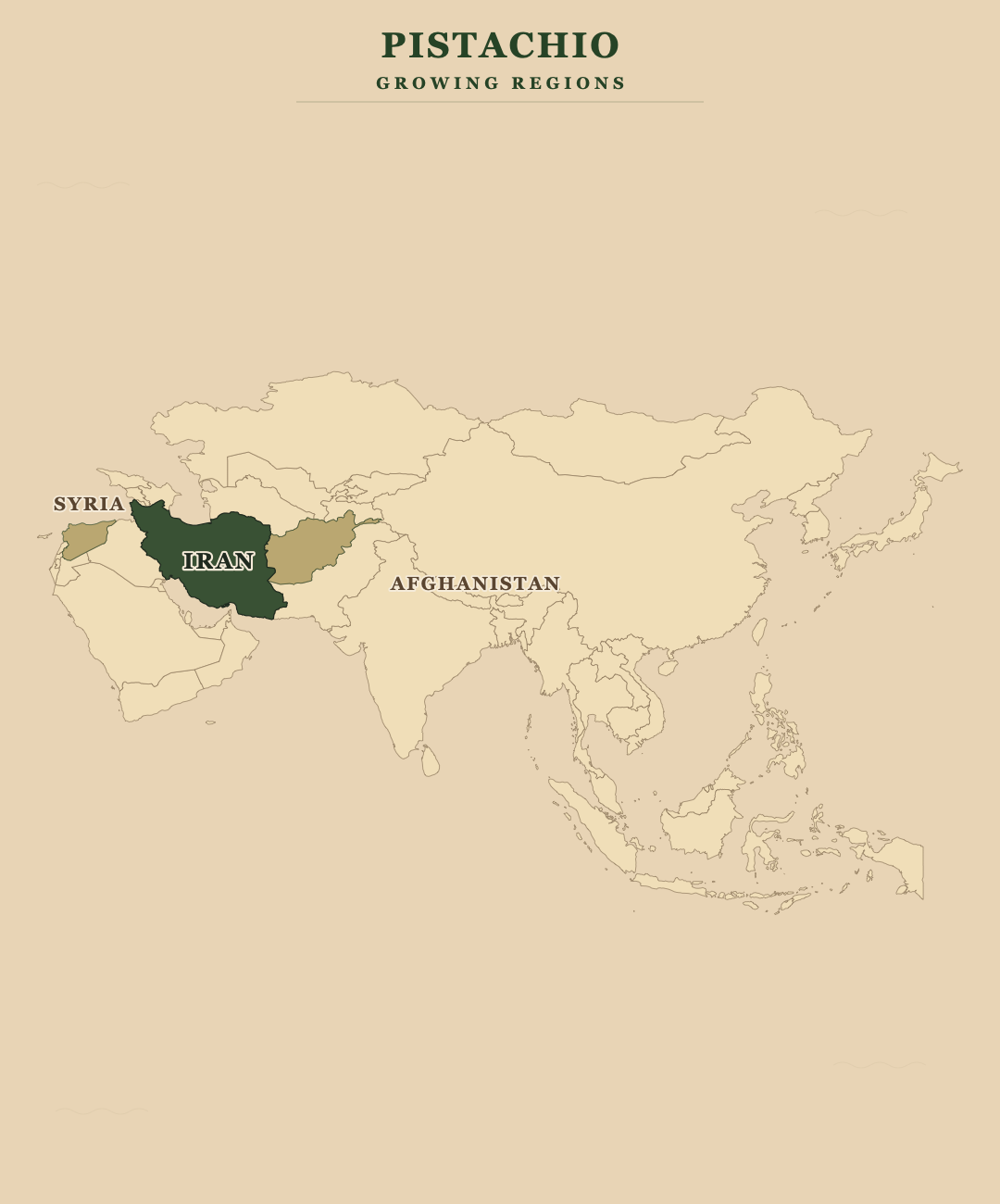
Pistachio is primarily cultivated in USA (California), Iran, Turkey (combined 87% of world production), with secondary growing regions in Italy (Bronte, Sicily — DOP), Syria, Greece, Afghanistan.
Spice Story
Pistachio is among the oldest cultivated tree crops in human history — archaeological evidence places domestication in Iran and Anatolia at least 3,000 years ago, and likely back into the Bronze Age. Pistachios appear in Persian royal cuisine, in classical Greek and Roman writings, and in continuous Iranian, Turkish, Levantine and Italian (Sicilian Bronte DOP) cuisine. Modern production is dominated by Iran, Turkey and the USA (California), which together produce 87% of the world's 1.4 million tonnes annual output. [source] In gin, pistachio is an unusual contemporary botanical providing soft sweet-nutty character.
Gin Creativity
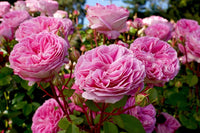
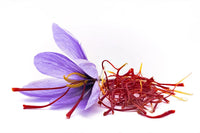
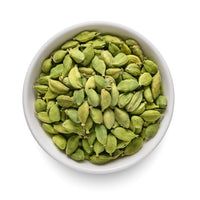
Pistachio brings soft sweet-nutty character with a faint green-resinous edge. A full sachet pushes a gin firmly into dessert-style territory; a half-sachet provides quiet rounded body that integrates with juniper. Pair with rose petal and cardamom for a Persian-leaning profile, or with vanilla and saffron for a Middle Eastern-confectionery blend.
Blending Science
Main flavour compounds
 Oleic acid—
 Linoleic acid—
 Chlorophyll—
 Volatile aldehydes—
Pairs well with
Pistachio's character is dominated by lipid chemistry rather than volatile aromatics. Oleic acid (around 50% of the kernel oil) provides the soft buttery body. Linoleic acid layers additional richness. Chlorophyll preserves the characteristic green colour (it is non-volatile and stable in cool conditions). Volatile aldehydes develop during roasting and provide the deeper nutty aromatic. Cool extraction preserves the green colour; warm extraction develops the roasted character.
Food Partners
- Baklava and Persian/Turkish desserts — the canonical use.
- Sicilian Bronte pistachio dishes — DOP-protected high-grade pistachio.
- Pistachio gelato and ice cream — Italian and Iranian summer classics.
- Roast chicken stuffings — Middle Eastern and North African use.
- Soft fresh cheese — ricotta with pistachio honey.
Cocktails To Try

- Persian Old Fashioned — pistachio-and-rose gin, demerara, orange bitters.
- Pistachio Sour — pistachio gin, lemon, sugar, egg white.
- Saffron-Pistachio Spritz — pistachio-and-saffron gin, prosecco.
Release The Flavour
- Cool to gentle warmth — preserves green colour and chlorophyll.
- Filter carefully — high oil content clouds the spirit.
- Light roast — develops aromatic without darkening the green.
- Source matters — Iranian, Turkish and Sicilian Bronte pistachios are premium grades.
Discover more
From the same region
Pairs well with
Same flavour family
Surprise me

Sources & Citations
- scientific_name (Pistacia vera, Anacardiaceae):en.wikipedia.org/wiki/Pistachio
- central_asian_origin (NE Iran, N Afghanistan):www.mdpi.com/2073-4395/12/8/1758
- world_production (USA, Iran, Turkey 87% combined):en.wikipedia.org/wiki/Pistachio
- 1.4_million_tonnes_2024:en.wikipedia.org/wiki/Pistachio
- dioecious_tree:en.wikipedia.org/wiki/Pistachio
- main_flavour_compounds (CSV-sourced):inputs/source.csv — Pistachio row
