
MEADOWSWEET

- Botanical name
- Filipendula ulmaria
- Also known as
- Queen of the Meadow, Bridewort, Meadwort, Lady of the Meadow
- Main flavour compound
- Salicylates
- Part used
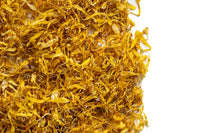
- Dried flower (with small leafy fragments often included)
- Method of cultivation
- Tall flowering perennial of the Rosaceae family (the rose family, related to strawberry and apple), native to Europe and Western Asia from Iceland south to Spain. The plant grows up to 1.2 metres tall, with deeply-cut leaves and dense plumes of creamy-white flowers in mid-summer. Thrives in moist soils — natural habitat is wet meadows and stream banks. Cultivation is small-scale; commercial supply is largely wild-harvested or from herb gardens.
- Commercial preparation
- Flowering tops are cut at peak bloom in mid-summer and gently dried at low temperatures to preserve the volatile compounds. The flowers retain their pale cream-yellow colour when properly dried.
- Non-culinary uses
- Foundational medicinal-herb ingredient in European herbalism — the source of the first isolation of salicylic acid in 1838 (which later became the basis for aspirin); the name "meadowsweet" derives from the plant's use in flavouring mead (the fermented honey drink); traditional flavouring in northern European herbal liqueurs.
Meadowsweet — Filipendula ulmaria — is a tall flowering perennial of the rose family, native to Europe and Western Asia from Iceland and the British Isles across to Russia and central Asia. The plant grows in damp meadows, stream banks and wet woodland, reaching up to 1.2 metres tall, with deeply-cut leaves and dense fluffy plumes of small creamy-white flowers in mid-summer. The flowers carry a distinctive honey-and-almond aroma — a combination of compounds including salicylates, benzaldehyde and coumarin — that has made the plant a foundational herb in European cottage gardens for centuries. [source]
Whole dried flower head
The standard form — slow-releasing in cool maceration.
Loose dried florets
Faster extraction.
Region of cultivation
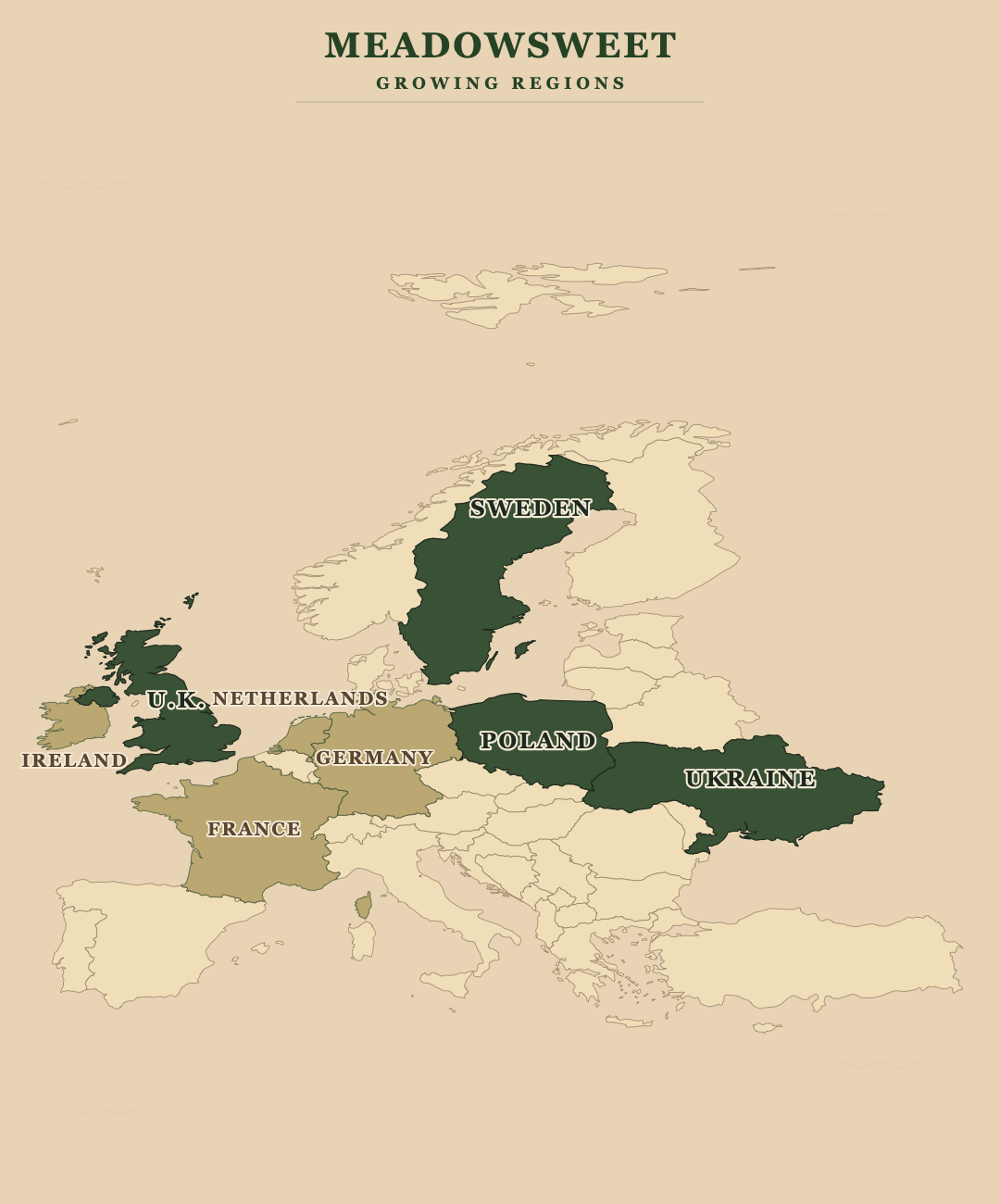
Meadowsweet is primarily cultivated in UK, Scandinavia, Eastern Europe, Russia, with secondary growing regions in Ireland, Germany, Netherlands, France.
Spice Story
Meadowsweet has accumulated several layers of historical importance. The plant's name comes directly from its historical use in flavouring mead (the fermented honey drink) — "meadowsweet" being a contraction of "mead-wort sweet." Medieval Europeans used the dried flowers as a strewing herb for floors (its honey-almond fragrance covered less pleasant household smells). Most importantly for modern medicine, salicylic acid was first isolated from meadowsweet in 1838, when it was still classified as Spiraea ulmaria — and Bayer's aspirin (acetylsalicylic acid) takes its name from this earlier genus name (a-cetyl + spir, from Spiraea). [source] In gin, meadowsweet has become a signature botanical in Scottish and Northern European craft expressions, providing honey-floral character with a distinctive almond undertone.
Gin Creativity
Meadowsweet brings honey-floral character with a soft almond background. A full sachet pushes a gin firmly into honeyed-floral territory; a half-sachet adds quiet sweet-floral depth that integrates with juniper. Pair with honey and chamomile for a wellness profile, or with rose petal and elderflower for a layered floral blend.
Blending Science
Main flavour compounds
 Salicylates—
 Benzaldehyde—
 Coumarin—
Pairs well with
Salicylates (precursors of salicylic acid) provide a faint medicinal-floral edge. Benzaldehyde (the same compound that defines almond character) contributes the marzipan-like background note. Coumarin (related to vanilla and hay aromatic) adds a sweet-grass depth. Cool extraction preserves the bright honey-floral top; warm extraction can develop bitterness from the salicylate compounds.
Food Partners
- Mead-style honey drinks — the original culinary use.
- Almond and stone-fruit desserts — meadowsweet's almond note doubles the effect.
- Honey-spiked custards — meadowsweet-infused crème anglaise.
- Soft fresh cheese — chèvre with meadowsweet honey.
- Cool summer salads — meadowsweet vinaigrette.
Cocktails To Try

- Scottish G&T — meadowsweet gin, floral tonic, fresh leaf garnish.
- Honey Sour — meadowsweet gin, honey, lemon, egg white.
- Floral Spritz — meadowsweet gin, prosecco, soda, fresh flower garnish.
Release The Flavour
- Cool extraction — preserves the bright honey-floral top.
- Brief contact — 30 minutes to 2 hours.
- Whole flowers — hold up better than crushed.
- Source matters — Scottish and Scandinavian wild-harvest is the premium grade.
Discover more
From the same region
Pairs well with
Same flavour family
Surprise me
Sources & Citations
- scientific_name (Filipendula ulmaria, Rosaceae):en.wikipedia.org/wiki/Filipendula_ulmaria
- european_native_range:en.wikipedia.org/wiki/Filipendula_ulmaria
- salicylic_acid_1838_isolation:www.wildfiregin.com/logbook/meadowsweet-a-floral-delight-...
- name_origin_mead_flavouring:www.wildfiregin.com/logbook/meadowsweet-a-floral-delight-...
- almond_flavour_in_flowers:www.eatweeds.co.uk/meadowsweet-filipendula-ulmaria
- scottish_gin_use:www.wildfiregin.com/logbook/meadowsweet-a-floral-delight-...
- main_flavour_compounds (CSV-sourced):inputs/source.csv — Meadowsweet row
