
SEA PARSLEY
- Botanical name
- Apium prostratum
- Also known as
- Sea Celery, Native Parsley, Native Celery
- Main flavour compound
- Phthalides (related to celery)
- Part used
- Dried leaf
- Method of cultivation
- Biennial or perennial herb of the Apiaceae family (the carrot/celery/parsley family), native to coastal Australia and New Zealand. The plant grows 0.5–1 metre tall in low ground-cover form, with broad or narrow divided shiny leaves that resemble common parsley but are thicker and saltier. The plant naturally grows along southern and eastern Australian coasts in sand dunes, headlands and along the foreshore, tolerating salty soils.
- Commercial preparation
- Leaves are harvested from cultivated or sustainable wild-harvested plants, gently dried, and sold whole or cracked. Most production is small-scale and bushfood-driven.
- Non-culinary uses
- Traditional Maori and Australian Aboriginal bushfood; foundational vegetable for early European explorers (Captain Cook collected sea celery at Botany Bay and Poverty Bay in 1769 to protect his crew from scurvy); ornamental ground-cover in coastal Australian gardens.
Sea Parsley — Apium prostratum, also called Sea Celery — is a biennial or perennial herb of the Apiaceae family (the same family as carrot, celery, parsley and coriander), native to coastal Australia and New Zealand. The plant grows 0.5–1 metre tall in a low ground-cover form, with shiny divided leaves that resemble common parsley but are thicker, saltier, and more peppery. [source] Sea Parsley naturally grows along southern and eastern Australian coasts and across Aotearoa New Zealand, in sand dunes and along salt-spray-exposed headlands.
Whole dried leaf
The standard form — crumble lightly to release the oils.
Cracked
Faster extraction.
Region of cultivation
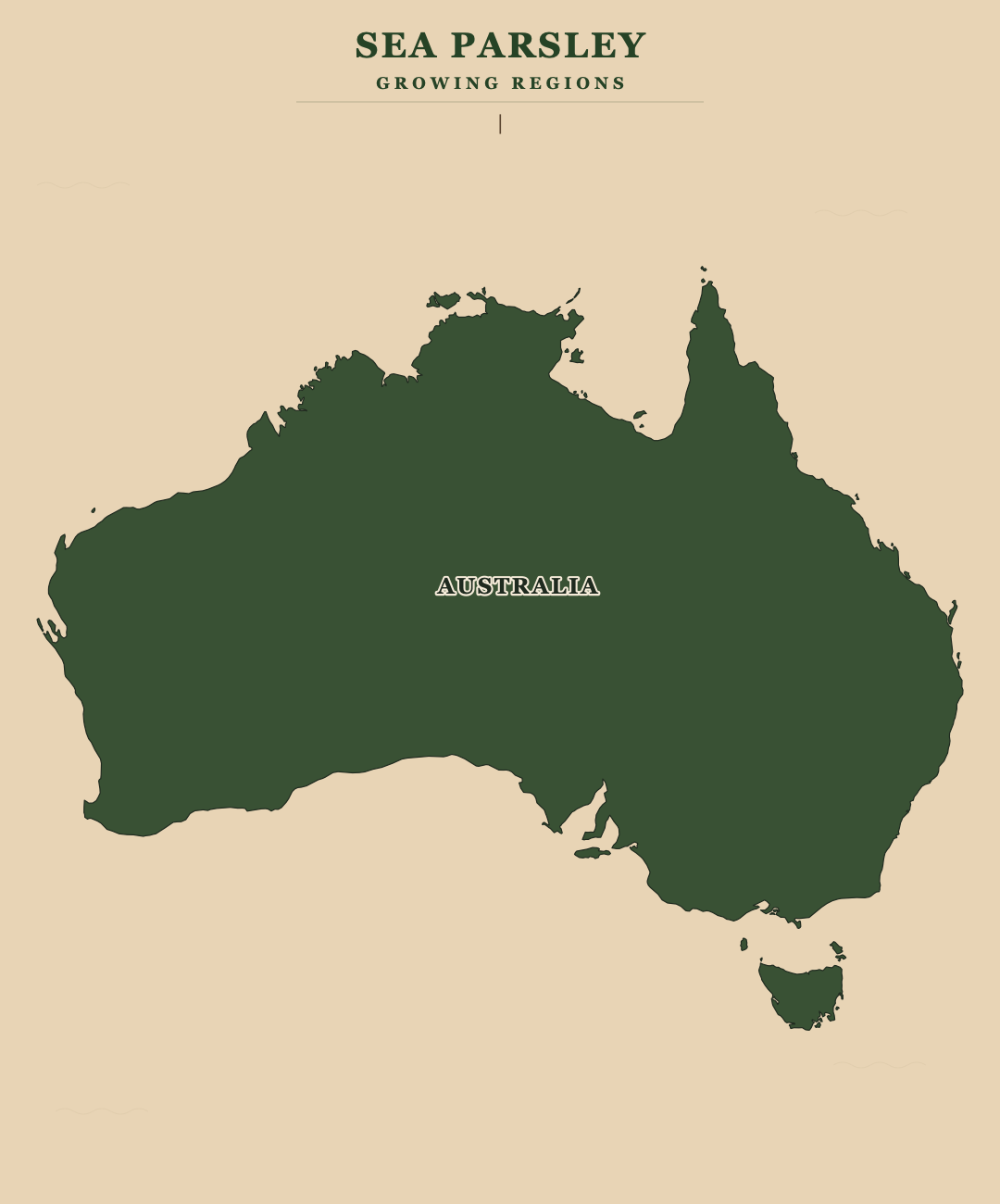
Sea Parsley is native to Australia, Australia — southern and eastern coastal areas; New Zealand, with secondary growing regions in Small-scale cultivation across coastal Australia. |
Spice Story
Sea Parsley has been a traditional bushfood for First Nations peoples across coastal Australia and Maori in New Zealand for tens of thousands of years. The plant's most famous European-history moment: Captain James Cook gathered substantial quantities at Botany Bay (1770) and at Poverty Bay, New Zealand (1769) — using the herb as an anti-scorbutic to protect his crew from scurvy on long sea voyages. [source] The plant remains foundational to coastal Indigenous Australian cuisine and increasingly appears in modern Australian native cooking. In gin, Sea Parsley provides genuine salty-coastal character that no imported parsley can match.
Gin Creativity
Sea Parsley brings salty-celery character with a peppery green edge. A full sachet pushes a gin firmly into clearly coastal-savoury territory; a half-sachet provides quiet salty-green depth that integrates with juniper. Pair with Saltbush and Lemon Myrtle for a fully coastal Australian profile, or with celery seed and dill for a Bloody-Mary-leaning blend.
Blending Science
Main flavour compounds
 Phthalides (related to celery)—
 Apioleparsley, musky-green
 Volatile aldehydes—
Pairs well with
Phthalides (related to those in common celery) provide the characteristic savoury-celery aromatic. Apiole (the Apiaceae-family signature compound) contributes a slightly bitter green note. Volatile aldehydes provide the fresh green-leaf top. Cool extraction preserves the bright green character.
Food Partners
- Native fish and seafood — Sea Parsley with grilled native fish.
- Coastal seaweed-and-celery dishes — Sea Parsley with wakame and samphire.
- Cool summer salads — Sea Parsley as a peppery garnish.
- Bloody-Mary-style cocktails — Sea Parsley with saltbush.
- Bush-style stuffings — Sea Parsley in native-herb poultry stuffing.
Cocktails To Try

- Coastal Bloody Mary — Sea Parsley-and-saltbush gin, tomato, lemon.
- Native G&T — Sea Parsley gin, native tonic, fresh coastal-herb garnish.
- Bush Gimlet — Sea Parsley gin, lime cordial, native lemon-myrtle.
Release The Flavour
- Cool extraction — preserves the bright green character.
- Brief contact — 1–4 hours.
- Pair with native botanicals — reinforces an explicitly Australian coastal profile.
- Source matters — sustainable Australian bushfood production is the standard.
Discover more
Pairs well with
Same flavour family
Surprise me

Sources & Citations
- scientific_name (Apium prostratum, Apiaceae):en.wikipedia.org/wiki/Apium_prostratum
- native_to_coastal_australia_nz:aussiegreenthumb.com/sea-parsley-apium-prostratum/
- captain_cook_scurvy_use_1769_1770:www.sgaonline.org.au/sea-celery-an-indigenous-edible-plant/
- salty_celery_parsley_flavour:warndu.com/blogs/first-nations-food-guide/sea-parsley-par...
- main_flavour_compounds (CSV-sourced):inputs/source.csv — Sea Parsley row
