
CELERY SEED

- Botanical name
- Apium graveolens
- Also known as
- Smallage seed, Wild celery seed, Ajwain-ka-patta seed (Indian)
- Main flavour compound
- Phthalides (3-n-butylphthalide, sedanolide)
- Part used
- Dried fruit (commonly called the seed; technically the achene of the celery plant)
- Method of cultivation
- Biennial herb of the Apiaceae family — the same family as carrot, parsley, fennel and coriander — native to the Mediterranean and Middle East. Modern celery is bred for thick, juicy stems; celery seed is harvested from a different, older variety called *smallage* or wild celery, which produces small wiry stems and abundant aromatic seeds. The plant flowers in its second year and the seeds are harvested at maturity.
- Commercial preparation
- Seed heads are harvested when fully ripe but before shedding, dried gently, threshed, and cleaned. India and France are the primary commercial producers. Seed is sold whole or ground, sometimes as part of "celery salt" blends.
- Non-culinary uses
- Traditional medicine across Europe, the Middle East and South Asia for digestive complaints, joint pain and as a mild diuretic; the essential oil is used in perfumery as a savoury-aromatic ingredient.
Celery seed comes from the same species as common kitchen celery — Apium graveolens — but from a different cultivar group. Modern stem celery has been bred for thick, juicy crisp stems at the expense of seed production; celery seed is harvested instead from smallage or wild celery, which produces small wiry plants and abundant tiny brown seeds. The plant is a biennial of the Apiaceae family, growing about a metre tall in its second year with feathery leaves and umbels of small white-green flowers ripening to the familiar small ridged seeds. Botanist Carl Linnaeus first described the species formally in 1753. [source]
Whole dried seed
The standard form — bruise lightly before use to release the oils.
Ground
Faster extraction but loses the volatile phthalide compounds within months.
Region of cultivation
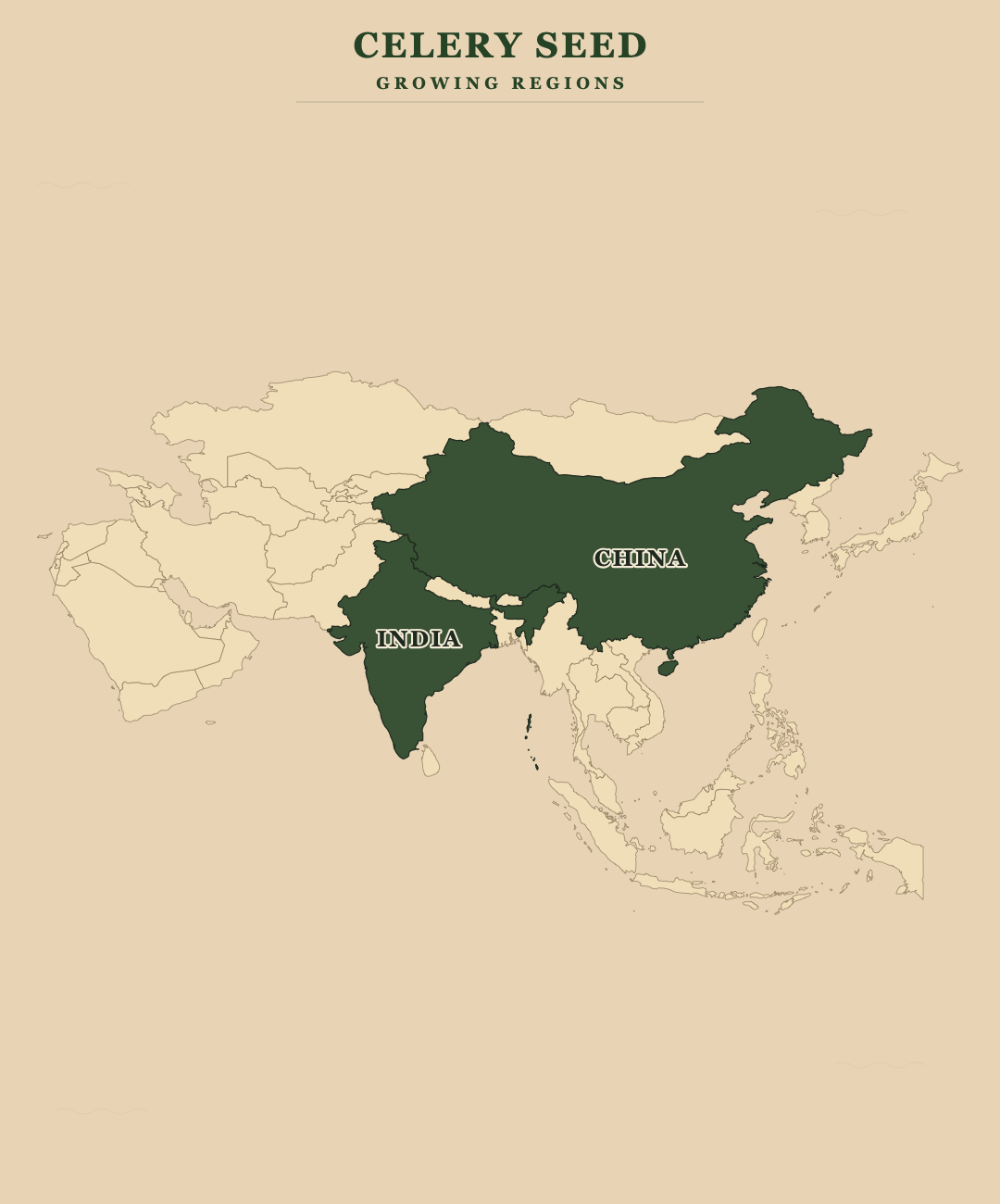
Celery Seed is primarily cultivated in India, France, China, with secondary growing regions in USA, Netherlands, Egypt.
Spice Story
Celery has been cultivated around the Mediterranean and Middle East for more than 3,000 years — wild celery was used by the Egyptians for funerary garlands, by the Greeks as a medicinal herb, and by the Romans as both food and flavouring. The shift from celery-as-seed-spice to celery-as-stem-vegetable came in the 17th–18th centuries in Italy and France, where breeders selected for the thick, sweet, blanched stems that we now think of when we hear the word "celery". Celery seed retained its older spice role and remains foundational to French quatre épices blends, American Old Bay seasoning, and the entire Bloody Mary tradition. In craft gin, celery seed has appeared as a contemporary savoury botanical, often alongside caraway and coriander for a fresh-vegetable register that pairs particularly well with juniper-forward London Drys.
Gin Creativity
Celery seed brings a quietly savoury, earthy-warm depth that is unusual among gin botanicals. A full sachet pushes a gin into clearly savoury territory and pairs naturally with caraway and dill for a Bloody-Mary-style gin; a half-sachet adds a quiet background that integrates with traditional London Dry juniper without dominating. It works particularly well alongside coriander seed (the two share the Apiaceae family chemistry) and lemon peel for contemporary balance. Avoid combining with very heavy spices — celery's restrained character disappears.
Blending Science
Main flavour compounds
 Phthalides (3-n-butylphthalide, sedanolide)—
 Apioleparsley, musky-green
 Limoneneclean citrus lift
Pairs well with
- Caraway
- Coriander seed
- Dill
- Black pepper
- Lemon peel
The defining compounds are the phthalides — especially 3-n-butylphthalide and sedanolide — a class of compounds essentially unique to celery and its close relatives. These phthalides carry the characteristic savoury-earthy character that no other spice provides. [source] Apiole layers a slightly aniseed-medicinal background. Limonene adds a faint citrus brightness. Phthalides are alcohol-soluble and survive both vapour infusion and traditional maceration cleanly; long extraction emphasises the savoury depth, short cool extraction preserves the brighter top notes.
Food Partners
- Bloody Mary mix: Celery seed and tomato — a foundational pairing in any Bloody Mary spec.
- Coleslaw and slaw dressings: Celery seed in the dressing balances sweet-creamy cabbage.
- Pickled vegetables: Especially cabbage, beetroot and onion — celery seed in the pickle.
- Roast pork and chicken: Celery seed in the dry rub or in the gravy.
- Cream-of-celery soup: Doubling up on the celery character.
Cocktails To Try

- Bloody Mary: Celery-seed gin, tomato, lemon, horseradish — the textbook savoury cocktail.
- Celery Salt-rimmed Martini: Classic dry Martini with a celery-salt rim.
- Caesar (Canadian Bloody Mary): Celery-gin, clamato, hot sauce, celery salt rim.
Release The Flavour
- Bruise lightly: Releases the phthalides without bitterness.
- Heat-tolerant: Phthalides are heat-stable; vapour and maceration both work.
- Time: Celery character builds slowly; 24–48 hours for full development.
- Whole seed: Holds character much longer than ground product.
Discover more
From the same region


Pairs well with
Same flavour family
Surprise me

Sources & Citations
- scientific_name (Apium graveolens, Apiaceae):en.wikipedia.org/wiki/Celery
- Linnaeus_first_description_1753:en.m.wikipedia.org/wiki/Apium_graveolens
- phthalides_as_key_aromatic_compounds:www.ncbi.nlm.nih.gov/pmc/articles/PMC8227241/
- native_range (Mediterranean, Middle East):en.wikipedia.org/wiki/Celery
- main_flavour_compounds (CSV-sourced):inputs/source.csv — Celery Seed row
