
CHERRY

- Botanical name
- Prunus avium
- Also known as
- Sweet Cherry, Wild Cherry, Gean, Bird Cherry (UK regional)
- Main flavour compound
- Benzaldehyde
- Part used
- Fruit
- Method of cultivation
- A mid-size deciduous tree, typically 10–15 metres in cultivation, that thrives in temperate, well-drained soils across Europe, Anatolia, and the Caucasus. [source: https://en.wikipedia.org/wiki/Cherry] Commercial orchards use semi-dwarf rootstocks for ease of harvest; trees bear fruit from their third or fourth year and reach full production around year seven. [source: https://en.wikipedia.org/wiki/Cherry]
- Commercial preparation
- Sweet cherries are hand-picked or mechanically shaken at full colour and processed quickly — fresh, frozen, or pitted and dried. Turkey is the world's leading producer, accounting for roughly 28% of global output (approximately 725,000 tonnes in 2020), followed by the United States, Chile, and Uzbekistan. [source: https://en.wikipedia.org/wiki/Cherry]
- Non-culinary uses
- Cherry wood is a fine furniture timber valued for its warm grain; the fruit's anthocyanins provide a natural deep-red dye; blossom is widely ornamental, and the cherry is a quintessential street and garden tree across East Asia and Europe.
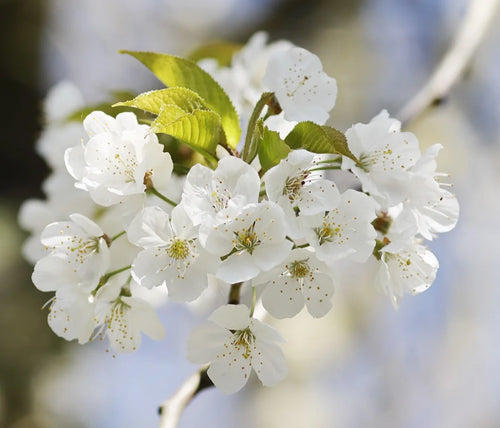
Sweet cherry — Prunus avium — is the full-size deciduous tree of European hedgerows and orchards: upright, reaching 10–15 metres in cultivation, with shiny bronze-grey bark and a canopy of serrated, ovate leaves that turn flame-orange in autumn. [source] White five-petalled blossom arrives in early spring before the leaves — spectacular, short-lived, and beloved by pollinators. By midsummer the fruit hangs in pairs on long stalks: small, glossy globes ripening from amber to deep red to near-black depending on cultivar. A young tree waits three to four years before it yields its first harvest, and another few before it hits full stride. [source]
Fresh pitted
Maximum juicy freshness; muddle or steep whole in spirit and keep the contact short.
Frozen
Cell walls rupture on thawing, releasing juice quickly — ideal for a fast, vibrant infusion.
Dried whole / pitted
Concentrated sweetness and colour; rehydrate or macerate directly in spirit.
Region of cultivation
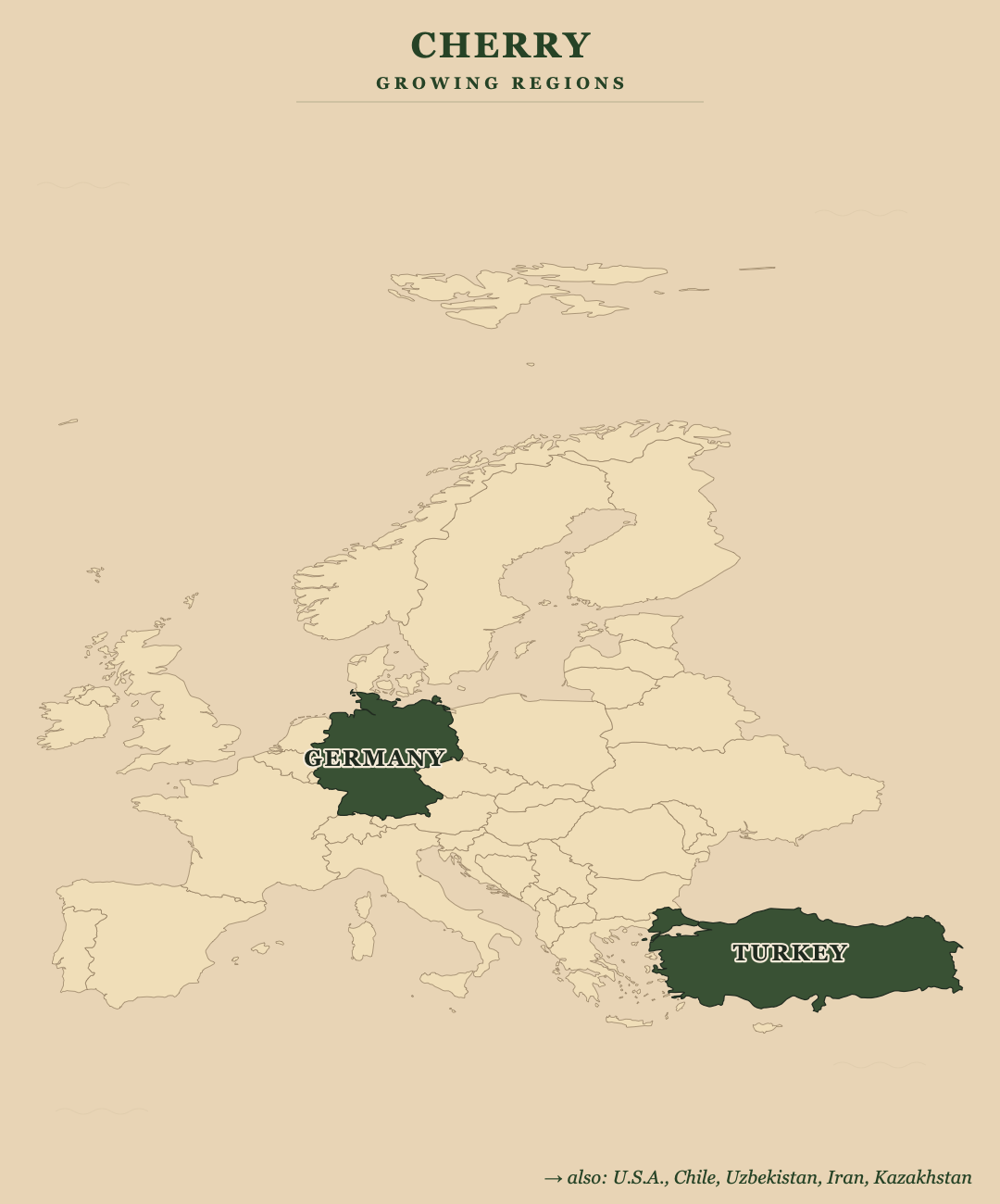
Cherry is primarily cultivated in Turkey, Europe, with secondary growing regions in United States, Chile, Uzbekistan, Iran, Central Asia.
Spice Story
The word "cherry" carries the weight of an ancient journey. The English name traces back through Old Northern French cherise to Latin cerasum — itself the name of a coastal town in the Pontus region of northeastern Anatolia (present-day Giresun, Turkey), from where the Romans believed the cherry first arrived in Europe. [source] In 72 BCE, the Roman general Lucius Licinius Lucullus is said to have brought cultivated cherries from that same Pontus coast back to Rome after his campaigns — a tradition recorded by Pliny the Elder in Natural History Book XV. [source] In reality the tree's genetic home is the Caucasus and surrounding highlands, and it had likely been growing wild across Europe long before any consul planted it. Turkey still leads the world in production today, harvesting roughly 28% of global output. [source]
The cherry's shadow falls over two of the great spirits traditions. Kirsch (Kirschwasser) is distilled from fermented morello cherries (Prunus cerasus) in Germany's Black Forest and the Swiss and Alsatian valleys across the Rhine — its earliest documented reference a 1726 decree of the Bishop of Strasbourg. [source] Maraschino liqueur comes from the small, intensely aromatic Marasca cherry (P. cerasus var. marasca) of the Dalmatian coast; Luxardo has made it by the same method in northern Italy since 1821. [source] Both traditions depend on the pit as much as the fruit: the crushed stone releases benzaldehyde — the cherry-almond compound — into the spirit. In gin, sweet cherry (P. avium) does the same thing without any help from the distiller.
Gin Creativity
Cherry's role in a gin is all about balance: you're chasing the almond-sweet fruit note without tipping into cordial. A full sachet makes cherry the headline — warm, ripe, and stone-fruit forward, wonderful with juniper's pine and cardamom's spice. A half-dose layers quietly under a citrus gin, adding a soft sweetness and a suggestion of flowers. Try it alongside orange peel for a classic festive profile, or push it against almond to deepen the marzipan end of the spectrum.
Blending Science
Main flavour compounds
 Benzaldehyde—
 Hexanal—
 (E)-2-Hexenal—
 beta-Ionone—
Pairs well with
Cherry's aroma is built on four collaborating odorants. Benzaldehyde is the one you recognise — the cherry-almond character that comes from amygdalin naturally present in the fruit and its stone; it's the defining marker of both the raw fruit and the spirits made from it. [source] Hexanal and (E)-2-hexenal bring the fresh, cut-fruit greenness that makes a ripe cherry smell like something just pulled from the branch — both rank among the highest OAV compounds across cultivars. [source] β-Ionone completes the picture with a violet, softly woody-floral depth; it recorded the single highest OAV in the study (over 800 in the 'Honyang' cultivar), punching far above its quiet concentration. [source] In spirit, cool maceration protects all four; hard heat dissolves the fresh-green lift and leaves only the sweeter, heavier almond note behind.
Food Partners
- Dark chocolate: the classic pairing — benzaldehyde's almond sweetness cuts right through dark bitter cocoa.
- Duck confit and game: cherry's tart-sweet fruit has enough body to stand beside rich gamey meat.
- Almond frangipane: deepens the marzipan register already present in the gin.
- Soft cheeses: mild brie and chèvre love the sweet-tart counterpoint of cherry.
- Cream desserts: a cherry-forward gin poured over vanilla ice cream or panna cotta is a simple, devastating move.
- Stone-fruit crumble: peach, nectarine, or plum — cherry's β-ionone floral note bridges orchard fruits beautifully.
Cocktails To Try

- Cherry G&T: a cherry-forward gin with good-quality tonic, a few fresh cherries and a strip of orange peel — simple, seasonal, vivid.
- Greenalls Black Cherry Gin and tonic: a London Dry base infused with natural black cherries, best served with Mediterranean tonic and lemon — an approachable, supermarket-accessible way into the style. [source]
- Aviation cocktail connection: maraschino liqueur (the cherry-adjacent classic) appears in the Aviation — gin, lemon, crème de violette, maraschino — where the almond-floral note of cherry and violet work in near-perfect sympathy.
Release The Flavour
- Heat: keep maceration cool and short — gentle steeping protects benzaldehyde's delicate almond lift; hard heat or prolonged warmth flattens the fresh-green top notes.
- Alcohol: a 40–45% base spirit pulls the aromatic compounds efficiently; lower-ABV macerations over longer periods can work but risk muddiness.
- Time: whole fresh cherries release their best in 12–48 hours; dried fruit can go longer. Always taste at intervals — cherry turns jammy if over-extracted.
- Stone: if using whole fruit, leaving the stone in adds benzaldehyde and deepens the almond note; remove pits for a purer, lighter fruit character.
Discover more

Pairs well with
Same flavour family
Surprise me

Sources & Citations
- scientific_name (Prunus avium (L.) L., ACCEPTED, Rosaceae):GBIF Backbone Taxonomy, usageKey 3020791 — api.gbif.org/v...
- native_range (Europe, Anatolia, Maghreb, Western Asia, British Isles to Caucasus):en.wikipedia.org/wiki/Prunus_avium
- plant_form, cultivation (tree height, fruiting at 3–4 yrs, full maturity 7 yrs, mechanical shaker harvesting):en.wikipedia.org/wiki/Cherry
- top_producing_countries (Turkey 28% / ~725,000 t, US, Chile, Uzbekistan — 2020 FAO data):en.wikipedia.org/wiki/Cherry
- origin_locality (Caucasus / Pontus / NE Anatolia as centre of diversity):en.wikipedia.org/wiki/Prunus_avium (Distribution and habi...
- word_cherry_etymology (Old Northern French 'cherise' from Latin 'cerasum' → Giresun/Kerasous, Turkey):en.wikipedia.org/wiki/Cherry
- Lucullus bringing cherry to Rome from Pontus, 72 BCE:en.wikipedia.org/wiki/Cherry (states 'A cultivated cherry...
- benzaldehyde_as_character_impact (from amygdalin hydrolysis; main contributor):Baldoni et al. 2023, Frontiers in Plant Science review — ...
- benzaldehyde_FD_factor (FD=32 in 'Bing' Prunus avium; high aroma value):Sun et al. 2010, Flavour and Fragrance Journal DOI 10.1002/ffj.1994 (cited in Wen et al. 2014)
- compounds_top_OAV (beta-ionone OAV >800 in 'Honyang'; hexanal, decanal, (E)-2-hexenal also top; 18 compounds OAV>1):Wen et al. 2014, Food Chemistry, DOI 10.1016/j.foodchem.2...
- benzaldehyde_hexanal_major_free_volatiles (alongside (E)-2-hexenal, (E)-2-hexen-1-ol, benzyl alcohol):Wen et al. 2014, Food Chemistry, DOI 10.1016/j.foodchem.2...
- pubchem_cids (benzaldehyde 240, hexanal 6184, trans-2-hexenal 5281168, beta-ionone 638014):PubChem compound name lookup — pubchem.ncbi.nlm.nih.gov/
- kirsch_made_from_sour_cherry (Prunus cerasus morello; Black Forest / Alsace / Switzerland; ~1726 first record):en.wikipedia.org/wiki/Kirsch
- maraschino_Marasca_cherry (P. cerasus var. marasca; Zara/Zadar; Luxardo from 1821):en.wikipedia.org/wiki/Maraschino ; mycocktailrecipes.com/...
- Greenalls_Black_Cherry_Gin:www.greenallsgin.com/greenalls-gin-range/black-cherry-gin/
