
APPLE

- Botanical name
- Malus domestica
- Also known as
- Orchard apple, Dessert apple, Cultivated apple
- Main flavour compound
- Ethyl 2-methylbutanoate
- Part used
- Fruit
- Method of cultivation
- A deciduous tree growing 2–4.5 metres tall in cultivation, with five-petalled spring blossoms and fruit ripening from late summer into autumn across temperate regions. [source: https://en.wikipedia.org/wiki/Apple] More than 7,500 named cultivars exist worldwide, bred for sweetness, acidity, texture and flavour — from sharp Bramley cookers to aromatic Cox Orange Pippins. [source: https://en.wikipedia.org/wiki/Apple]
- Commercial preparation
- Dessert apples are harvested ripe and used fresh, pressed to juice, or fermented to cider before any distillation step. In gin production the fruit is used either as a fresh maceration ingredient, as a vapour-infused botanical, or as the base spirit itself — as at Chase Distillery in Herefordshire, where 48 cider-apple varieties are fermented then redistilled with botanicals. [source: https://en.wikipedia.org/wiki/Chase_Distillery]
- Non-culinary uses
- Apple blossom is used in perfumery for light, green-floral accords; fruit extracts appear in cosmetics and skincare; the timber is prized for woodworking and smoking food.
Apple — Malus domestica — is the orchard tree you already know: a deciduous spreader growing 2 to 4.5 metres tall in cultivation, bursting into white-to-pink five-petalled blossom in spring, and hanging heavy with fruit from late summer into autumn. [source] Its wild ancestor is Malus sieversii, which still grows in fragmented forests in the Tian Shan mountains of southeastern Kazakhstan — trees up to 10 metres tall with fruit nearly indistinguishable from a modern Golden Delicious. [source] Over 7,500 named cultivars exist today, bred for sweetness, acidity, crunch, and keeping quality. [source]
Fresh sliced
Crisp apple slice or core added to still pot or maceration jar — delivers the green, juicy top notes directly.
Dried rings or chips
Concentrated sweetness with less green-aldehyde lift; longer shelf life, easier to portion.
Apple juice / fresh-pressed
Easy way to introduce ester-led apple character into a maceration without adding fruit solids.
Cider (fermented)
A step up — fermentation transforms sugars into complex esters; base for an apple-spirit gin like Chase Elegant 48.
Region of cultivation
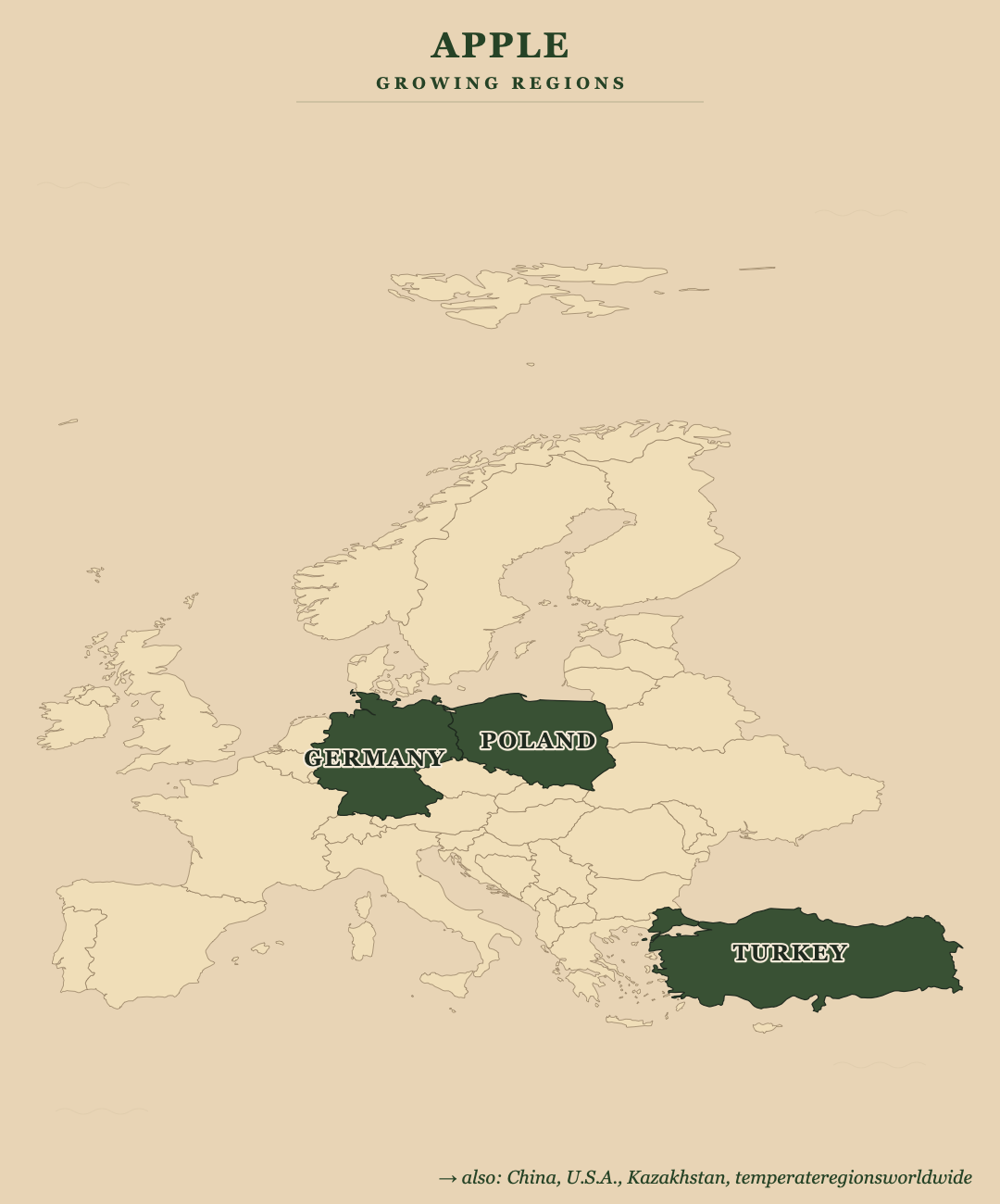
Apple is primarily cultivated in China, United States, Turkey, Poland, Europe, with secondary growing regions in Central Asia, temperate regions worldwide.
Spice Story
The apple's journey from wild mountain fruit to the world's most-grown tree fruit is one of the great botanical road trips. Domestication happened in the first millennium BCE — over fewer than 100 generations of selection — in the Tian Shan foothills, where early biologist Nikolai Vavilov traced the genome back to wild groves near modern Almaty. [source] From there, apple travelled the Silk Road westward, hybridising with European crabapples (M. sylvestris) along the way to produce the diversity we know today. [source] By 2023, global production had reached 97.3 million tonnes — with China alone producing 49.6 million tonnes, more than half the world's supply. [source] In distilling, apple is either a fresh botanical, a vapour companion, or the base spirit itself — fermented to cider and then redistilled, as at Chase Distillery in Herefordshire, where the Elegant 48 gin draws its body from 48 cider-apple varieties. [source]
Gin Creativity
Apple is one of those botanicals that can play any role in a gin bill. A full sachet pushes your spirit into unmistakably orchard territory — fresh, crisp, sweetly fruity, great with tonic and a green apple garnish. A partial amount sits in the background as a quiet roundness that softens the sharper juniper and citrus edges without shouting "fruit gin." Try it alongside elderflower for an English-country feel, or cinnamon and cardamom for a spiced autumn bottle that leans toward mulled warmth.
Blending Science
Main flavour compounds
 Ethyl 2-methylbutanoate—
 Hexyl acetate—
 (E)-2-Hexenal—
 beta-Damascenone—
Pairs well with
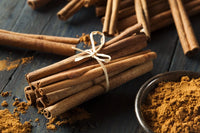
- Cinnamon
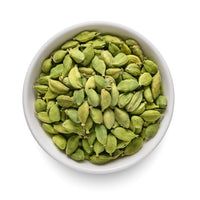
- Cardamom
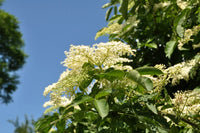
- Elderflower
- Lemon peel
- Vanilla
- Ginger
Apple's aroma is driven by four high-OAV compounds. Ethyl 2-methylbutanoate is the headline — reaching an extraordinary OAV of 1988 in ripe apple peel, it delivers the pure "green apple" ester hit that the nose recognises immediately. [source] Hexyl acetate (OAV 97–269) adds a broader fruity, sweet, slightly green note that rounds the profile and makes the apple smell ripe rather than sharp. [source] (E)-2-Hexenal (OAV 73–293) is the crisp, cut-grass freshness you get when a knife goes through the flesh — it's the "just-picked" signal. [source] β-Damascenone sits in the background at OAV 23, but its extreme potency adds depth — a cooked-apple, faintly rose-like warmth that stops the profile from reading as simple juice. [source] High-proof spirit extracts the esters quickly; water kills the green-aldehyde edge first, so diluting your macerate shifts the profile from crisp to mellow.
Food Partners
- Aged cheddar: salt and fat in the cheese flatter the sweet ester top notes — the classic ploughman's pairing.
- Pork and charcuterie: apple's acidity cuts rendered fat and brings the meat's sweetness forward.
- Caramel and toffee desserts: β-damascenone's cooked-apple depth bridges gin into toffee apple territory.
- Walnuts and hazelnuts: nutty bitterness sets off the ester brightness beautifully.
- Blue cheese: the sweetness of apple checks the funk; think Stilton with Calvados.
- Roast duck: fruit cuts through rich poultry in the same way it does pork — proven pairing logic.
Cocktails To Try

- Apple G&T: the simplest showcase — apple-forward gin over ice with quality tonic and a green apple slice. The esters sing with the quinine's bitterness.
- Chase Elegant 48 & Soda: William Chase's cider-base gin is so apple-inflected it barely needs a mixer — long, clean, orchard-fresh. [source]
- Caorunn Highball: Caorunn's Coul Blush Apple (grown in Ross-Shire since 1827) gives it a sweet aromatic lift — try over ice with ginger ale. [source]
- Apple Negroni riff: swap your usual gin for an apple-botanical gin and replace Campari with Calvados — the apple-citrus-bitter triangle works beautifully.
Release The Flavour
- Heat: a warm maceration (50°C) unlocks the esters quickly, but also softens the green-aldehyde freshness — decide which character you want before reaching for heat.
- Alcohol: high ABV (above 60%) pulls the aromatic esters fast; lower-proof extraction gives softer, juicier apple at the cost of the crisp green edge.
- Time: fresh apple gives its brightest, most aromatic character in 12–24 hours; beyond 48 hours the profile turns rounder and more oxidised.
- Water: diluting the macerate diminishes (E)-2-hexenal first — the green, cut-apple note fades and the sweeter ester character takes the lead.
Discover more
From the same region
Pairs well with
Same flavour family
Surprise me

Sources & Citations
- scientific_name (Malus domestica (Suckow) Borkh., ACCEPTED, Rosaceae):GBIF Backbone Taxonomy, usageKey 3001244 — api.gbif.org/v...
- plant_form (deciduous tree 2–4.5 m, spring flowers, 7,500+ cultivars, late-summer fruit):en.wikipedia.org/wiki/Apple
- wild_ancestor_origin (Malus sieversii, Tian Shan mountains, SE Kazakhstan, Silk Road dispersal):Wikipedia Apple article — en.wikipedia.org/wiki/Apple ; D...
- domestication_timeline (first millennium BCE, less than 100 generations):Dillard (2019) Frontiers in Plant Science — pmc.ncbi.nlm....
- world_production_2023 (97.3 Mt global; China 49.6 Mt / 51%; US 5.2 Mt; Turkey 4.6 Mt; Poland 3.9 Mt):en.wikipedia.org/wiki/Apple
- commercial_preparation_Chase (Chase Distillery 48 cider-apple varieties, cider-to-gin base):en.wikipedia.org/wiki/Chase_Distillery
- compound_ethyl_2_methylbutanoate (OAV 1988 at full ripeness; fruity, green apple; CID 24020):Evaluation of volatile compounds in 'Orin' apple at diffe...
- compound_hexyl_acetate (OAV 97–269; fruity, green, sweet; CID 8908):SBSE-GC-O-MS apple aroma fingerprint study — pmc.ncbi.nlm...
- compound_e2hexenal (OAV 73–293; green; CID 5281168):SBSE-GC-O-MS apple aroma fingerprint study — pmc.ncbi.nlm...
- compound_beta_damascenone (OAV 23; cooked apple/rose; CID 5366074):SBSE-GC-O-MS apple aroma fingerprint study — pmc.ncbi.nlm...
- gin_caorunn_coul_blush_apple (Coul Blush Apple, Ross-Shire since 1827, sweet aromatic):www.caorunngin.com/about-us/gin-botanicals
- gin_nikka_coffey_apple (apple botanical, 11 botanicals, Coffey still):nikka.com/en/brands/coffey-gin-vodka/
- gin_chase_elegant_48 (Bramley apple in botanical bill, apple-cider base distillation):en.wikipedia.org/wiki/Chase_Distillery
