
ROSALINA

- Botanical name
- Melaleuca ericifolia
- Also known as
- Swamp Paperbark, Heath Melaleuca, Lavender Tea Tree
- Main flavour compound
- Linalool
- Part used
- Dried leaf and twig
- Method of cultivation
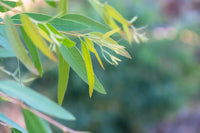
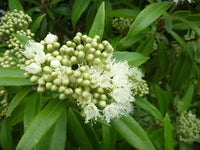
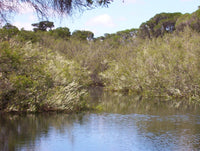
- Tall, dense shrub or small tree of the Myrtaceae family, native to south-eastern Australia. The plant grows up to 9 metres tall, with pale white or brownish papery bark (the "Swamp Paperbark" common name) and dark green linear leaves. Tolerates permanently wet soil, salt, coastal exposure, shade and moderate frost — a remarkably hardy plant. The Rosalina chemotype is distinguished by high linalool content (the same compound that defines coriander seed and lavender), giving it a softer, more floral character than common tea tree.
- Commercial preparation
- Leaves and twigs are harvested by coppicing or selective cutting, gently dried, and either sold whole or steam-distilled for essential oil. The oil is exceptionally gentle and non-irritating, making it popular in natural skin care.
- Non-culinary uses
- Natural cosmetics and skincare (Rosalina is highly valued for being gentle on sensitive skin); aromatherapy; ornamental tolerant of wet and coastal conditions.
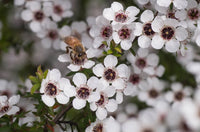
Rosalina — Melaleuca ericifolia, the Swamp Paperbark — is a tall dense shrub or small tree of the Myrtaceae family, native to south-eastern Australia. The plant grows up to 9 metres tall, with pale papery bark and dark green linear needle-like leaves, naturally growing in swampy and seasonally-wet country. [source] The defining feature is the essential-oil chemistry: Rosalina's high linalool content gives it a softer, more floral character than common tea tree, earning it the alternative name "lavender tea tree."
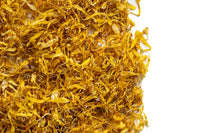
Whole dried leaf and twig
Crumble lightly to release the oils.
Cracked
Faster extraction.
Region of cultivation
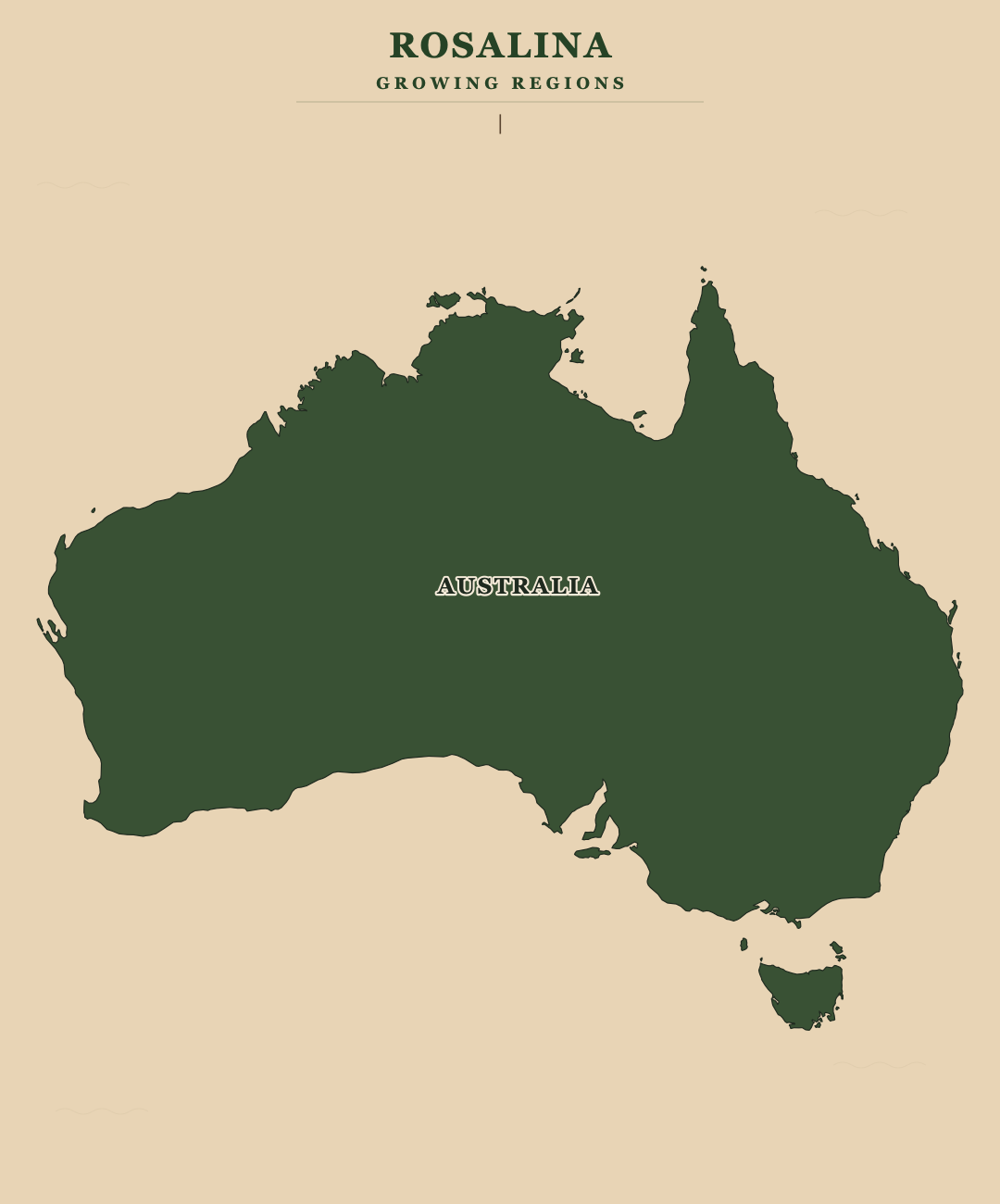
Rosalina is native to Australia, Australia — south-eastern Australia, coastal NSW, Victoria, Tasmania, with secondary growing regions in Plantation cultivation across temperate eastern Australia. |
Spice Story
Rosalina is one of the gentler members of the commercial Australian Melaleuca family. While most Melaleucas (including the common tea tree M. alternifolia) have terpinen-4-ol-dominated essential oils with characteristically medicinal character, Rosalina's high linalool content shifts its profile firmly into floral territory. The oil is valued in natural cosmetics for its gentleness on sensitive skin. In gin, Rosalina provides a quietly Australian floral character that doesn't compete with juniper.
Gin Creativity
Rosalina brings soft floral-tea-tree character. A full sachet pushes a gin into clearly Australian floral territory; a half-sachet provides quiet floral depth that integrates with juniper. Pair with Lemon Myrtle and Honey Myrtle for a native-floral profile, or with Lavender for layered linalool character.
Blending Science
Main flavour compounds
 Linaloolfloral, soft
 1,8-Cineoleeucalyptus, cool
 Alpha-Pinenefresh pine, top note
Pairs well with
Linalool dominates the Rosalina chemotype — providing the soft floral character familiar from coriander seed and lavender. 1,8-Cineole layers a cool eucalypt edge. Alpha-pinene adds a resinous backbone that bridges to juniper. Cool extraction preserves the bright linalool.
Food Partners
- Native floral cocktails — Rosalina with Lemon Myrtle and Honey Myrtle.
- Honey-floral desserts — Rosalina-honey syrup.
- Cool summer drinks — Rosalina cordial.
- Floral teas — Rosalina as a tea ingredient.
- Soft cheese — chèvre with Rosalina-honey.
Cocktails To Try

- Native Floral Spritz — Rosalina gin, prosecco, soda.
- Bush Garden G&T — Rosalina gin, floral tonic.
- Lavender-Rosalina Sour — Rosalina-lavender gin, honey, lemon.
Release The Flavour
- Cool extraction — preserves the linalool.
- Crumble gently — releases the volatile oils.
- Time — 24 hours for full development.
- Pair with native botanicals — reinforces a clearly Australian profile.
Discover more
From the same region
Pairs well with

Same flavour family
Surprise me

Sources & Citations
- scientific_name (Melaleuca ericifolia, Myrtaceae):en.wikipedia.org/wiki/Melaleuca_ericifolia
- south_eastern_australian_native:en.wikipedia.org/wiki/Melaleuca_ericifolia
- high_linalool_chemotype (Rosalina):biologyinsights.com/how-to-grow-and-care-for-rosalina-plant/
- gentle_non_irritating_oil:biologyinsights.com/how-to-grow-and-care-for-rosalina-plant/
- tolerates_wet_salt_frost:easyscape.com/species/Melaleuca-ericifolia(Swamp-Paperbark)
- main_flavour_compounds (CSV-sourced):inputs/source.csv — Rosalina row
