
TARRAGON

- Botanical name
- Artemisia dracunculus
- Also known as
- French tarragon (premium culinary), Russian tarragon (milder), Estragon
- Main flavour compound
- Estragole (methyl chavicol)
- Part used
- Dried leaf
- Method of cultivation
- Perennial herb of the Asteraceae family (the daisy/sunflower family, same as wormwood and mugwort — also genus *Artemisia*), widespread in the wild across Eurasia and North America. Two main cultivated varieties: **French tarragon** (*A. dracunculus* var. *sativa*) — the premium culinary form, rarely produces seeds (propagated by cuttings or division), highest estragole content — and **Russian tarragon** (*A. dracunculus* var. *inodora*) — hardier and seed-grown but with milder flavour. French is the gin-quality grade.
- Commercial preparation
- Leaves harvested at peak season, gently dried, and either sold whole or cracked. French tarragon production centres on France, Spain and Italy.
- Non-culinary uses
- Foundational French culinary herb (Béarnaise sauce, fines herbes, vinegar production); essential oil for perfumery; traditional medicine across European herbalism for digestion.
Tarragon — Artemisia dracunculus — is a perennial herb of the Asteraceae family (the daisy family, same genus as wormwood and mugwort). The plant grows about 1.5 metres tall, with narrow linear leaves and small greenish-yellow flowers. [source] Two main cultivated varieties exist: French tarragon (the premium culinary grade with intense estragole-driven anise flavour, propagated only by cuttings or division) and Russian tarragon (hardier and seed-grown but with much milder flavour). The species name dracunculus — "little dragon" — refers to the plant's coiled serpentine roots.
Whole dried leaf
The standard form — crumble lightly to release the oils.
Cracked
Faster extraction.
Region of cultivation
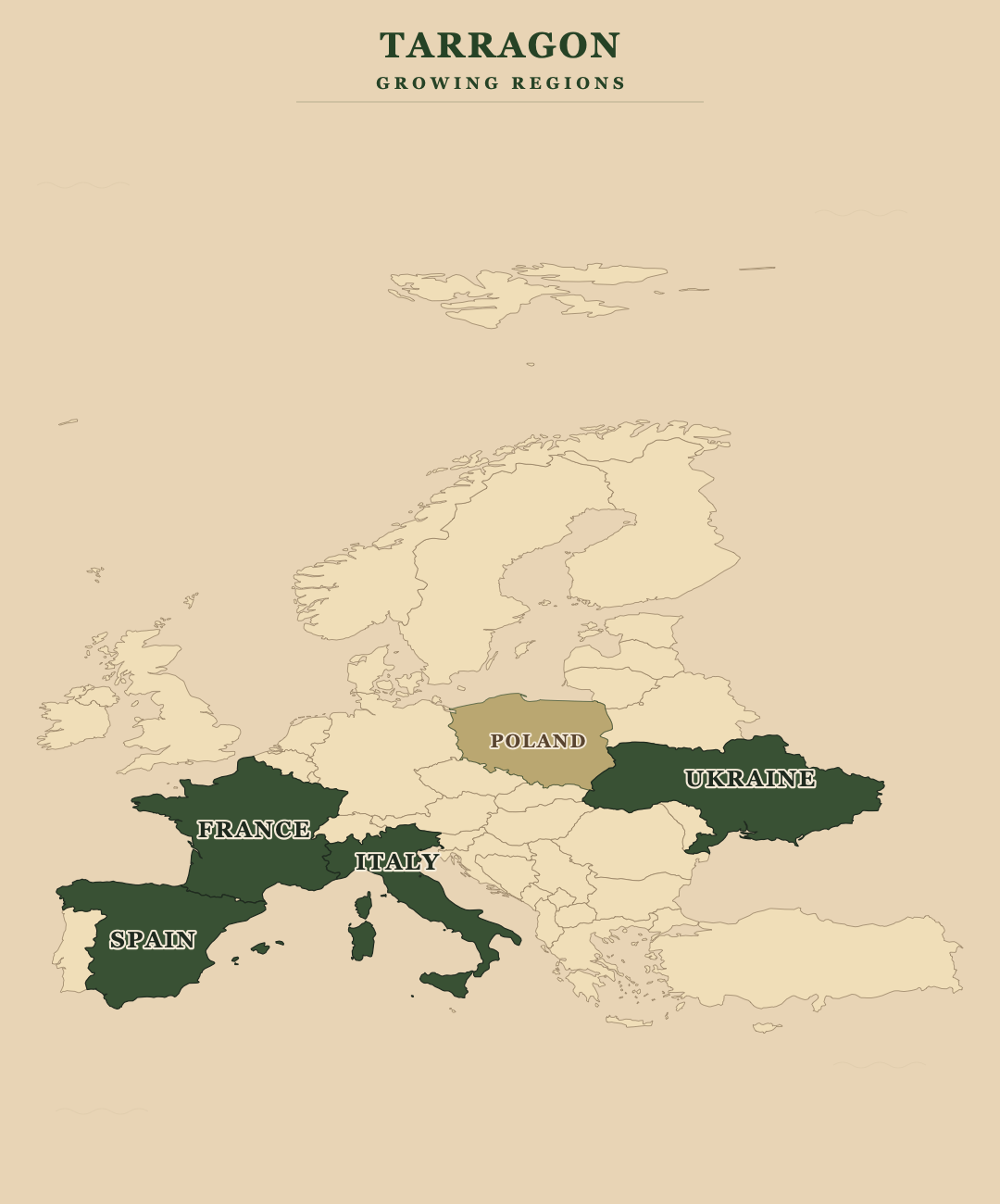
Tarragon is primarily cultivated in France, Spain, Italy, Russia (Russian variety), with secondary growing regions in Eastern Europe, USA, Australia.
Spice Story
Tarragon has been used as a culinary and medicinal herb across Europe and Asia for over a thousand years. It became foundational to French cuisine through the medieval and Renaissance periods — Béarnaise sauce, fines herbes, tarragon vinegar, and chicken in tarragon cream are all defining French dishes. French tarragon is one of the great culinary herbs precisely because of its inability to produce seed: every commercial French tarragon plant traces back to vegetative propagation, preserving the specific chemotype with its high estragole content. Russian tarragon, propagated from seed, is hardier but milder. In gin, tarragon is a contemporary herbaceous botanical providing bright anise-herb character.
Gin Creativity
Tarragon brings bright anise-herbal character with a soft licorice background. A full sachet pushes a gin firmly into clearly anise-herbaceous territory; a half-sachet provides quiet anise depth that integrates with juniper. Pair with lemon balm and chives for a French-style profile, or with lemon peel and lavender for a Provençal blend.
Blending Science
Main flavour compounds
 Estragole (methyl chavicol)anise, herbal
 Ocimene—
 Phellandrenecitrus-mint, peppery
 Pinenefresh pine, top note
Pairs well with
- Lemon balm
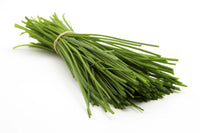
- Chives
- Lemon peel
- Coriander seed
- Lavender
Estragole (methyl chavicol) is the dominant compound — the same compound that contributes anise character to basil and fennel, but in tarragon present at higher concentration. Ocimene layers a green-grassy lift. Phellandrene and pinene contribute supporting resinous depth. Cool extraction preserves the bright anise top.
Food Partners
- Béarnaise sauce — the canonical French use.
- Roast chicken with herbs — tarragon, butter, lemon.
- Tarragon vinegar — foundational French pantry item.
- Cream-based sauces — tarragon cream over fish or chicken.
- Egg dishes — omelette aux fines herbes.
Cocktails To Try

- French G&T — tarragon gin, tonic, fresh tarragon sprig.
- Béarnaise Bloody Mary — tarragon gin, tomato, lemon.
- Garden Sour — tarragon-and-lemon-balm gin, lemon, honey.
Release The Flavour
- Cool extraction — preserves bright estragole.
- Crumble gently — releases the volatile oils.
- French tarragon — significantly more aromatic than Russian.
- Time — 24 hours for full development.
Discover more
From the same region

Pairs well with
Same flavour family
Surprise me

Sources & Citations
- scientific_name (Artemisia dracunculus, Asteraceae):en.wikipedia.org/wiki/Tarragon
- french_vs_russian_varieties:en.wikipedia.org/wiki/Tarragon
- estragole_signature_compound:pubs.acs.org/doi/10.1021/jf202277w
- french_propagation_by_cuttings:progardentips.com/plants/tarragon/
- main_flavour_compounds (CSV-sourced):inputs/source.csv — Tarragon row
