
JASMINE GREEN TEA

- Botanical name
- Camellia sinensis (tea) + Jasminum sambac (jasmine)
- Also known as
- Mo Li Hua Cha (Chinese), Yin Hao (premium grade)
- Main flavour compound
- Theaflavins (tea)
- Part used
- Green tea leaves scented with fresh jasmine flowers (the flowers may or may not remain in the final blend)
- Method of cultivation
- Green tea comes from the leaves of *Camellia sinensis*, the same tea plant as black, oolong and white teas — but is processed without oxidation (fresh leaves are pan-fired or steamed shortly after picking to lock in the green colour). Jasmine green tea uses base tea from Chinese Fujian province, scented with fresh *Jasminum sambac* flowers. Fuzhou (Fujian's capital) is the historic centre of jasmine tea production.
- Commercial preparation
- The scenting process is laborious and precise. Jasmine flowers are picked early in the day when their petals are tightly closed, kept cool until nightfall, and then layered with the dried tea (or blended with it) so the tea absorbs the volatile compounds released by the flowers as they open in the dark. Premium grades like Yin Hao undergo 6–10 separate scenting rounds, with fresh flowers replacing the spent ones at each step.
- Non-culinary uses
- Hot beverage (the foundational use); jasmine-tea-flavoured confectionery; cosmetic and aromatherapy use for stress and skin care.
Jasmine Green Tea is a scented blend, not a single botanical: green tea from Camellia sinensis perfumed with fresh Jasminum sambac flowers. Most premium jasmine green tea originates in Fujian province in eastern China, particularly around Fuzhou, where the tradition has been refined over centuries. [source] The base green tea is processed without oxidation (the fresh leaves are pan-fired or steamed within hours of picking to lock the colour and chlorophyll); the jasmine flowers are added later, in a separate scenting step that defines the final character.
Scented loose-leaf tea
The standard form — open the leaves up before extraction.
With visible jasmine flowers
Decorative grade; flowers usually included for visual appeal but the tea has already absorbed the aromatics.
Region of cultivation
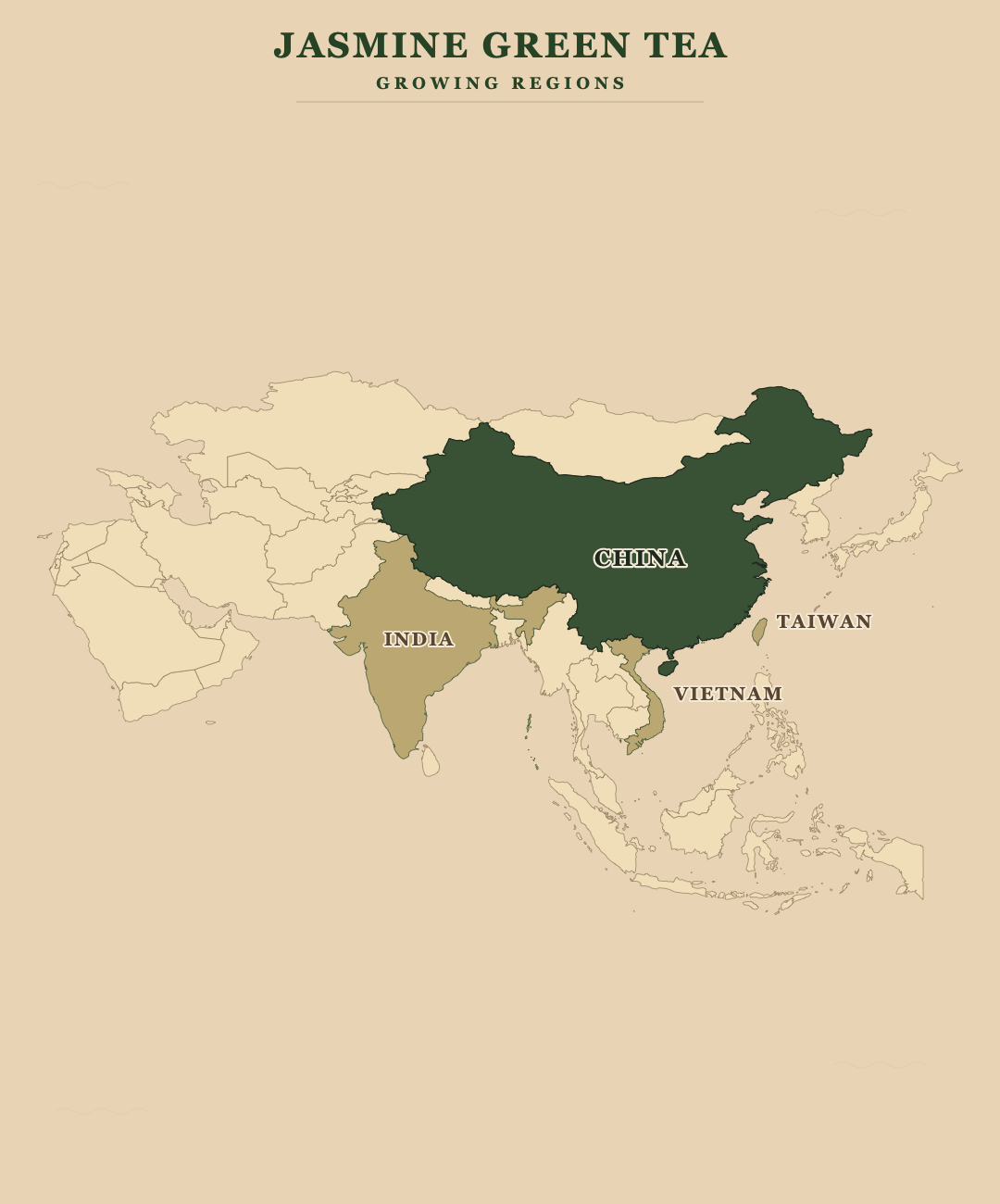
Jasmine Green Tea is primarily cultivated in China — Fujian province (Fuzhou the production centre), with secondary growing regions in Limited production in Taiwan, Vietnam, India.
Spice Story
Jasmine green tea is one of the most labour-intensive teas in the world. Jasmine flowers are picked early in the day when their petals are tightly closed, kept cool until evening, and then layered with the dried tea (or blended into it) overnight. As the flowers open in the dark and release their volatile aromatic compounds, the tea absorbs the fragrance. Top grades like Yin Hao undergo 6–10 separate scenting rounds, with fresh flowers replacing the spent ones each night. [source] The tradition has been continuous in Fujian since at least the Song Dynasty (10th–13th century). The famous Chinese folk song "Mo Li Hua" ("Jasmine Flower") celebrates the species. In craft gin, jasmine green tea has emerged as a contemporary East-Asian-influenced botanical, providing both tea tannin body and jasmine floral aromatic in a single ingredient.
Gin Creativity
Jasmine green tea brings two character layers: the green-tea malt-tannin body and the jasmine floral aromatic on top. A full sachet pushes a gin into clearly tea-leaning floral territory; a half-sachet provides a quiet, sophisticated background that integrates with juniper. Pair with bergamot or rose petal for layered florals, or with honey and lemon balm for a softer wellness-leaning profile. Avoid long warm extraction — green tea tannins go astringent quickly.
Blending Science
Main flavour compounds
 Theaflavins (tea)—
 Methyl jasmonate (jasmine)—
 Linaloolfloral, soft
 Benzyl acetatejasmine-floral, fruity
Pairs well with
The tea contributes theaflavins (less than in black tea, since green is unoxidised) and catechins (more than in black) — both contributing soft tannic body and slight bitterness. The jasmine scenting transfers methyl jasmonate (the signature jasmine aromatic), linalool (soft floral lift) and benzyl acetate (sweet floral body) into the tea leaves. All these compounds are alcohol-soluble; the green-tea catechins are temperature-sensitive, so cool extraction is essential.
Food Partners
- Lightly perfumed desserts — panna cotta, white chocolate, jasmine-tea ice cream.
- Steamed dumplings — jasmine tea is the canonical Chinese pairing.
- Light fish dishes — green-tea-poached fish with jasmine garnish.
- Fresh tropical fruit — jasmine and mango is a chef's pairing.
- Almond and white-chocolate confections — jasmine green tea ganache.
Cocktails To Try

- Jasmine MarTEAni — jasmine-tea-infused gin, lemon, sugar, egg white.
- Floral Spritz — jasmine-tea gin, prosecco, soda, fresh jasmine garnish.
- Asian-Garden G&T — jasmine-tea gin, floral tonic, jasmine bud garnish.
Release The Flavour
- Cool extraction — preserves both the green-tea catechins and the floral aromatics.
- Brief contact — 30 minutes to 2 hours is enough; longer extractions go bitter.
- Use premium grade — Yin Hao or similar — for the deepest floral character.
- Source matters — genuine Fujian-origin jasmine tea is significantly different from generic blends.
Discover more
From the same region

Same flavour family

Surprise me

Sources & Citations
- tea_origin (Camellia sinensis, Fujian China):en.wikipedia.org/wiki/Jasmine_tea
- jasmine_species (mainly Jasminum sambac):senchateabar.com/blogs/blog/jasmine-green-tea
- scenting_process (overnight flower-tea contact):en.wikipedia.org/wiki/Jasmine_tea
- multiple_scenting_rounds (6-10 for top grades):en.wikipedia.org/wiki/Jasmine_tea
- fuzhou_traditional_centre:senchateabar.com/blogs/blog/jasmine-green-tea
- main_flavour_compounds (CSV-sourced):inputs/source.csv — Jasmine Green Tea row
