
SPRUCE

- Botanical name
- Picea abies (Norway spruce)
- Also known as
- Norway spruce, European spruce, Christmas tree spruce
- Main flavour compound
- Alpha-Pinene
- Part used
- Dried needles and small twigs (and sometimes fresh young spring shoots)
- Method of cultivation
- Medium-sized fast-growing evergreen coniferous tree of the Pinaceae family, native to northern, central and eastern Europe — naturally distributed from Scandinavia south to the Alps and east to the Carpathians and beyond. Trees can reach 40 metres tall and live up to 1,000 years. *Picea abies* prefers acidic soils and tolerates saline coastal conditions. It is one of the most commercially important conifer species in Europe — extensively planted for timber, pulp and (most famously) as the European Christmas tree.
- Commercial preparation
- Young needles and small twigs are picked in spring or early summer when oil content is highest, gently dried, and either sold whole or steam-distilled. Essential oil yield is low (about 0.2% of needle weight); the spring-harvested material is the most aromatic. Some commercial spruce gin uses fresh young spring shoots rather than dried needles for the brightest character.
- Non-culinary uses
- Christmas tree (the European tradition); timber and pulp (major commercial source); aromatherapy and natural cosmetics; resin for traditional varnishes; the essential oil is used in fragrance and household products.
Spruce — Picea abies, the Norway spruce — is a tall fast-growing evergreen conifer of the Pinaceae family, native to northern, central and eastern Europe. The tree can reach 40 metres tall and live up to 1,000 years, with dense dark green needles arranged spirally along the branches. Picea abies is one of the most economically important conifer species in Europe — extensively planted for timber, paper pulp and as the iconic European Christmas tree. [source] The young spring needles are exceptionally aromatic and produce a bright, citrusy-resinous essential oil very different from the heavy resinous character of older needles.
Dried needles
The standard form — crumble lightly before use.
Fresh young shoots (where available)
Brightest character; use within hours of picking.
Region of cultivation
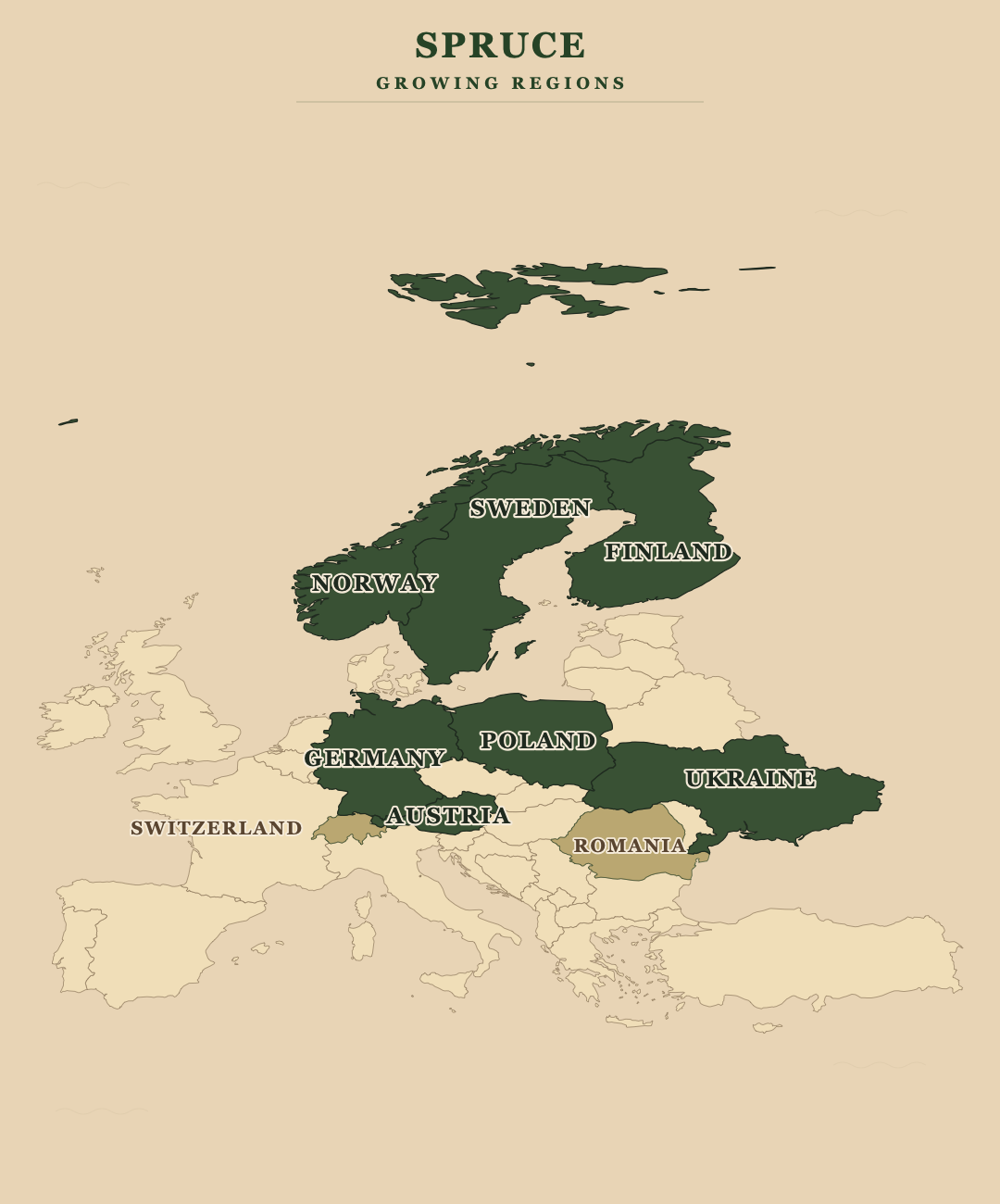
Spruce is primarily cultivated in Norway, Sweden, Finland, Germany, Austria, Poland, Russia, with secondary growing regions in Switzerland, Romania, Canada, USA (Pacific Northwest).
Spice Story
Spruce has been used in Nordic and Eastern European folk medicine for centuries — spruce-needle tea was a traditional anti-scorbutic preparation (the needles are rich in vitamin C, and Scandinavian sailors used spruce tea on long voyages much as the British used citrus). The Noma-driven New Nordic cuisine movement of the 2000s rediscovered spruce as a foraged spring ingredient — young spruce tips appearing in everything from pickles to ice cream to fermentation programs. In gin, spruce is a contemporary foraged-style botanical, particularly prominent in Scandinavian, Eastern European and craft expressions where the goal is a "forest" or "wild" character.
Gin Creativity
Spruce brings resinous-fresh forest character with a quietly citrus brightness. A full sachet pushes a gin firmly into clearly forest-conifer territory; a half-sachet provides quiet resinous depth that integrates with juniper (the two share pinene chemistry). Pair with juniper for layered forest-resin character, or with lemon peel and rosemary for a Mediterranean-Nordic fusion.
Blending Science
Main flavour compounds
 Alpha-Pinenefresh pine, top note
 Beta-Pinenefresh pine, top note
 Limoneneclean citrus lift
 Camphene—
Alpha-pinene and beta-pinene dominate spruce's chemistry — the same compounds that define juniper, which is why spruce and juniper integrate so well. Limonene layers citrus brightness (particularly in spring needles). Camphene adds further resinous depth. Cool extraction preserves the bright spring character; warm extraction develops deeper resinous body. The compound profile changes significantly across the seasons — spring needles are dominated by monoterpenes, late-summer needles by sesquiterpenes. [source]
Food Partners
- Scandinavian smoked fish — spruce-cured salmon is a Nordic classic.
- Nordic cuisine — Noma-style spruce-tip preparations.
- Bush honey and resin-tinged honey — spruce-and-honey pairings.
- Slow-braised meats — spruce in a game-meat marinade.
- Cool sorbets and ice creams — spruce-tip ice cream.
Cocktails To Try

- Nordic G&T — spruce gin, native tonic, fresh spruce tip garnish.
- Forest Sour — spruce gin, honey, lemon, egg white.
- Pine-Spruce Negroni — spruce gin, Campari, vermouth.
Release The Flavour
- Cool extraction — preserves the bright pinene character.
- Crumble gently — releases the volatile oils.
- Spring material preferred — young needles are dramatically more aromatic than autumn needles.
- Pair with juniper — they share pinene chemistry and reinforce each other.
Discover more
From the same region
Same flavour family
Surprise me

Sources & Citations
- scientific_name (Picea abies, Pinaceae):en.wikipedia.org/wiki/Picea_abies
- european_native_range:pmc.ncbi.nlm.nih.gov/articles/PMC9824094/
- oil_yield_0.2_percent:pmc.ncbi.nlm.nih.gov/articles/PMC9824094/
- seasonal_variation_compounds (monoterpenes peak April):pmc.ncbi.nlm.nih.gov/articles/PMC9824094/
- main_flavour_compounds (CSV-sourced):inputs/source.csv — Spruce row
