
PINE NUT

- Botanical name
- Pinus pinea
- Also known as
- Italian stone pine kernel, Pinoli, Piñón
- Main flavour compound
- Pinene compounds
- Part used
- Dried (and sometimes lightly roasted) seed
- Method of cultivation
- Slow-growing evergreen pine of the Pinaceae family, native to southern Europe and the Levant. The Mediterranean Italian Stone Pine (*Pinus pinea*) is the canonical commercial species, producing the large oily pine nuts famous in Italian cuisine. Trees take 15 years to begin producing seeds and up to 25 years to crop reliably; cones mature over 36 months. Each tree produces only about 1 kg of pine nuts per season — one of the lowest-yielding nut crops, which is why pine nuts are among the most expensive nuts on the market. Production centres: Spain, Portugal, Italy, Tunisia, Turkey.
- Commercial preparation
- Mature cones are harvested, dried so the scales open, and the seeds extracted by hand or machine. The seeds are still encased in a hard shell that must be cracked to release the cream-coloured kernel. Quality is graded on kernel size, freshness and absence of rancidity (pine nuts go rancid quickly because of their high oil content).
- Non-culinary uses
- Italian pesto (the canonical use); foundational ingredient in Mediterranean cuisine across centuries; cosmetics (pine nut oil); ornamental in Mediterranean landscape architecture.
Pine Nut comes from Pinus pinea, the Italian stone pine — a slow-growing evergreen of the Pinaceae family, native to southern Europe and the Levant. The tree grows 12–20 metres tall, with a distinctive umbrella-shaped canopy that is one of the iconic silhouettes of the Mediterranean landscape. The cones take 36 months to mature; each tree begins producing seeds only after about 15 years, and produces only about 1 kg of pine nuts per season at maturity — which is what makes pine nuts among the most expensive nuts in commerce. [source] Pine nuts have been cultivated in the Mediterranean for at least 6,000 years.
Whole raw kernel
The standard form — chop coarsely before use to expose oils.
Lightly toasted
Deeper aromatic character.
Region of cultivation
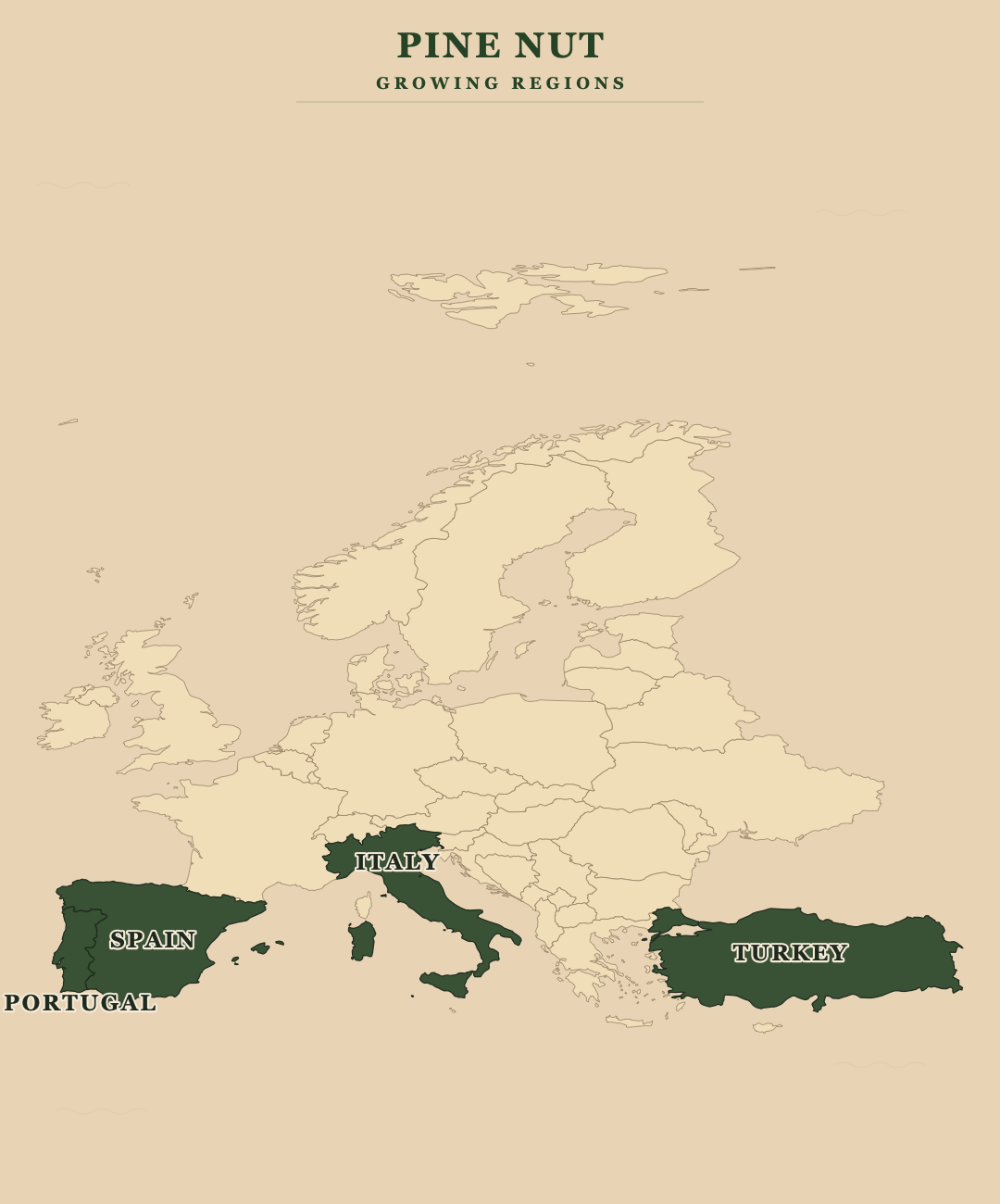
Pine Nut is primarily cultivated in Spain, Portugal, Italy, Tunisia, Turkey, with secondary growing regions in China (different species — *Pinus koraiensis* — Korean pine nut), Pakistan, USA.
Spice Story
Pine nuts are foundational to Italian and broader Mediterranean cooking — the canonical use is Genoese pesto (basil, pine nuts, garlic, olive oil, Parmesan). Pine nuts also appear in Lebanese, Turkish, Moroccan and Spanish dishes; they were a staple food across the Roman Empire and have been traded since antiquity. Korean pine nuts (Pinus koraiensis) are produced in East Asia but are a different species; Italian pinoli are the Mediterranean standard. In gin, pine nuts are an unusual contemporary botanical providing soft buttery body and a faint pine-resinous aromatic.
Gin Creativity
Pine Nuts bring soft buttery body with a quiet pine-resinous aromatic. A full sachet provides clear soft-nut character; a half-sachet adds quiet textural depth. Pair with rosemary and basil for an Italian-summer profile, or with pine needle for layered pine character.
Blending Science
Main flavour compounds
 Pinene compoundsfresh pine, top note
 Oleic acid—
 Linoleic acid—
 Pyrazines (from roasting)roasted, nutty
Pinene compounds (alpha-pinene and beta-pinene) provide the soft resinous-piney aromatic that distinguishes pine nuts from other nuts. Oleic acid and linoleic acid are the dominant fatty acids contributing the buttery body. Pyrazines develop during toasting via Maillard chemistry and provide deeper roasted character if pine nuts are toasted before extraction. The high oil content makes pine-nut-infused gin prone to clouding — filter carefully.
Food Partners
- Italian pesto — the canonical pairing.
- Mediterranean salads with cheese — pine nut + feta + tomato.
- Lamb tagines — Moroccan and Persian uses.
- Honey-and-pine-nut pastries — Lebanese and Turkish baklava.
- Pine nut tarts and biscotti — Italian dessert tradition.
Cocktails To Try

- Pesto Spritz — pine nut and basil gin, prosecco, soda.
- Tuscan Negroni — pine nut gin, Campari, vermouth.
- Mediterranean Sour — pine nut gin, lemon, honey.
Release The Flavour
- Chop coarsely — exposes the oils.
- Light toast — develops deeper aromatic character.
- Filter carefully — high oil content clouds the spirit.
- Use fresh — pine nuts go rancid quickly.
Discover more
From the same region


Same flavour family
Surprise me

Sources & Citations
- scientific_name (Pinus pinea, Pinaceae):en.wikipedia.org/wiki/Pine_nut
- mediterranean_native_range:en.wikipedia.org/wiki/Stone_pine
- 6000_year_cultivation_history:en.wikipedia.org/wiki/Stone_pine
- yield_1kg_per_tree_per_season:eurocompany.it/en/filiera/pine-nuts-italy/
- 15_year_first_seeds_25_year_reliable:eurocompany.it/en/filiera/pine-nuts-italy/
- main_flavour_compounds (CSV-sourced):inputs/source.csv — Pine Nut row
