
HAZELNUT

- Botanical name
- Corylus avellana
- Also known as
- Cobnut, Filbert, European hazel
- Main flavour compound
- Filbertone (5-methyl-(E)-2-hepten-4-one)
- Part used
- Roasted dried kernel
- Method of cultivation
- Deciduous shrub or small tree of the Betulaceae family (the birch family), native to Europe and Western Asia from Ireland to the Caucasus. The plant grows 3–8 metres tall, producing male catkins in late winter and female flowers that develop into nuts encased in leafy bracts (involucres). Turkey is by far the dominant world producer — about 75% of global supply comes from Turkey, especially the Giresun Province on the Black Sea coast; Italy, Azerbaijan and the USA make up most of the rest.
- Commercial preparation
- Nuts are harvested in autumn when they fall naturally, dried, shelled, and either roasted whole, sliced or ground. For distilling, lightly-to-moderately roasted whole kernels are preferred — heavy roasting masks the natural buttery character with burnt notes.
- Non-culinary uses
- Confectionery (Nutella and gianduja are the most famous global uses); cosmetics (hazelnut oil); ornamental garden plant (especially the contorted-stem cultivar "Harry Lauder's Walking Stick"); the wood is used for fencing and walking sticks.
Hazelnut comes from Corylus avellana, a deciduous shrub or small tree of the birch family, native across Europe and Western Asia. The plant grows 3–8 metres tall, with broad heart-shaped leaves and (in late winter) golden male catkins that produce wind-borne pollen for the inconspicuous female flowers. The fruit develops over the summer as a hard-shelled nut wrapped in a leafy frill-like bract. The Latin name Corylus derives from the Greek korys — "helmet" — referring to the leafy bract enveloping the nut. [source] Turkey produces about 75% of the world's hazelnuts, mostly from the Giresun Province on the Black Sea.
Whole roasted kernel
The standard form — chop coarsely before use to expose more surface.
Sliced or slivered
More surface area; faster extraction.
Region of cultivation
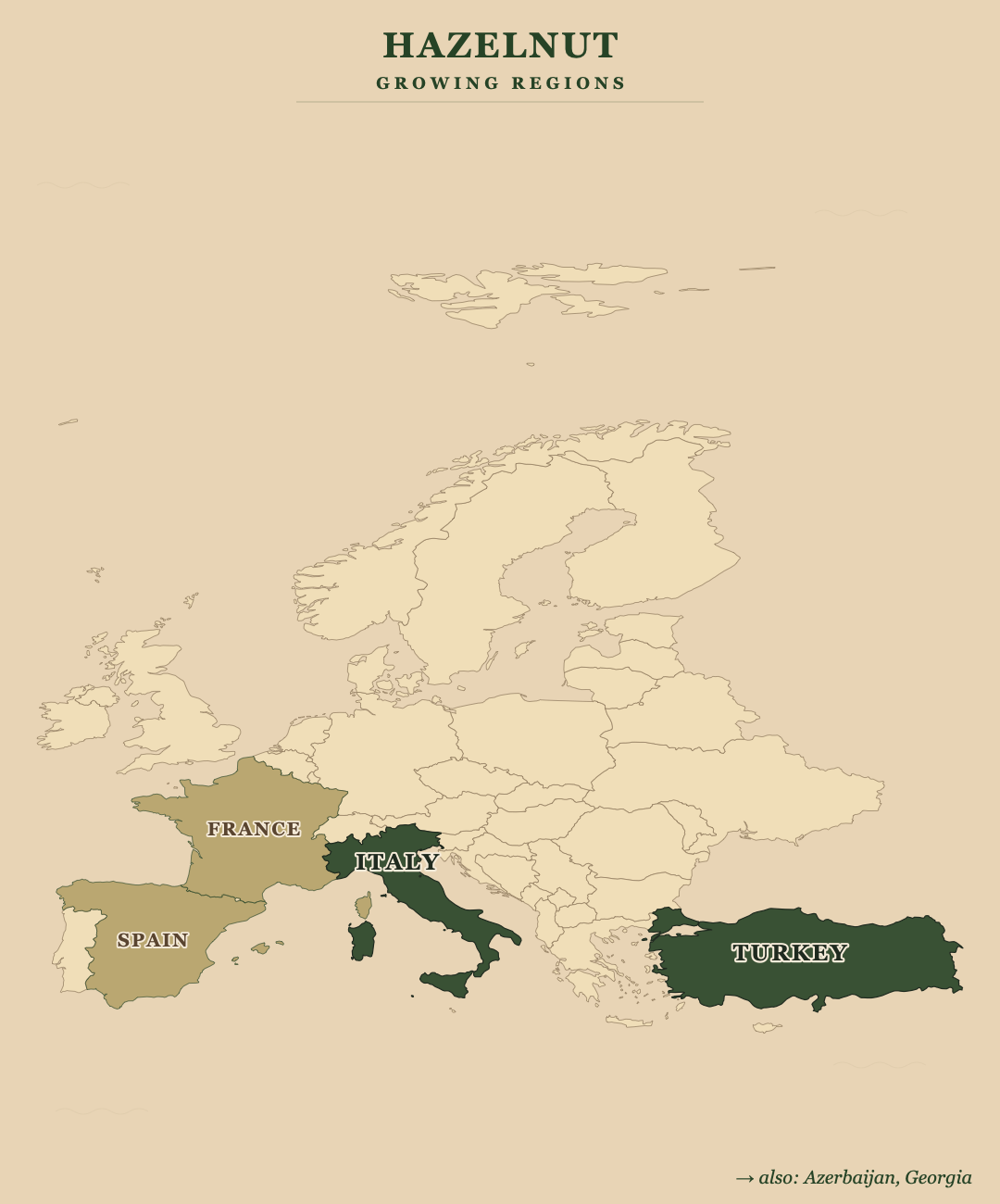
Hazelnut is primarily cultivated in Turkey (75% world production), Italy, Azerbaijan, USA, with secondary growing regions in Georgia, Spain, France, Iran.
Spice Story
Hazelnut is one of the oldest cultivated tree crops in human history — Chinese manuscripts from around 5,000 BCE reference hazelnuts, and the plant was widely used across Roman, Greek and medieval European cuisine. [source] The Italian tradition of gianduja (chocolate-hazelnut paste, developed in Turin during Napoleonic-era cocoa shortages) is the foundation of the global Ferrero/Nutella empire, and remains one of the most successful confectionery innovations of the modern era. In gin, hazelnut is an uncommon but distinctive contemporary botanical, providing soft buttery body and a warm-toasted depth — particularly effective in dessert-style gins and in expressions designed to pair with chocolate or coffee.
Gin Creativity
Hazelnut brings soft buttery body and a warm-toasted depth without prominent aromatics. A full sachet pushes a gin firmly into dessert-and-after-dinner territory; a half-sachet adds quiet roasted depth that integrates with juniper. Pair with cacao nibs and vanilla for a gianduja-leaning profile, or with cinnamon and orange peel for a soft warming gin.
Blending Science
Main flavour compounds
 Filbertone (5-methyl-(E)-2-hepten-4-one)—
 Pyrazines (from roasting)roasted, nutty
 Fatty acids—
Pairs well with
Filbertone (5-methyl-(E)-2-hepten-4-one) is the signature aromatic compound of hazelnut — the molecule most responsible for "hazelnut character" and used in commercial hazelnut flavouring. Pyrazines (especially 2-methylpyrazine and 2,5-dimethylpyrazine) develop during roasting via Maillard chemistry and contribute the toasted-nutty depth. Fatty acids (mainly oleic and linoleic) provide the soft buttery body but require fine filtration to avoid clouding. Roast level matters: light roast for clean nut character, medium roast for the deepest filbertone development, dark roast tips into burnt territory.
Food Partners
- Hazelnut praline and gianduja — the canonical confectionery use.
- Chocolate desserts — hazelnut and chocolate are inseparable.
- Roast pork and game birds — hazelnut-gin in a stuffing or glaze.
- Cheese boards — especially blue and aged hard cheeses.
- Brown-butter sauces — hazelnut-gin in a beurre noisette over roast vegetables.
Cocktails To Try

- Hazelnut Old Fashioned — hazelnut gin, demerara, orange bitters.
- Gianduja Sour — hazelnut and cacao gin, lemon, honey, egg white.
- Espresso Martini (gin variant) — hazelnut gin, espresso, coffee liqueur.
Release The Flavour
- Roast first — medium-roast nuts give the best filbertone-driven character.
- Chop coarsely — exposes oils.
- Filter carefully — fatty acids cloud the spirit; cold filtration helps.
- Time — 24–48 hours for full character.
Discover more

Pairs well with

Same flavour family
Surprise me

Sources & Citations
- scientific_name (Corylus avellana, Betulaceae):en.wikipedia.org/wiki/Corylus_avellana
- turkey_75_percent_world_production:www.ferrerohazelnutcompany.com/int/en/our-hazelnuts/about...
- native_range (Ireland to Caucasus):en.wikipedia.org/wiki/Corylus_avellana
- 5000_BCE_china_evidence:www.carapulinpiemonte.com/en/activities/the-hazelnut-plant
- name_origin (Corylus from Greek korys, helmet):en.wikipedia.org/wiki/Corylus_avellana
- main_flavour_compounds (CSV-sourced):inputs/source.csv — Hazelnut row
