
TURMERIC

- Botanical name
- Curcuma longa
- Also known as
- Haldi (Hindi), Indian saffron, Kunyit (Indonesian)
- Main flavour compound
- Curcumin (yellow pigment)
- Part used
- Dried, ground rhizome
- Method of cultivation
- Tropical perennial herb of the Zingiberaceae family (the ginger family), indigenous to India and cultivated extensively across South and South-East Asia. The plant grows 1–1.5 metres tall, with broad green leaves and small yellow flowers; the working part is below ground, in the bright orange-yellow rhizomes that have given turmeric its colour-defining role across Indian, Indonesian, Middle Eastern and Persian cooking. India is the centre of turmeric diversity, particularly southern India (Tamil Nadu, Kerala), and the dominant world producer.
- Commercial preparation
- Mature rhizomes are dug at the end of the growing season, washed, boiled briefly to gelatinise the starches and even the colour, then sun-dried for two to three weeks. The dried rhizomes are then either sold whole ("turmeric fingers") or ground to the familiar bright orange-yellow powder. Curcumin content varies significantly between cultivars — typically 0.4% to 2.2% of the dried rhizome.
- Non-culinary uses
- Foundational ingredient across Indian, Persian, Indonesian, Malaysian and Thai cooking; foundational natural food colourant (used in mustard, cheese, curry powders); foundational ingredient in Ayurvedic and traditional Indian medicine for inflammation, digestion and many other purposes; the bright yellow dye is used in religious and ceremonial contexts across Hinduism, Buddhism and Islam.
Turmeric — Curcuma longa — is a tropical perennial of the ginger family (Zingiberaceae), indigenous to India and cultivated extensively across South and South-East Asia. The plant grows 1–1.5 metres tall, with broad green leaves and small yellow flowers; the working part is below ground — bright orange-yellow rhizomes that give the spice its defining colour and flavour. [source] India is the centre of turmeric biodiversity (with extensive cultivar variation in southern India — Tamil Nadu, Kerala, Andhra Pradesh) and the dominant world producer.
Whole dried "finger"
Less common; slow-extracting.
Ground powder
The standard form — disperses quickly in cool maceration.
Region of cultivation
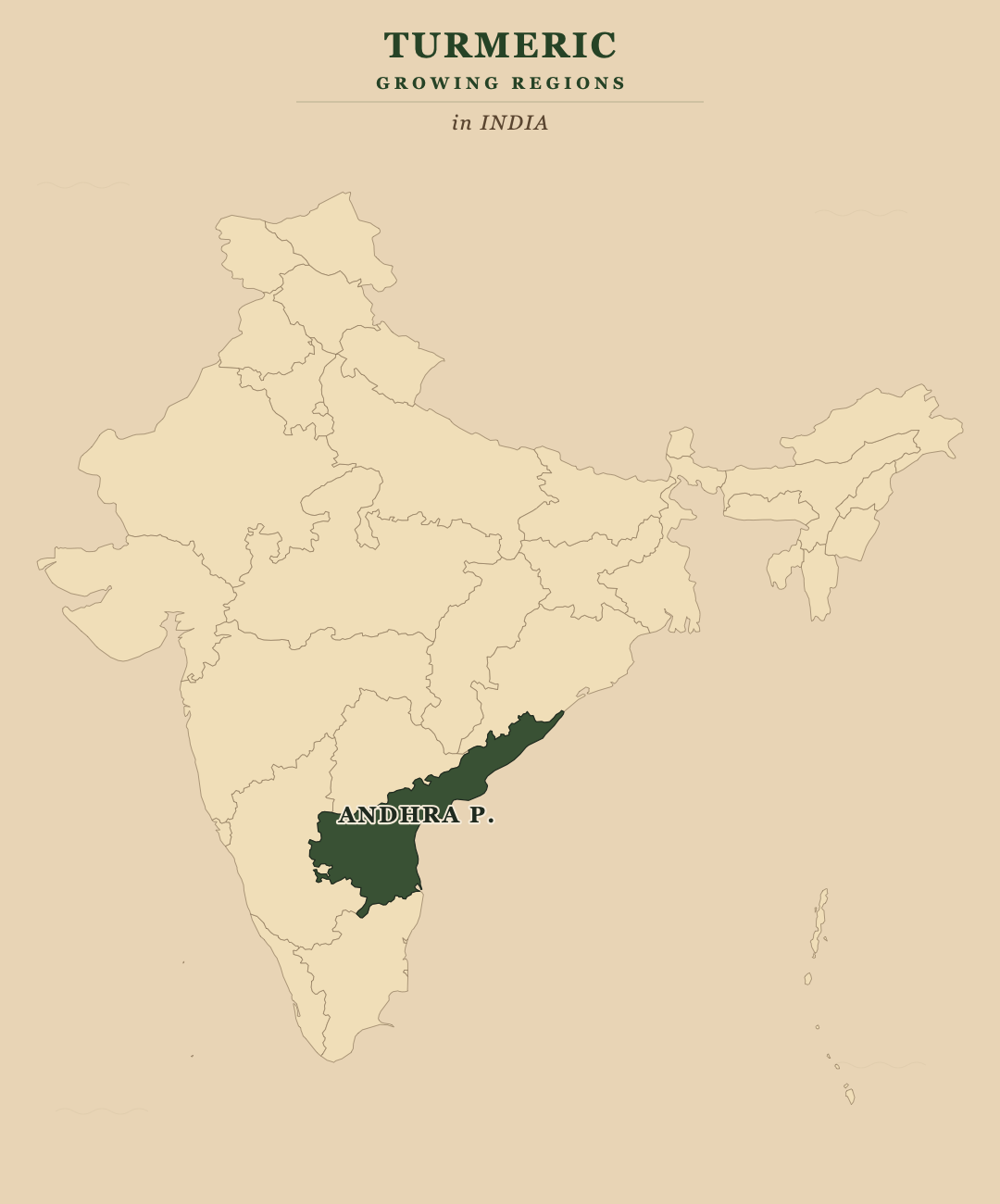
Turmeric is primarily cultivated in India (Tamil Nadu, Kerala, Andhra Pradesh) — dominant world producer, with secondary growing regions in Indonesia, Thailand, China, Bangladesh, Sri Lanka.
Spice Story
Turmeric has been cultivated in India for at least 4,000 years and is foundational to Indian cuisine, religious ceremony and traditional medicine. Curry powder, haldi doodh (golden milk), Indonesian rendang, Persian rice colouring, and the iconic English mustard's yellow colour all depend on turmeric. The brilliant orange-yellow stain that turmeric leaves on fingers, fabric and cooking surfaces is from curcumin — a polyphenol responsible for both the colour and most of the documented bioactive properties. Curcumin content varies dramatically between cultivars (0.4–2.2% of dry rhizome weight). [source] In gin, turmeric is an unusual contemporary botanical providing brilliant golden colour and earthy-warm character.
Gin Creativity
Turmeric brings earthy-warm character with brilliant golden colour. A full sachet pushes a gin firmly into clearly Indian-spice territory; a half-sachet provides quiet earthy depth with significant colour change. Pair with ginger and black pepper for an Indian profile (these three combinations also work because black pepper increases curcumin bioavailability), or with coriander seed and cumin for a broader spice-route blend.
Blending Science
Main flavour compounds
 Curcumin (yellow pigment)earthy, savoury
 Turmerone—
 Ar-Turmerone—
 Zingiberene—
Pairs well with
Curcumin is the dominant compound — providing both the brilliant orange-yellow colour (it's used as a natural food dye, E100) and a faint bitter taste. Turmerone and ar-turmerone are the dominant volatile aromatic compounds, providing the earthy-spicy character. Zingiberene (the same compound that defines ginger) layers a warm-aromatic note. Cool extraction preserves the brilliant colour; warm extraction develops a deeper earthy register.
Food Partners
- Indian curries — turmeric is foundational to virtually every Indian curry.
- Golden milk (haldi doodh) — turmeric, milk, black pepper, ghee.
- Indonesian rendang — slow-cooked beef with turmeric, coconut, lemongrass.
- Persian rice dishes — turmeric for colour and warmth.
- Pickled vegetables — turmeric in Indian and Iranian pickles.
Cocktails To Try

- Golden Gin Sour — turmeric gin, lemon, honey, egg white.
- Indian G&T — turmeric-and-coriander gin, tonic, fresh curry leaf garnish.
- Spice-Route Margarita — turmeric gin, lime, agave, salt rim.
Release The Flavour
- Cool extraction — preserves the brilliant colour.
- Brief contact — 1–4 hours captures the bright top.
- Filter carefully — fine powder clouds the spirit.
- Bottle in dark glass — light can fade curcumin colour over weeks.
Discover more
From the same region

Pairs well with
Same flavour family
Surprise me

Sources & Citations
- scientific_name (Curcuma longa, Zingiberaceae):www.mdpi.com/2072-6643/18/8/1197
- indian_origin_and_diversity_centre:www.frontiersin.org/journals/plant-science/articles/10.33...
- curcumin_content_variability (0.41-2.17%):pmc.ncbi.nlm.nih.gov/articles/PMC9797976/
- tamil_nadu_kerala_southern_india_centre:www.frontiersin.org/journals/plant-science/articles/10.33...
- main_flavour_compounds (CSV-sourced):inputs/source.csv — Turmeric row
