
WINTER SAVORY

- Botanical name
- Satureja montana
- Also known as
- Mountain Savory, Bohnenkraut, Sarriette (French), Satureja montana
- Main flavour compound
- Carvacrol
- Part used
- Leaf
- Method of cultivation
- A woody-stemmed, semi-evergreen perennial reaching 15–40 cm tall, it grows on dry rocky slopes and calcareous hillsides across southern Europe and the Mediterranean. [source: https://en.wikipedia.org/wiki/Winter_savory] Cultivated in well-drained alkaline soil in full sun; drought-tolerant once established. [source: https://plants.ces.ncsu.edu/plants/satureja-montana/]
- Commercial preparation
- Leaves are harvested in summer, just before or during flowering, when essential-oil content peaks. [source: https://www.notulaebotanicae.ro/index.php/nbha/article/view/9645] Sold dried (whole or rubbed) or as steam-distilled essential oil; the carvacrol-dominant chemotype grown across Mediterranean Europe and Romania is the dominant commercial form. [source: https://pmc.ncbi.nlm.nih.gov/articles/PMC7230815/]
- Non-culinary uses
- Perfumery and cosmetics (carvacrol is antimicrobial and used in flavour/fragrance formulations); traditional herbal medicine (digestive aid, particularly with legumes); ornamental rockery and low-growing hedging plant. [source: https://en.wikipedia.org/wiki/Winter_savory]
Winter savory — Satureja montana — is a woody-stemmed, semi-evergreen perennial that barely clears your ankle, growing 15–40 cm tall on rocky, sun-baked limestone slopes across southern Europe and the Mediterranean. [source] Stiff, dark green lance-shaped leaves line each branch; small pale-lavender to white flowers appear from midsummer through October. [source] Rub a leaf and the oil hits you first — a pungent, resinous heat quite unlike its milder annual cousin, summer savory. It's a herb that tastes like the hillside it grows on.
Dried whole leaf
The standard form — rub between your fingers to release the oils before adding to a botanical bill or a dish.
Dried rubbed / crumbled
More surface area, faster flavour release; good for short gin macerations.
Fresh sprig
Subtle and green-edged compared to dried; strip the leaves before use.
Region of cultivation
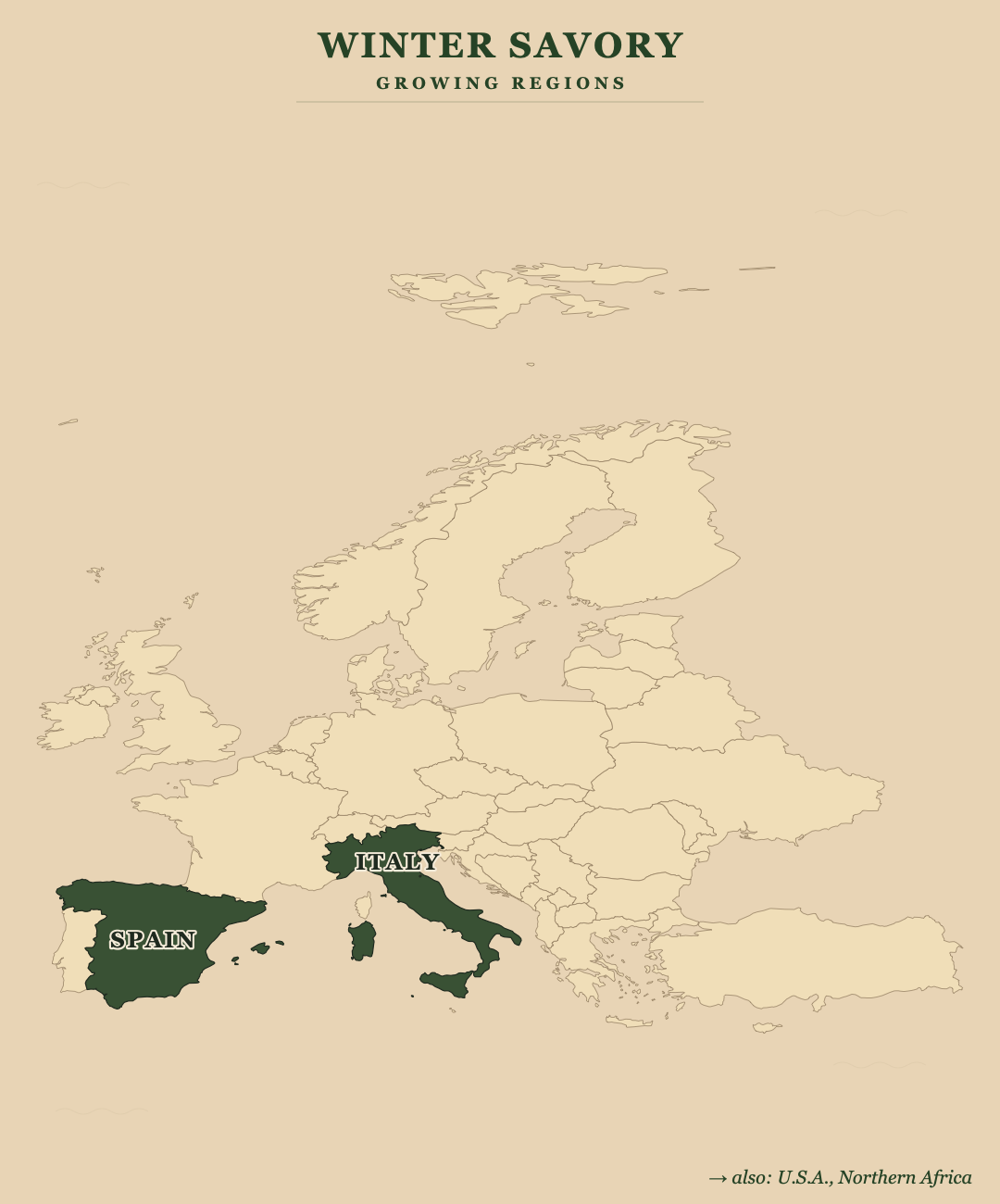
Winter Savory is primarily cultivated in Southern Europe, Mediterranean, with secondary growing regions in Northern Africa, southwestern Asia.
Spice Story
The Romans knew this plant well. Columella — Rome's foremost farming writer — opened his famous moretum (an herb-and-cheese spread) recipe with savory as the first ingredient, around 60 AD. [source] The legions carried it north as they pushed their empire into Europe, embedding it in French and German kitchens where it earned the enduring German name Bohnenkraut — literally "bean herb" — for its affinity with lentils and dried legumes. [source] Medieval herbalists also attached some romance to the genus: summer savory was believed an aphrodisiac, while winter savory was thought the opposite — the anaphrodisiac, the monk's herb, the herb of restraint. [source] Whatever its moral reputation, winter savory eventually naturalised itself across Britain's hedgerows. [source]
Gin Creativity
Winter savory brings a bold, peppery heat that shares structural ground with thyme and oregano but has its own rocky-Mediterranean edge. At a full sachet dose, it dominates the gin bill and will challenge a drinker who's expecting something floral; use it at a third to half a sachet as a supporting player and it adds a savoury ruggedness that gives structure to otherwise soft botanical builds. Pair it with coriander seed for earthy citrus warmth, or lean into its herb-garden character alongside juniper and black pepper for a restrained, culinary-style gin.
Blending Science
Main flavour compounds
 Carvacrol—
 p-Cymene—
 Gamma-terpinenefresh pine, top note
 Thymolthyme, antiseptic
Pairs well with
Carvacrol does the heavy lifting here — comprising around 53–63% of the essential oil in the commercially dominant Mediterranean chemotype, it delivers the hot, pungent oregano-like punch that defines winter savory. [source] p-Cymene (10–13%) contributes a woody, terpy citrus note that adds brightness and carries the heat without amplifying it. [source] γ-Terpinene provides the fresh, herbaceous-citrusy lift and is particularly interesting as the direct biosynthetic precursor to carvacrol — the plant makes carvacrol from it, which is why the two track each other through the oil. [source] Thymol, the structural isomer of carvacrol, rounds out the profile with a spicy-herbaceous, distinctly thyme-like warmth. [source] Heat drives off the lighter volatiles first — long boils push savory's profile toward the harder phenolics; cold maceration preserves the fresh γ-terpinene lift.
Food Partners
- White beans and lentils: the ancient pairing — savory has been used with legumes since Columella; its oils also aid digestion of pulses.
- Grilled lamb: peppery phenolics cut the fat and echo the char beautifully.
- Roast chicken: a lighter meat that savory seasons without overwhelming — a classic Provençal combination.
- Sausages and charcuterie: traditional sausage herb across German and French kitchens.
- Soft goat's cheese: pungent herb against creamy tangy cheese — works the same way thyme does, but rougher.
- Hearty soups and stews: long-cook dishes where winter savory's robustness outlasts more delicate herbs.
Cocktails To Try

- Secret Garden Distillery range (Edinburgh): winter savoury is a core base botanical in all their gins — juniper, angelica root, coriander seed and winter savory form the spine; their Christmas Gin shows how this structure carries warming spice additions. [source]
- Savoury G&T: any heavy-on-the-savory gin pairs naturally with a quality tonic and a sprig of fresh thyme or a slice of cucumber — the herbaceous phenolics hold up against tonic's bitterness in a way sweeter botanicals don't.
- Dirty Martini style: savory gin builds find an easy home here — the savoury, peppery character echoes the olive brine.
Release The Flavour
- Heat: long boils strip off the fresh γ-terpinene top notes and leave the harsher carvacrol behind — a shorter, controlled vapour infusion gives the fullest character.
- Alcohol: high-ABV spirit extracts carvacrol and thymol fast; diluting to 40% for maceration slows extraction and keeps the balance more nuanced.
- Time: dried leaf gives up its oils within a few hours of maceration; don't push past overnight or you'll lose the citrusy lift to the phenolic base.
- Crush: lightly crush dried leaves before adding to your still basket — more surface area, faster and more even oil release.
Discover more
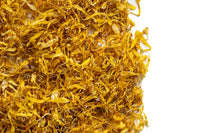
From the same region
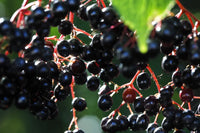
Pairs well with
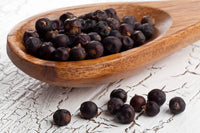
Surprise me

Sources & Citations
- scientific_name (Satureja montana L., ACCEPTED, Lamiaceae):GBIF Backbone Taxonomy, usageKey 2926884 — api.gbif.org/v...
- plant_form (semi-evergreen perennial, 15–40 cm, warm temperate southern Europe, Mediterranean, Africa):en.wikipedia.org/wiki/Winter_savory
- plant_form_detail (dark green lanceolate leaves, pale lavender/white flowers, calcareous/rocky habitat):plants.ces.ncsu.edu/plants/satureja-montana/
- harvest_timing_affects_oil_content (harvest before/during flowering for peak oil):Wogiatzi et al., 'Influence of Harvest Term on the Conten...
- carvacrol_dominant_chemotype_63pct (carvacrol ~63% in commercial-type oil):Skalicka-Wozniak et al., Foods 2020, DOI 10.3390/foods904...
- compound_percentages_multiple_origins (South France: carvacrol 53.35%, p-cymene 13.03%, γ-terpinene 13.54%; Romania: carvacrol 63.40%, p-cymene 10.97%, γ-terpinene 3.70%):Synthesis across multiple GC-MS studies summarised in search of peer-reviewed literature; primary source: Wogiatzi et al. (Notulae Botanicae) for harvest-term data; Miladi et al. 2013 Journal of Chemistry DOI 10.1155/2013/275698 (Tunisia/South France sample)
- carvacrol_aroma (hot pungent oregano-type):en.wikipedia.org/wiki/Carvacrol
- p_cymene_aroma (woody, citrusy, earthy, terpy):www.acs.org/molecule-of-the-week/archive/c/p-cymene.html ...
- gamma_terpinene_aroma (fresh herbaceous-citrusy, Arctander):pellwall.com/products/gamma-terpinene
- gamma_terpinene_biosynthesis_precursor_carvacrol:Comparative transcriptome analysis for carvacrol biosynth...
- thymol_aroma (spicy-herbaceous, thyme-like phenolic):www.scentspiracy.com/fragrance-ingredients/p/thymol ; pub...
- pubchem_cids (carvacrol 10364, p-cymene 7463, gamma-terpinene 7461, thymol 6989):PubChem compound lookup — pubchem.ncbi.nlm.nih.gov/
- ancient_Roman_use (evidence of use ~2000 years ago, Romans and Greeks):en.wikipedia.org/wiki/Winter_savory
- Columella_moretum (savory first ingredient in moretum recipe, De Re Rustica ~60 AD):tavolamediterranea.com/2018/01/15/columellas-moretum/
- Romans_brought_savory_to_Britain:Katzers Spice Pages, Satureja — gernot-katzers-spice-page...
- bean_herb_bohnenkraut (German name = bean herb; legume-digestive tradition):gernot-katzers-spice-pages.com/engl/Satu_hor.html ; www.t...
- anaphrodisiac_belief (winter savory = anaphrodisiac, vs summer savory = aphrodisiac):en.wikipedia.org/wiki/Winter_savory
- secret_garden_distillery_winter_savory_base_botanical:Secret Garden Distillery base botanical blend — secretgar...
- naturalized_in_Great_Britain:en.wikipedia.org/wiki/Winter_savory
- herbes_de_provence_uses_summer_savory_NOT_winter:spicestationsilverlake.com/herbes-de-provence-the-complet...
