
ELDERBERRY

- Botanical name
- Sambucus nigra
- Also known as
- Elder, Black Elder, European Elderberry, Common Elder
- Main flavour compound
- beta-Damascenone
- Part used
- Berry
- Method of cultivation
- A fast-growing deciduous shrub or small tree reaching 3–8 metres, elder thrives in moist, well-drained soils in temperate climates and tolerates partial shade. [source: https://www.botanicalrealm.com/plant-identification/european-black-elderberry-sambucus-nigra/] It is native across most of Europe, western and central Asia, and parts of northern Africa. [source: https://www.gbif.org/species/2888728]
- Commercial preparation
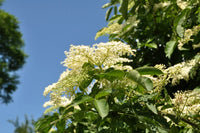
- Small cream-white flowers in flat-topped corymbs open in late spring; the deep purple-black berries follow in late summer and autumn. [source: https://www.botanicalrealm.com/plant-identification/european-black-elderberry-sambucus-nigra/] Commercially, berries are processed into juice, syrup, cordial, and dried extract — importantly, always cooked or heat-treated first, as raw berries contain cyanogenic glycosides (primarily sambunigrin) that are destroyed by heating. [source: https://pmc.ncbi.nlm.nih.gov/articles/PMC7961730/]
- Non-culinary uses
- Deep anthocyanin pigment used as natural food dye; bark, flowers, and leaves all used in traditional European herbal medicine for centuries. [source: https://www.visiontimes.com/2022/08/19/traditional-use-of-elderberry.html] Historically, elder wood was fashioned into flutes and small musical instruments. [source: https://en.wikipedia.org/wiki/Elderberry]
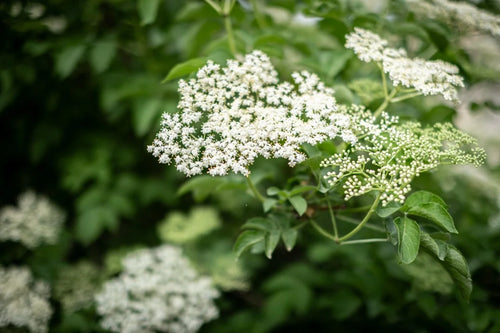
Elder — Sambucus nigra — is the hedgerow shrub everyone walks past without looking twice, until late summer when the clusters of purple-black berries stop you mid-step. [source] A fast-growing deciduous tree reaching three to eight metres, it grows in moist, nitrogen-rich soils across Europe, western Asia, and northern Africa — equally at home on a farm boundary as it is in an English country lane. [source] The berries hang in broad, heavy corymbs, ripening from green to deep purplish-black in autumn, following the same flat-topped cream-white flower clusters that, just months earlier, gave you elderflower.
Dried berries
The most common form for gin distillation — macerate or add to still basket for dark fruit and colour.
Elderberry cordial / syrup
Pre-cooked and sweetened — fast colour and flavour in cocktails; no maceration time needed.
Fresh ripe berries (cooked)
Highest aromatic complexity; must be simmered before use to neutralise cyanogenic glycosides.
Region of cultivation
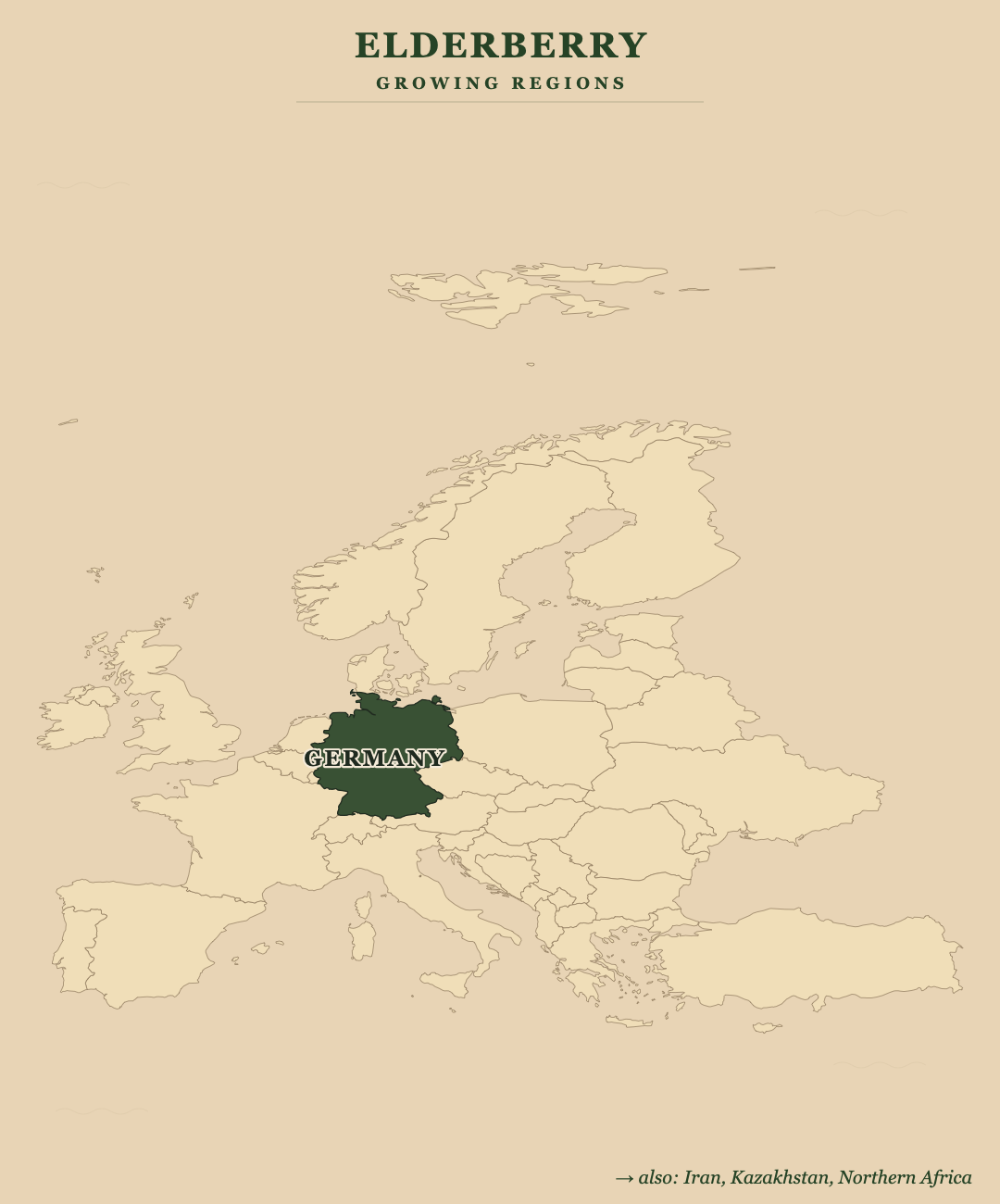
Elderberry is primarily cultivated in Europe, with secondary growing regions in Western Asia, Central Asia, Northern Africa.
Spice Story
The elder tree has been feeding and healing Europeans for as long as humans have been foraging — traces of its berries turn up in Neolithic settlements. [source] For centuries it was considered a kind of living dispensary: bark for burns, flowers for fevers, berries for everything from colds to the plague. Northern European folklore elevated it further — elder wood hung over doorways as a charm, believed to hold off evil and ease the crossing between worlds. [source] The berry's deep anthocyanin pigment made it equally useful as a natural dye and the backbone of country wines and cordials — traditions still alive in hedgerow kitchens across Britain, Scandinavia, and Central Europe. [source] One note for the practical-minded: raw elderberries contain cyanogenic glycosides that cause nausea and vomiting if eaten uncooked — cooking destroys them, which is why every traditional elder recipe begins with heat. [source]
Gin Creativity
Elderberry and elderflower are two chapters of the same story — same tree, different season, completely different character. Where elderflower floats above a gin, elderberry drops it into the roots: dark fruit, a hint of wine tannin, and that distinctive brooding floral undertow. A full sachet pushes a gin into berry-forward, dusky territory — think deep violet G&Ts and winter hedgerow profiles. A partial amount sits quietly behind juniper as colour and depth. Pair it with elderflower for the full elder experience, sloe for a layered dark-berry English profile, or cinnamon to lean into the spiced cordial direction.
Blending Science
Main flavour compounds
 beta-Damascenone—
 Dihydroedulan—
 Phenylacetaldehyde—
 Linaloolfloral, soft
Pairs well with
- Elderflower
- Juniper
- Lemon peel
- Sloe
- Hibiscus
- Cinnamon
Elderberry's character is driven by three uniquely characterising odorants that together produce its unmistakable dark-fruity-floral signature. β-Damascenone leads: a cooked apple and rose note with a honey warmth, present in elderberry juice at high odour-activity values — the same compound that lifts Chardonnay and Riesling. [source] Dihydroedulan adds the woody, wine-like elderberry-specific earthiness — a compound occurring in high concentration in elderberry headspace and rarely found in other fruits. [source] Phenylacetaldehyde rounds it out with a sweet honey-rose character. [source] Linalool, shared with elderflower, is the floral thread tying berry back to blossom. [source] All four are heat-sensitive: gentle maceration in spirit preserves them; hard prolonged heat strips the floral lift and leaves only flat berry fruit.
Food Partners
- Venison and game: the classic partnership — elderberry's acidity and jammy depth cut the richness of wild meat. [source]
- Dark chocolate: bitter cocoa amplifies the berry's brooding fruit and tightens the sweet edge.
- Aged cheeses: a sharp, salty hard cheese loves the berry's tart-sweet counterpoint.
- Apple and pear: orchard fruit softens and brightens elderberry, a classic autumn pairing.
- Honey: echoes the phenylacetaldehyde note — honey and elder are almost telepathically matched.
- Warm spice desserts: cinnamon, clove, and nutmeg lean into the berry's wine-like depth.
Cocktails To Try

- Elderberry Kir Royale: elderberry cordial in a Champagne flute, topped with sparkling wine — the berry version of the French classic. [source]
- Arbutus Elderberry Gin & tonic: British Columbia's Arbutus Distillery cold-presses local elderberries into their gin, delivering citrus, jam, and blackcurrant over ice. [source]
- Turner Stillhouse Elderberry Gin: from Rosevears, Tasmania — jammy elderberry richness paired with rose and citrus in a 40% ABV craft expression. [source]
- Dark & Berry Negroni: swap sweet vermouth for an elderberry-infused gin and let the Campari play off the berry's tannin.
Release The Flavour
- Heat: do not boil fresh berries in spirit — a gentle warm macerate (not more than 50°C) preserves the delicate floral top notes and keeps the fruit lively.
- Alcohol: spirit draws colour and the jammy fruit quickly; a short maceration of dried berries (4–8 hours) captures the brightest character without the flat tannin of a long soak.
- Time: overnight is usually enough; beyond 24 hours the elderberry-specific volatiles fade and you're left with colour more than flavour.
- Water: diluting the final spirit back from maceration strength (above 50% ABV) to 40% restores the delicate floral lifts that high-proof spirit can suppress.
Discover more
From the same region

Pairs well with

Same flavour family
Surprise me

Sources & Citations
- scientific_name (Sambucus nigra L., ACCEPTED, Adoxaceae):GBIF Backbone Taxonomy, usageKey 2888728 — www.gbif.org/s...
- plant_form (3-8 m shrub/tree, moist soils, compound leaves, temperate):BotanicalRealm 'European Black Elderberry (Sambucus nigra...
- native_range (Europe, western/central Asia, northern Africa):GBIF species page 2888728 — www.gbif.org/species/2888728 ...
- berry_characteristics (cream-white corymb flowers late spring; purple-black berries late summer/autumn):BotanicalRealm — www.botanicalrealm.com/plant-identificat...
- cyanogenic_glycosides_safety (sambunigrin; cooking destroys; 44-96% reduction; ripe berry levels low; stems/green highest):Kowalska et al. 2021, 'Cyanogenic Glycoside Analysis in A...
- cyanogenic_cooking_confirms (cooking breaks down sambunigrin + alkaloids; raw juice illness documented):CompoundChem 'The Chemistry of Elderflowers & Elderberrie...
- compounds_beta-damascenone_dihydroedulan_phenylacetaldehyde (primary characterising elderberry odorants by GC-sniff):Jensen, Christensen & Edelenbos 2001, 'Olfactory and quan...
- compound_linalool (floral volatile confirmed in elderberry headspace, shared with elderflower):CompoundChem 2016 (linalool listed as shared volatile flo...
- pubchem_cids (beta-damascenone 5366074; dihydroedulan-II 11030688; phenylacetaldehyde 998; linalool 6549):PubChem compound lookup — pubchem.ncbi.nlm.nih.gov/compou...
- beta-damascenone_descriptor (cooked apple, rose, honey; synergistic fruitiness enhancer in wine):PMC7956508 — pmc.ncbi.nlm.nih.gov/articles/PMC7956508/ ; ...
- traditional_medicine_history (ancient use, Neolithic, Britain fever/plague, folklore protection):VisionTimes 'The Enchanted Elder: Folklore, Medicine and ...
- elder_wood_flutes:Wikipedia 'Elderberry' — en.wikipedia.org/wiki/Elderberry
- named_gin_Arbutus (BC elderberry gin — cold pressed BC elderberries, citrus/jam/blackcurrant):Arbutus Distillery product page — arbutus-distilleries.my...
- named_gin_Turner (Turner Stillhouse, Rosevears TAS — elderberry gin, jammy richness):Turner Stillhouse product page — turnerstillhouse.com/sho...
- elderberry_kir_royale (cordial + champagne):Great British Chefs 'Elderberry Kir Royale Recipe' — www....
- venison_elderberry_sauce (classic pairing; also wild duck):Food for Hunters 'Venison with Elderberry Pan Sauce' — fo...
