
SLOE

- Botanical name
- Prunus spinosa
- Also known as
- Blackthorn, Sloe berry, Wild plum
- Main flavour compound
- Benzaldehyde
- Part used
- Fruit (berry/drupe, with stone)
- Method of cultivation
- A hardy deciduous shrub or small tree of the rose family (Rosaceae), native to Europe and western Asia, where it forms dense, spiny hedgerows. It grows to about 5 metres, with blackish bark and stiff thorny branches; white flowers open in early spring before the leaves, and the fruit — the sloe — ripens in autumn as a blue-black drupe 10–12 mm across.
- Commercial preparation
- Sloes are mostly wild-foraged from hedgerows rather than farmed, traditionally gathered after the first autumn frost which softens their fierce astringency. For sloe gin they are pricked or frozen to split the skins, then steeped whole (stone included) in gin with sugar for several months; the stone is the source of the almond character.
- Non-culinary uses
- Blackthorn wood is dense and traditionally used for walking sticks and the Irish shillelagh; the shrub is widely planted as stock-proof hedging. The fruit is also made into jellies, syrups, and the Basque liqueur pacharán.
Sloe is the fruit of the blackthorn — Prunus spinosa — a hardy, thorn-dense shrub of the rose family that grows to about 5 metres along the hedgerows of Europe and western Asia. [source] In early spring it foams with small white flowers before a single leaf unfurls; by autumn it carries the sloe itself, a blue-black drupe 10–12 mm across with a dusty waxy bloom. [source] Bite one fresh and it is mouth-puckeringly astringent — a wild plum that fights back.
Whole fresh (frozen)
The classic — freeze to mimic frost, then steep whole in gin with sugar.
Whole dried
Rehydrates in the maceration; convenient out of season, milder colour.
Region of cultivation
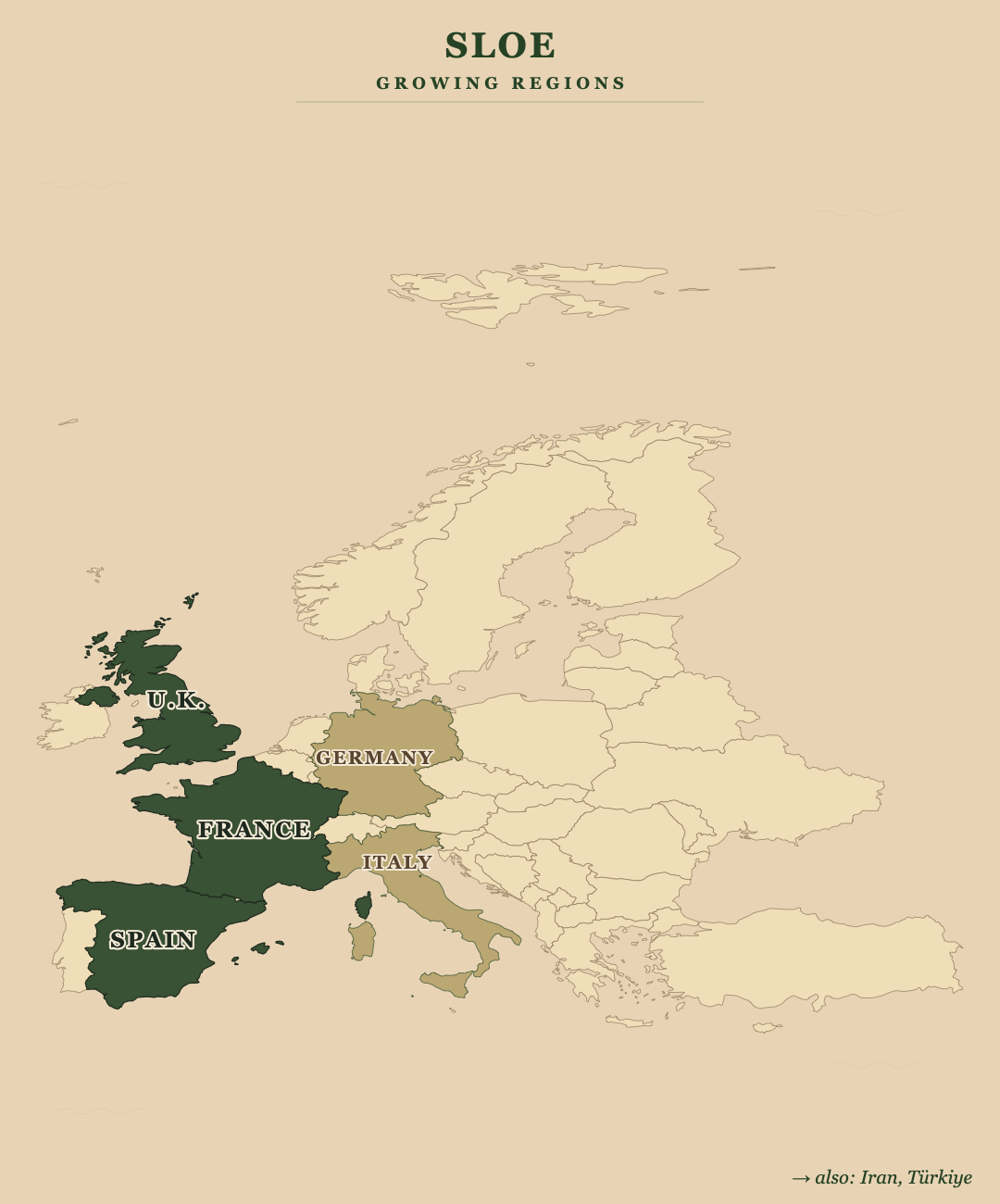
Sloe is primarily cultivated in United Kingdom, France, Spain, with secondary growing regions in Germany, Italy, Türkiye, western Asia.
Spice Story
The sloe is the original hedgerow harvest. For generations across Britain, the ritual was fixed to the calendar: wait for the first frost of late autumn, then go out and gather the blue-black fruit, traditionally pricking each one with a blackthorn spine before dropping it into gin and sugar. [source] The frost was the point — it softens the fierce tannins and coaxes the fruit toward something you can actually drink. As the months pass, the alcohol draws an almond-like essence out of the stones, and the skins bleed a deep ruby colour into the jar. [source] The same fruit travels south, too: in Navarre and the Basque country, sloes are macerated with anise to make pacharán, a russet liqueur poured over ice after dinner. [source] Few botanicals carry their folklore quite so completely into the glass.
Gin Creativity
Sloe is less a top-note botanical and more a transformation — it turns a clear gin into a ruby liqueur. A full sachet steeped with sugar over several months gives you a true sloe gin: tart, almond-edged, deeply coloured. A partial amount lets the dark-plum fruit support a juniper-forward spirit without taking it over. Lean into the almond by pairing with a little true almond or cinnamon; keep it bright by leaving the juniper and orange peel in play.
Blending Science
Main flavour compounds
 Benzaldehyde—
 Benzyl alcohol—
 Malic acid—
 Cyanidin-3-glucoside—
Pairs well with
Sloe's signature almond character is benzaldehyde, the bitter-almond / marzipan aroma the alcohol slowly extracts from the fruit's stone during a long maceration. [source] A softer floral-almond benzyl alcohol rides alongside it in the macerate. [source] The bright tartness is malic acid, the fruit's predominant organic acid at around 1.2 g per 100 g. [source] The ruby colour is anthocyanin pigment, led by cyanidin-3-glucoside, which leaches from the skins. [source] Behind all of it sit the tannins that make a fresh sloe so astringent — sugar and a long, cool steep are what tame them. [source]
Food Partners
- Dark chocolate: the bitter-almond and tart fruit cut richness and echo a black-forest note.
- Game and roast duck: sloe's sharp dark fruit is a classic foil to rich, gamey meat.
- Aged hard cheese: tannin and acidity stand up to a mature cheddar or manchego.
- Almond desserts: the stone-derived benzaldehyde makes frangipane and bakewell a natural match.
- Stewed apple and plum: sister stone-and-orchard fruit that amplifies sloe's wild-plum side.
Cocktails To Try

- Sloe Gin Fizz: the definitive serve — sloe gin, lemon, sugar, soda, long over ice.
- Sloe gin (neat): the liqueur itself, sipped after dinner like a hedgerow port.
- Plymouth Sloe Gin: made at Black Friars Distillery to an 1883 recipe, steeped about four months at 26% ABV. [source]
- Sipsmith & Hayman's: Sipsmith vintage-dates its bottlings; Hayman's revived a family sloe gin in 2009 from wild English sloes. [source]
Release The Flavour
- Frost first: freeze the sloes before steeping to split the skins and mellow the tannins, just as a winter frost would.
- Time: this is a slow botanical — give it three to six months for the colour and almond to develop fully.
- Alcohol: the stone's almond essence is alcohol-extracted; a higher-proof gin pulls it faster.
- Sugar: add it to balance the malic-acid tartness and tame the astringency — taste and adjust as it matures.
Discover more
From the same region
Pairs well with
Same flavour family

Surprise me

Sources & Citations
- scientific_name (Prunus spinosa L., Rosaceae, ACCEPTED):GBIF Backbone Taxonomy, usageKey 3023221 (Prunus spinosa ...
- plant_description (5 m shrub, thorns, white flowers before leaves, 10–12 mm blue-black drupe, native Europe/W Asia, hedgerow):en.wikipedia.org/wiki/Prunus_spinosa
- commercial_preparation_and_timing (foraged from hedgerows; picked after first frost late Oct–early Nov; prick/freeze to split skins; steep whole with stone; stone gives almond essence):en.wikipedia.org/wiki/Sloe_gin
- sloe_gin_method_and_abv (sugar ~110 g per pint of sloes, ≥3 months; 15–30% ABV traditional; EU minimum 25% ABV; almond-like essence from the stones):en.wikipedia.org/wiki/Sloe_gin
- compound_benzaldehyde (principal almond/bitter-almond aroma volatile; CID 240):en.wikipedia.org/wiki/Sloe_gin (almond essence from stone...
- compound_benzyl_alcohol (characterising sloe-liqueur co-volatile; CID 244):Springer, Quantification of significant volatile componen...
- compound_malic_acid (predominant organic acid ~1.245 g/100 g; CID 525):Sensory/Biochemical Properties of Wild Blackthorn (P. spi...
- compound_cyanidin_3_glucoside (principal anthocyanin pigment; CID 197081):Polyphenol-Enriched Extracts of P. spinosa Fruits, Molecu...
- tannins_astringency (tannins responsible for the fruit's astringency):www.ayurtimes.com/prunus-spinosa-blackthorn/
- pacharan (Basque/Navarrese liqueur from sloes macerated with anise):Springer, Quantification of significant volatile componen...
- plymouth_sloe_gin (1883 recipe, Black Friars Distillery, hedgerow sloes, ~4 months steep, 26% ABV):www.plymouthgin.com/en/product/plymouth-sloe-gin/
- sipsmith_haymans (Sipsmith vintage-dated, freezes sloes; Hayman's launched sloe gin 2009, wild English sloes):imbibemagazine.com/taste-test-sloe-gin/
- non_culinary_uses (blackthorn wood for walking sticks/shillelagh; stock-proof hedging):en.wikipedia.org/wiki/Prunus_spinosa
- hero_image:iStock royalty-free licence (asset 1263846593)
