
RHUBARB

- Botanical name
- Rheum rhabarbarum
- Also known as
- Garden rhubarb, Wine-plant, Pie-plant
- Main flavour compound
- Malic acid
- Part used
- Stalk / petiole (leaf stalk) — leaves are toxic and never used
- Method of cultivation
- A herbaceous perennial of the family Polygonaceae, growing from short, thick rhizomes and throwing up large triangular leaves on fleshy, often crimson petioles. Hardy and long-lived, it is grown as a field crop in temperate regions. The prized "forced" rhubarb is raised by storing the roots in fields for two years, then moving them into heated, totally dark sheds to draw up tender, pale-crimson early stalks.
- Commercial preparation
- Only the petiole (leaf stalk) is harvested; the large leaves are discarded because they carry toxic levels of oxalic acid and anthrone glycosides. Forced Yorkshire rhubarb is pulled by hand in the dark — historically by candlelight, since strong light halts growth. Stalks are sold fresh, or pressed for juice and cordial.
- Non-culinary uses
- The root (a separate part from the edible stalk) has a long history as a medicinal purgative in Chinese and later European pharmacy; ornamental Rheum species are grown for their dramatic foliage.
Rhubarb — Rheum rhabarbarum — is a hardy herbaceous perennial of the knotweed family, Polygonaceae, growing from short, thick rhizomes. [source] Each spring it throws up huge triangular leaves on fleshy, often crimson leaf-stalks. It is those stalks — the petioles — that you eat and distil; the broad leaves are left in the field because they carry toxic levels of oxalic acid and anthrone glycosides. [source] A robust, long-lived clump-former, it is grown right across the temperate world.
Fresh stalk
Trim and discard the leaf and base, chop the stalk into chunks, then macerate in spirit with sugar.
Rhubarb cordial / pressed juice
A fast way to build colour and tart fruit without long maceration.
Region of cultivation
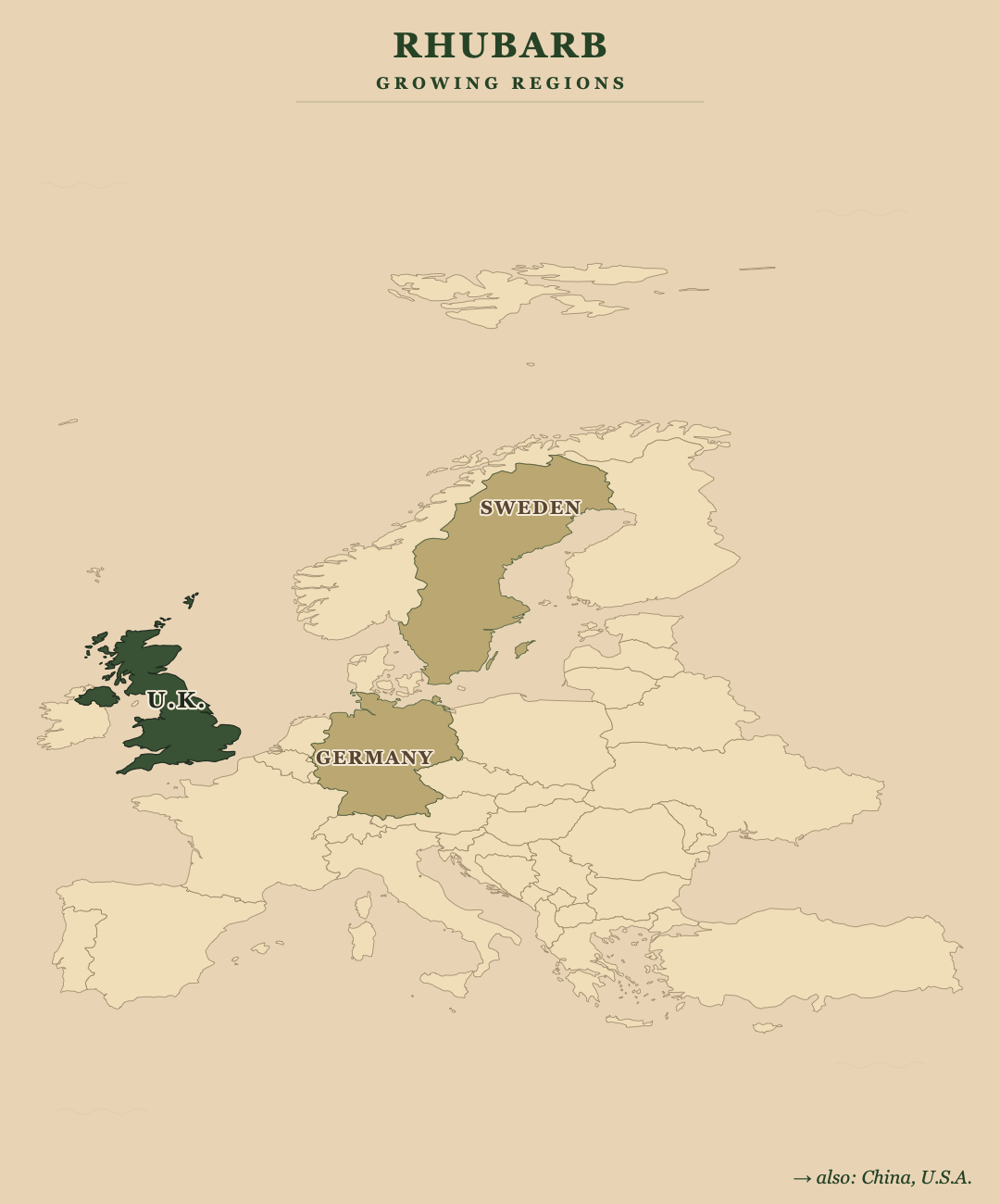
Rhubarb is primarily cultivated in United Kingdom, with secondary growing regions in Sweden, Germany, China and Siberia (native range of Rheum), North America.
Spice Story
Rhubarb travelled to your glass the long way round. The plant is Asian — Rheum is native to China and Siberia, where the root was prized as "the great yellow," a medicine recorded in Chinese herbals nearly two thousand years ago. [source] Carried west along the Silk Road, dried medicinal root reached Europe by the 14th century through the ports of Aleppo and Smyrna as "Turkish rhubarb," later eclipsed by quality-controlled "Russian rhubarb." [source] Only much later did anyone eat the stalk: Scotland harvested it from at least 1786, England around 1820. [source] Its great theatre is the Yorkshire Rhubarb Triangle between Wakefield, Morley and Rothwell, where "forced" rhubarb is drawn up in pitch-dark heated sheds and pulled by candlelight — a craft awarded Protected Designation of Origin status in 2010. [source]
Gin Creativity
Rhubarb is a colour-and-tartness botanical rather than a juniper-style backbone. A full sachet, or fresh-pressed stalk juice, makes it the headline — that blush-pink, sour-sweet character behind every modern rhubarb gin. Used lightly it lifts a classic gin with a crisp, green-fruit tartness. Its natural partner is ginger, the pairing made famous by countless rhubarb-and-ginger gins; angelica and citrus peel sharpen it further.
Blending Science
Main flavour compounds
 Malic acid—
 Oxalic acid—
 Citric acid—
 (E)-2-Hexenal—
Rhubarb's signature is acid, not oil. The stalk's tartness comes from a total acidity of about 2–2.5%, mostly malic acid, with oxalic acid at roughly 10% of that total giving the sharp, mouth-puckering edge, and citric acid adding a secondary brightness. [source] Those acids are water-soluble, so cold maceration or pressed juice carries the sourness and colour straight into the spirit. The green, "fresh-cut stalk" top-note is a trace of C6 aldehydes — chiefly (E)-2-hexenal — shown by gas chromatography-olfactometry to be sensory-key to rhubarb aroma; these are delicate, so keep heat low to hold that lift. [source] Pair with ginger to warm the sourness; with strawberry to round it.
Food Partners
- Strawberries: the classic sweet foil to rhubarb's sourness.
- Custard and cream: dairy softens the acid into a dessert-shop comfort.
- Ginger: warm spice against tart fruit — the defining rhubarb pairing.
- Oily fish like mackerel: sharp rhubarb cuts richness like a squeeze of lemon.
- Roast pork and duck: a tart rhubarb sauce balances fatty roast meats.
Cocktails To Try

- Slingsby Rhubarb Gin: infused with Yorkshire rhubarb from the famous Rhubarb Triangle. [source]
- Edinburgh Rhubarb & Ginger: rhubarb macerated with warming ginger and a little lemon zest. [source]
- Whitley Neill Rhubarb & Ginger: a best-selling rhubarb-and-ginger expression — try it long with ginger ale.
- Rhubarb G&T: rhubarb gin, tonic, and a strawberry or fresh ginger garnish.
Release The Flavour
- Heat: keep it low — the green C6 top-note is fragile and the acids need no cooking to extract.
- Alcohol: spirit pulls colour and tartness readily from fresh stalk or pressed juice.
- Time: a short cold maceration captures bright sourness; long steeps deepen colour but can dull the fresh note.
- Water: acids are water-soluble, so a cordial or syrup made with the juice carries the flavour beautifully into a long drink.
Discover more
From the same region

Same flavour family

Surprise me

Sources & Citations
- scientific_name (Rheum rhabarbarum L., Polygonaceae):GBIF Backbone Taxonomy, usageKey 2888867 (Rheum rhabarbar...
- plant_form_perennial_polygonaceae:en.wikipedia.org/wiki/Rhubarb
- native_range_asia_china_siberia:en.wikipedia.org/wiki/Rhubarb
- medicinal_trade_silk_road_russia (Turkish/Russian rhubarb, reached Europe 14th c.):en.wikipedia.org/wiki/Rhubarb
- culinary_adoption_britain (Scotland from 1786; England c.1820):en.wikipedia.org/wiki/Rhubarb
- toxic_leaves_oxalic_acid_anthrone_glycosides (only stalk used):en.wikipedia.org/wiki/Rhubarb
- stalk_acidity (2–2.5% total; oxalic ~10%; mainly malic):en.wikipedia.org/wiki/Rhubarb
- rhubarb_triangle (Wakefield–Morley–Rothwell, forcing sheds, candlelight, PDO 2010):en.wikipedia.org/wiki/Rhubarb_Triangle
- aroma_volatiles_C6_e2hexenal (GC-olfactometry, sensory-key C6 compounds):Dregus & Engel, 'Volatile constituents of uncooked rhubar...
- gin_use_slingsby_rhubarb_triangle:www.spiritofharrogate.co.uk/products/slingsby-yorkshire-r...
- gin_use_edinburgh_rhubarb_ginger_maceration:yorkshirewonders.co.uk/edinburgh-gin-rhubarb-and-ginger-gin
- pubchem_cids:PubChem: malic acid CID 525, oxalic acid CID 971, citric acid CID 311, (E)-2-hexenal CID 5281168
- hero_image:iStock royalty-free licence (asset 120707136)
