
SAMPHIRE

- Botanical name
- Crithmum maritimum
- Also known as
- Rock samphire, Sea fennel, Paccassassi del conero, Herbe de Saint Pierre
- Main flavour compound
- Sabinene
- Part used
- Aerial (fleshy leaves/stems)
- Method of cultivation
- A perennial coastal plant growing to around 40–50 cm on rocky sea-cliffs, sea defences, and rocky outcrops along southern and western European coastlines. [source: https://en.wikipedia.org/wiki/Crithmum_maritimum] It is not commercially farmed at scale; most supply comes from wild harvesting or small-scale coastal cultivation. The aromatic fleshy leaves are harvested in spring and early summer before the greenish-yellow umbel flowers open.
- Commercial preparation
- Supplied dried or pickled; historically shipped in casks of seawater from the Isle of Wight to London markets. [source: https://en.wikipedia.org/wiki/Crithmum_maritimum] For gin distilling, dried aerial parts are the most practical form; fresh stems and leaves are also used where available. Sold as a specialty ingredient through forage suppliers or coastal food producers.
- Non-culinary uses
- Historically considered a medicinal herb by Nicholas Culpeper for digestive properties; the plant's essential oil is studied today for antioxidant and antimicrobial activity. [source: https://pmc.ncbi.nlm.nih.gov/articles/PMC11512020/]
Rock samphire — Crithmum maritimum — is a perennial of the Apiaceae family (the carrot and fennel clan) that clings to sea-cliffs, rocky outcrops and coastal defences along the Atlantic and Mediterranean coasts of Europe. [source] It grows to around 40–50 cm in a sprawling, antler-like form: fleshy, round-sectioned fronds clustered into greenish-yellow umbel flowers in summer, with woody stems at the base and hairless, succulent leaves above. [source] Pinch a frond and it releases an unmistakable hit of citrus, fennel and ocean air. This plant is the real samphire — not the saline succulent sold at the fishmonger.
Dried aerial parts
Concentrated aromatic character; crumble a small amount into a vapour basket or cold maceration.
Fresh stems and leaves
Bruise lightly to release the volatile oil; use in a short maceration — intensely aromatic, use sparingly.
Pickled in vinegar
Traditional preservation method; brine and acidity dominate, less suitable for distilling but good as a savoury garnish.
Region of cultivation
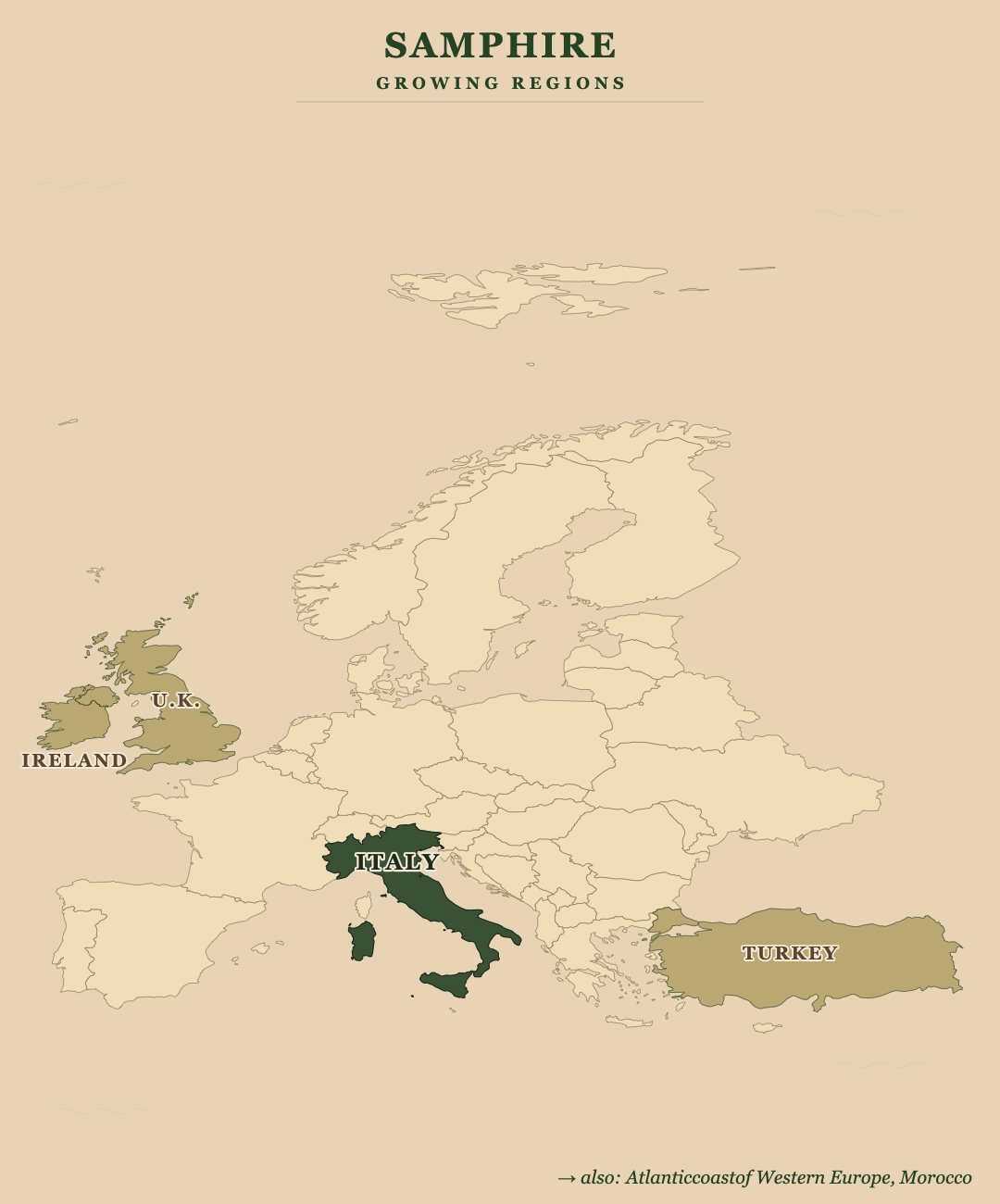
Samphire is primarily cultivated in Mediterranean Europe, Atlantic coast of Western Europe, with secondary growing regions in United Kingdom, Ireland, North Africa, Turkey.
Spice Story
In Act IV of King Lear, Edgar describes the terrifying view from a Dover cliff: "Hangs one that gathers sampire — dreadful trade!" [source] For centuries, foragers were lowered on ropes down sheer coastal cliffs to harvest it — which tells you something about how much Elizabethan England valued the flavour. Rock samphire was historically considered "true" samphire, the elite condiment: herbe de Saint Pierre, pickled in vinegar or shipped in casks of seawater from the Isle of Wight to London markets. [source] [source] Nicholas Culpeper praised its leaves as having "a pleasant, hot and spicy taste." [source] By the 19th century it had been largely displaced by the easier-to-harvest marsh samphire — a completely unrelated plant (Salicornia, Amaranthaceae) prized for salinity and crunch, with none of rock samphire's aromatic oils. [source] If you see "samphire" on a gin's botanical list, it's worth asking which one.
Gin Creativity
Rock samphire is a coastal gin botanical with real structural muscle — not just a salty note but a full aromatic herbal character. A full sachet builds a clifftop, sea-fennel gin in the spirit of coastal distilling; a partial amount adds a savoury, citrus-herbal edge that reads as "somewhere by the sea." Pair it with juniper and lemon peel for the classic maritime spine, or lean into the Apiaceae family and add fennel seed or coriander seed for a deeply herbal, fennel-and-sea coastal gin.
Blending Science
Main flavour compounds
 Sabinenepepper, warming
 gamma-Terpinenefresh pine, top note
 Dillapioleparsley, musky-green
 Limoneneclean citrus lift
Pairs well with
Rock samphire's essential oil is dominated by monoterpene hydrocarbons, but the exact mix shifts substantially with where the plant grew — you're working with a botanical that genuinely tastes different depending on its origin. [source] In Greek and Mediterranean plants, sabinene (up to 49%) anchors the profile: spicy, woody, with a warm citrus-peel quality. [source] γ-Terpinene (16–31% across all origins studied) adds a clean, slightly citrus-herbaceous brightness consistent from Greece to Libya. [source] [source] Dillapiole — the phenylpropanoid that carries the distinctive parsley/anise character — appears in Mediterranean and North African chemotypes but was entirely absent in Croatian plants. [source] Limonene anchors the citrus note (2–75% depending on origin), most pronounced in Croatian sea fennel. [source] A cool, short vapour infusion or maceration preserves the volatile top notes; over-extraction pushes the more resinous base notes to the foreground.
Food Partners
- Grilled fish: the fennel-citrus oil mirrors the classic fish-fennel pairing with a sea-salt backdrop.
- Oysters and shellfish: rock samphire and bivalves are a natural coastal match — aromatic where the shellfish is mineral.
- Pickled vegetables: the traditional preparation; the aromatic oils hold up beautifully against vinegar acidity.
- Goats cheese: the herbal brightness cuts through the lactic richness.
- Lemon butter sauce: sabinene and limonene echo the lemon; the fennel character deepens the butter.
- Italian seafood pasta: the Adriatic tradition uses paccassassi del conero (rock samphire) in pasta and seafood dishes along the Marche coast.
Cocktails To Try

- Coastal G&T: a rock samphire-forward gin with a premium tonic and a strip of lemon peel — clifftop air in a glass.
- Maritime Martini: rock samphire gin with a dry vermouth and a samphire garnish; the fennel-herbal note plays beautifully against dry, nutty vermouth.
- Sea Fennel Gimlet: samphire gin, fresh lime, a touch of simple syrup — the citrus oil in the botanical lifts the lime into something more complex.
Release The Flavour
- Heat: gentle vapour infusion works well — the monoterpenes are volatile and a light touch preserves the citrus-fennel brightness.
- Alcohol: the essential oil is highly soluble in spirit; even a brief cold maceration releases significant character — less is more.
- Time: short contact (4–8 hours) gives citrus and fennel; extended maceration emphasises the heavier, more resinous base notes.
- Quantity: rock samphire is intensely aromatic; a quarter sachet is a meaningful amount in a distillation.
Discover more
From the same region
Pairs well with
Same flavour family
Surprise me

Sources & Citations
- scientific_name (Crithmum maritimum L., ACCEPTED, Apiaceae):GBIF Backbone Taxonomy, usageKey 3632234 (Crithmum mariti...
- plant_description (perennial to 40–50 cm, rocky sea-cliffs and outcrops, fleshy hairless leaves, greenish-yellow umbel flowers, yellow/purple fruit 5–6 mm):en.wikipedia.org/wiki/Crithmum_maritimum
- habitat (sea cliffs, sea defences, rocky outcrops, precipitous coastal cliffs, shingle foreshores; common England, rare Scotland except Galloway/South Ayrshire):gallowaywildfoods.com/rock-samphire-identification-edibil...
- flavour_profile (lemon, salt, seaweed, fennel/aniseed, intensely aromatic carrot/parsley; some describe as kerosene-like):gallowaywildfoods.com/rock-samphire-identification-edibil...
- Culpeper_hot_spicy (Nicholas Culpeper described leaves as having a 'pleasant, hot and spicy taste'):en.wikipedia.org/wiki/Crithmum_maritimum
- Isle_of_Wight_cask_trade (shipped in casks of seawater from the Isle of Wight to London in the 19th century):en.wikipedia.org/wiki/Crithmum_maritimum
- Shakespeare_King_Lear (Edgar: 'Hangs one that gathers sampire- dreadful trade!', Act IV Scene 6):www.opensourceshakespeare.org/views/plays/play_view.php?W...
- rock_vs_marsh_confusion (rock samphire = aromatic Apiaceae; marsh samphire = saline Amaranthaceae; rock samphire largely replaced by marsh by 19th century due to harvest difficulty):www.britannica.com/plant/samphire ; gallowaywildfoods.com...
- compounds_sabinene_49pct_gammaterpinene_31pct (Greek cultivated sea fennel GC-MS: sabinene 49.45%, gamma-terpinene 31.37%, alpha-pinene 9.57%, limonene 2.73%):Pasias et al., Chemical Composition of Essential Oils of ...
- compounds_thymylmethylether_56pct_gammaterpinene_16pct (Libyan C. maritimum GC-MS: thymyl methyl ether 56.86%, gamma-terpinene 16.17%; comparison with Tunisia 20–40%, Turkey 7–29%, Portugal 12–15%):Ismail et al., Chemical composition, antioxidant, and enz...
- compounds_limonene_74pct_Croatian_dillapiole_absent (Croatian sea fennel: limonene 74.85% leaves, sabinene 15.72% flowers, dillapiole completely absent — chemotype II):Slišković et al., Biological Activities of Essential Oils...
- pubchem_cids (sabinene 18818; gamma-terpinene 7461; dillapiole 10231; limonene 5989):PubChem compound name lookup — pubchem.ncbi.nlm.nih.gov/
- medicinal_antioxidant_antimicrobial:pmc.ncbi.nlm.nih.gov/articles/PMC11512020/
- hero_image:iStock royalty-free licence (asset 1295251931)
