
WORMWOOD

- Botanical name
- Artemisia absinthium
- Also known as
- Absinthe wormwood, Grand wormwood, Common wormwood
- Main flavour compound
- Alpha-Thujone (regulated)
- Part used
- Dried flowering top and leaf
- Method of cultivation
- Hardy perennial herb of the Asteraceae family (the daisy family, same genus as tarragon, mugwort and sagebrush), native to temperate Eurasia and northern Africa, naturalised widely across North America. The plant grows 1 metre tall, with silvery-grey deeply-divided leaves and small yellow flowers. Thrives in dry, lime-rich (calcareous) soils, full sun, and is drought-tolerant. Harvested in July or August during flowering when essential-oil content is at its peak.
- Commercial preparation
- Aerial parts (flowering tops and leaves) are cut, bundled, and dried at 40°C indoors or outdoors. Quality is graded on freshness and presence of intact flowering structures.
- Non-culinary uses
- Foundational ingredient in the spirit absinthe (the species name *absinthium* gave absinthe its name) and several Italian *amari* and traditional vermouths; medieval European brewing (replaced largely by hops); traditional medicine. **Regulatory note:** Wormwood essential oil contains thujone — a compound that is regulated in many jurisdictions. The EU permits thujone in alcoholic beverages with strict concentration limits; the US permits "thujone-free" wormwood products. Verify local regulations before commercial gin use.
Wormwood — Artemisia absinthium — is a hardy perennial herb of the Asteraceae family, native to temperate Eurasia and northern Africa. The plant grows about 1 metre tall, with distinctive silvery-grey deeply-divided leaves and small yellow flowers in summer. Latin absinthium — and the modern word "absinthe" — both derive from Greek apsinthion, meaning "undrinkable" or "bitter beyond bearing" — a reference to the plant's extraordinarily bitter character. [source] Wormwood is one of the great "bittering" herbs of European drinks tradition.
Whole dried leaf and flowering top
The standard form — crumble lightly to release the oils.
Cracked
Faster extraction.
Region of cultivation
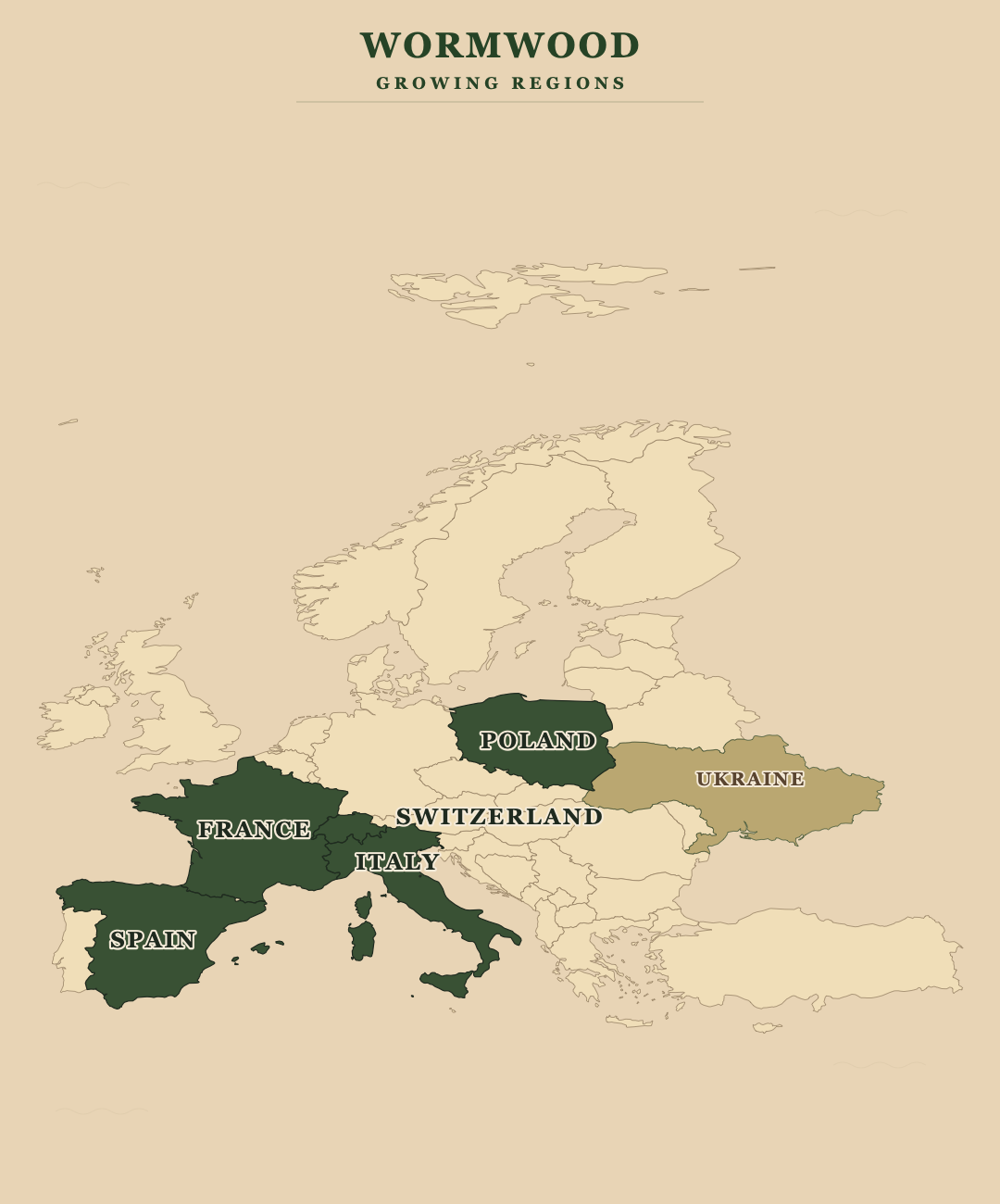
Wormwood is primarily cultivated in France, Switzerland, Spain, Italy, Eastern Europe, with secondary growing regions in USA, Canada, Russia, Morocco.
Spice Story
Gin Creativity
Wormwood brings intensely bitter herbal character with a sage-camphor depth. A quarter sachet is plenty — wormwood is one of the most bitter natural compounds in the spice rack. Pair with anise and fennel seed for a vermouth-leaning profile, or with angelica root and liquorice for old-style genever character.
Blending Science
Main flavour compounds
 Alpha-Thujone (regulated)—
 Beta-Thujone—
 Absinthin (signature bitter compound)—
 Chamazulene—
Pairs well with
Alpha-thujone and beta-thujone are the regulated compounds — both bicyclic monoterpene ketones contributing bitter-camphor character. Absinthin is the dominant bitter compound — a sesquiterpene lactone present only in Artemisia absinthium — and is responsible for the extraordinary bitterness rather than the thujone. Chamazulene develops during distillation and provides the famous blue colour of some absinthe preparations. Cool extraction preserves the brighter top notes; warm extraction develops the deep bitter body.
Food Partners
- Vermouth-based aperitifs — wormwood is foundational.
- Italian amari — Fernet-Branca contains wormwood; many other amari do too.
- Traditional Eastern European liqueurs — pelinkovac (Balkan wormwood spirit).
- Bitter culinary applications — wormwood used sparingly in game.
- Game-meat reductions — wormwood in venison glazes (very sparingly).
Cocktails To Try

- Vermouth Cocktail — wormwood gin, sweet vermouth — minimal wormwood concentration.
- Sazerac (with wormwood gin) — wormwood gin in place of rye, absinthe rinse.
- Italian Negroni — wormwood gin (small amount), Campari, vermouth.
Release The Flavour
- Use sparingly — wormwood's bitterness is exceptional.
- Verify legal status — thujone regulations vary by jurisdiction.
- Cool extraction — preserves the brighter aromatic top.
- Source matters — Roman wormwood (A. pontica) is lower-thujone than common A. absinthium.
Discover more
From the same region

Pairs well with
Same flavour family
Surprise me

Sources & Citations
- scientific_name (Artemisia absinthium, Asteraceae):en.wikipedia.org/wiki/Artemisia_absinthium
- native_range (temperate Eurasia, north Africa):en.wikipedia.org/wiki/Artemisia_absinthium
- thujone_content_concerns_and_regulation:en.wikipedia.org/wiki/Artemisia_absinthium
- absinthe_naming_and_history:www.alcoholprofessor.com/blog-posts/bitter-botanicals-wor...
- absinthin_signature_bitter_compound:en.wikipedia.org/wiki/Artemisia_absinthium
- main_flavour_compounds (CSV-sourced):inputs/source.csv — Wormwood row
