
MINT

- Botanical name
- Mentha spicata
- Also known as
- Spearmint, Garden Mint, Common Mint, Lamb Mint
- Main flavour compound
- R-(−)-Carvone
- Part used
- Leaf
- Method of cultivation
- Spearmint is a vigorous perennial herb, 30–100 cm tall, with square stems and pointed, serrated leaves 5–9 cm long — the "spear" of the common name. Native to Europe and southern temperate Asia, from Ireland east to southern China, it spreads readily by underground runners and thrives in moist, fertile soils in full sun or partial shade across temperate climates worldwide.
- Commercial preparation
- Spearmint leaves are harvested just before flowering, when essential oil content peaks, then steam-distilled for oil or dried and traded as whole or cut leaf. The USA — primarily Washington, Oregon, Idaho and Indiana — produces the majority of the world's commercially traded spearmint oil; India (Uttar Pradesh) is the leading global producer and exporter overall.
- Non-culinary uses
- Spearmint oil is used in perfumery and personal care (toothpaste, mouthwash, chewing gum); medicinally it has traditional uses in digestive and respiratory complaints; ornamental ground-cover in herb gardens.
Spearmint — Mentha spicata — is the mint that sits on your kitchen bench and edges kitchen gardens across the temperate world. A perennial that spreads by underground runners, it grows 30–100 cm tall on square stems — that four-sided stem is the Lamiaceae family's calling card — carrying pointed, serrated leaves that give the plant its name. [source] Brush one and the scent is instant: sweet, cool and unmistakably minty without any of peppermint's medicinal sharpness. Native from Ireland east to southern China, it now grows on every continent that can keep it moist. [source]
Fresh leaf
Muddled, torn, or bruised fresh for maximum cooling aroma; the gin and cocktail standard.
Dried whole leaf
Milder and earthier than fresh; works in still-gin macerations and botanical blends.
Essential oil
Highly concentrated carvone hit — use in micro-drops only for flavouring.
Region of cultivation
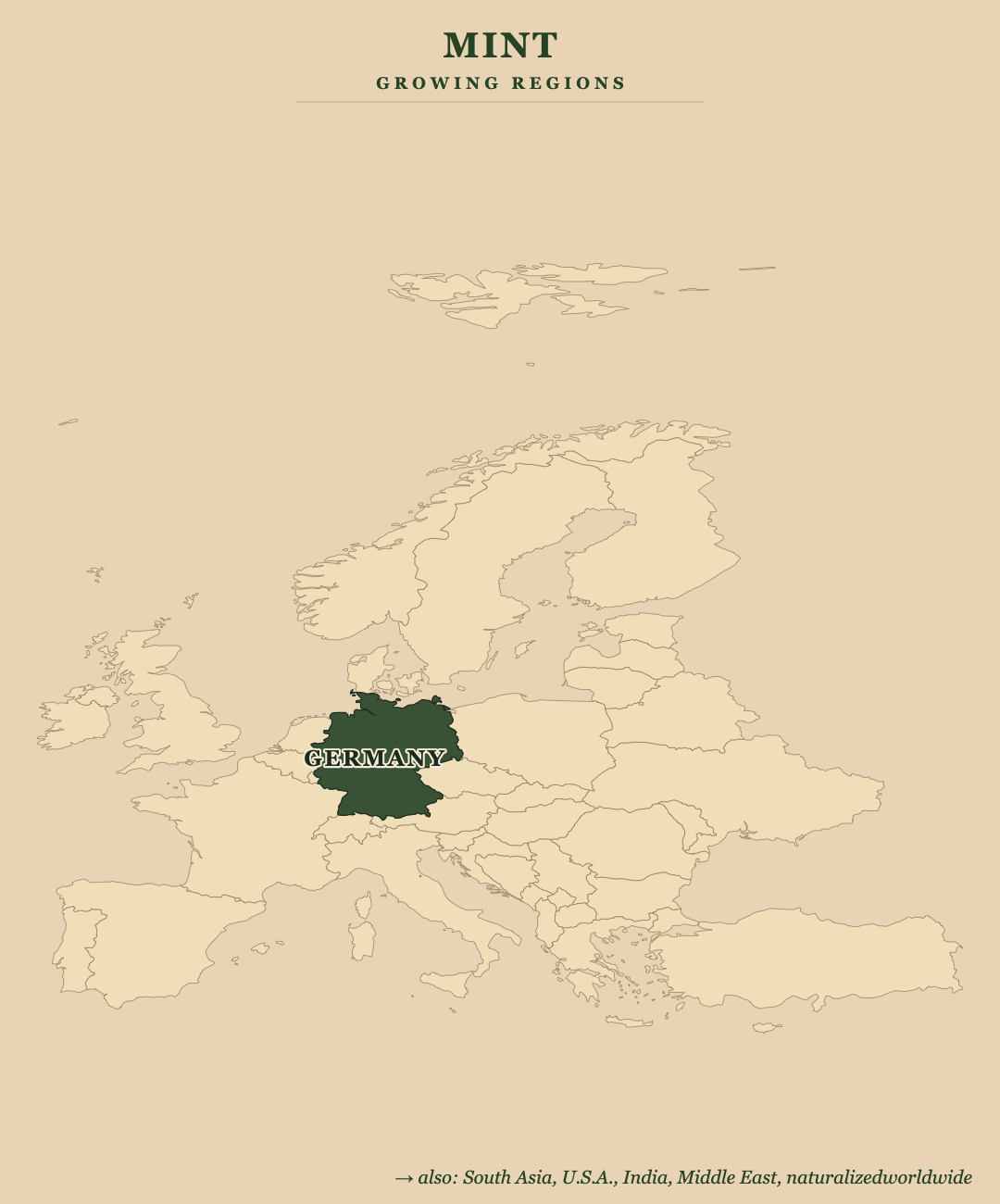
Mint is primarily cultivated in Europe, South Asia, with secondary growing regions in North America, India, Middle East, naturalized worldwide.
Spice Story
Mint has been in the record since the earliest cultivated gardens. The Romans are believed to have carried it to Britain as part of their herbal repertoire, and by around 1739 it was established in American gardens too — brought, like so much of the European kitchen, by colonists who couldn't imagine cooking without it. [source] By 1750, commercial distillation of spearmint oil was already underway in England, spreading to the Netherlands in 1770 and then through France and Germany. [source] Today, India and the United States together dominate global production — Washington state alone accounts for around 75% of US output, with total American spearmint oil production running to 2.9 million pounds in 2021. [source] That commercial ubiquity is part of the story: spearmint is everywhere because it works everywhere — in chewing gum, toothpaste, lamb sauces and, increasingly, in the gin still.
Gin Creativity
Spearmint is a bright, supporting botanical rather than a lead act — think of it as the aromatic freshness that opens a spirit before juniper and citrus close it down. A partial sachet lifts a G&T into something garden-green and cooling; a full sachet risks tipping the balance into herbal-toothpaste territory. Pair it with lemon peel for sherbet-like brightness, cucumber for a spa-fresh gin, or elderflower to soften the mint's edge into something floral and gentle. Keep maceration short and cold.
Blending Science
Main flavour compounds
 R-(−)-Carvonecaraway, minty
 1,8-Cineoleeucalyptus, cool
 Limoneneclean citrus lift
 (E)-β-Damascenone—
Pairs well with
Spearmint's flavour identity is built around four compounds. R-(−)-carvone — the dominant odorant, around 37% of the essential oil by weight — delivers the sweet, clean mint signature that you'd call "spearmint" before you'd call it anything else; it's why spearmint reads as softer and more confectionery-like than peppermint's menthol heat. [source] 1,8-Cineole (eucalyptol) adds a second, cooler dimension — slightly camphoraceous and airy, the note that makes a spearmint gin feel as much like a fresh breeze as a herb. [source] Limonene at around 10% gives a clean citrus lift that brightens the top of the palate. [source] Underneath those three, (E)-β-damascenone contributes a warm, rose-like fruity depth that rounds out what would otherwise be a purely sharp-green profile. [source] All of these volatiles are delicate — gentle maceration preserves them; heat drives them off fast.
Food Partners
- Lamb: the classic pairing — mint's carvone cuts through fat and sweetness simultaneously.
- Peas and broad beans: the original kitchen-garden match; spearmint's green sweetness echoes theirs.
- Dark chocolate: cooling mint against bitter cocoa is a pleasure older than After Eights.
- Watermelon: spearmint lifts watermelon's sweetness into something bright and almost sherbet-like.
- Greek yoghurt and fruit: the cool mint note extends yoghurt's freshness and ties it to any stone fruit.
- Vietnamese and Thai salads: torn fresh spearmint is a structural element in South-East Asian herb plates — the sweetness balances chilli and fish sauce.
Cocktails To Try

- The Southside: gin's answer to the mojito — London Dry gin, lemon, sugar and fresh mint, first documented in a Gordon's advertisement in 1913. [source] Spearmint is the natural choice here: sweet enough not to fight the gin, bright enough to hold its own against citrus.
- The Mint Julep: bourbon's drink, but spearmint is the traditional Southern choice, especially in Kentucky. [source] A mint-forward gin works beautifully in place of bourbon for a summer riff — over crushed ice, with a mint bouquet buried in the cup.
- The Botanist Islay Dry Gin: one of the few commercially bottled gins that declares spearmint (Mentha spicata) as one of its 22 hand-foraged Islay botanicals — a reference point for how subtly the herb can sit inside a complex botanical blend. [source]
Release The Flavour
- Heat: keep it cool — the carvone and cineole that give spearmint its character are volatile and flee fast under heat; room-temperature or cold maceration only.
- Alcohol: higher ABV pulls carvone readily; macerate in base spirit at cask strength, then dilute, to maximise aromatic intensity.
- Time: short is better — 30–60 minutes for fresh leaf, a few hours for dried; over-maceration pushes stalky, chlorophyll-bitter notes forward.
- Water: a small splash of cold water after maceration can open the aroma, the same way it opens a whisky.
Discover more
From the same region

Same flavour family
Surprise me

Sources & Citations
- scientific_name + gbif_usage_key (Mentha spicata L., ACCEPTED, Lamiaceae, 2927175):GBIF Backbone Taxonomy — api.gbif.org/v1/species/2927175
- plant description (height 30-100 cm, leaves 5-9 cm, serrated, square stems, name from pointed tips, native range Ireland to southern China):Wikipedia 'Spearmint' — en.wikipedia.org/wiki/Spearmint
- Romans introduced mint to Britain; established American gardens by ~1739:homestead.org 'Facts and History about Mint' — www.homest...
- commercial cultivation England by 1750; Netherlands 1770, France and Germany after:homestead.org 'Facts and History about Mint' — www.homest...
- USA leading producer (Washington, Oregon, Idaho, Indiana); India largest global producer/exporter; US total 2.9 million lb spearmint oil 2021:aghires.com 'The U.S. Produces Over 70% of the World's Mi...
- compound R-(-)-carvone = highest OAV odorant in spearmint oils (all three studied); 1,8-cineole, β-damascenone, (E,Z)-2,6-nonadienal, undecatriene also top OAV:Kelley & Cadwallader 2018, J. Agric. Food Chem. 66:2414-2...
- compound percentages (carvone 37%, limonene 10.3%, 1,8-cineole 5.1%, neo-dihydrocarveol 7.7%, linalool 4.2%):Moradi-Sadr, Ebadi & Ayyari 2023, Front. Plant Sci. 14:12...
- pubchem_cids (R-(-)-carvone 439570; 1,8-cineole 2758; limonene 440917; beta-damascenone 5366074):PubChem compound lookup — pubchem.ncbi.nlm.nih.gov/compou...
- spearmint is ingredient in mojito and mint julep (Wikipedia):Wikipedia 'Spearmint' — en.wikipedia.org/wiki/Spearmint
- mojito origin Havana Cuba; first recipe 1927 'El Arte De Hacer un Cocktail y Algo Más'; rum base; Cuban preferred mint = Mentha × villosa; spearmint the outside-Cuba substitute:Difford's Guide mojito history — www.diffordsguide.com/g/...
- Southside cocktail; first documented reference 1913 in Gordon's advertisement; Hugo Ensslin 1917 fizzy version; gin base; disputed origin (Chicago South Side, Southside Sportsmen's Club Long Island, Al Capone):Wikipedia 'South Side (cocktail)' — en.wikipedia.org/wiki...
- The Botanist Islay Dry Gin lists spearmint/garden mint (Mentha spicata) as one of 22 native Islay botanicals:Difford's Guide 'The Botanist Islay Dry Gin' — www.diffor...
- mint julep origin southern USA c. 18th century; first mention 1770; bourbon association post-1770s westward migration; Kentucky Derby association since 1938; spearmint is traditional Kentucky choice:Wikipedia 'Mint Julep' — en.wikipedia.org/wiki/Mint_julep...
