
KUMQUAT

- Botanical name
- Citrus japonica
- Also known as
- Fortunella japonica, Fortunella margarita, Golden orange, Cumquat
- Main flavour compound
- Limonene
- Part used
- Whole fruit (sweet edible peel)
- Method of cultivation
- A small, dense, thornless evergreen citrus tree of the Rutaceae family, growing roughly 2.5–4.5 metres tall with glossy leaves. It bears small olive-sized golden-orange fruit, distinctive among citrus because the sweet rind is eaten whole along with the tart inner flesh. The most cold-hardy of the citrus relatives, it is grown across East and Southeast Asia and warm-temperate regions worldwide.
- Commercial preparation
- Fruit is hand-picked when fully coloured. For gin and flavouring, the whole fruit is used fresh, candied, or made into marmalade and liqueurs; the peel oil can also be cold-pressed. Production centres include Corfu (Greece) and Dade City, Florida, alongside its East Asian heartland.
- Non-culinary uses
- Widely grown as an ornamental and as a symbol of prosperity at Lunar New Year; the fruit and peel are also used in traditional preserves and confectionery.
Kumquat — Citrus japonica — is the smallest and most cold-hardy of the citrus clan: a dense, thornless evergreen tree growing only 2.5–4.5 metres tall, with glossy leaves and fruit no bigger than a large olive. [source] Its trick is upside-down: the golden-orange rind is sweet and the inner flesh is tart, so the whole fruit is eaten in one bite, peel and all. [source] Botanists once gave it its own genus, Fortunella, before folding it back into Citrus.
Fresh whole fruit
Halve or muddle and macerate whole — peel and flesh together.
Dried slices
Concentrated sweet-bitter zest; rehydrates in the still.
Marmalade / preserve
A distiller's shortcut to deep candied-citrus character.
Region of cultivation
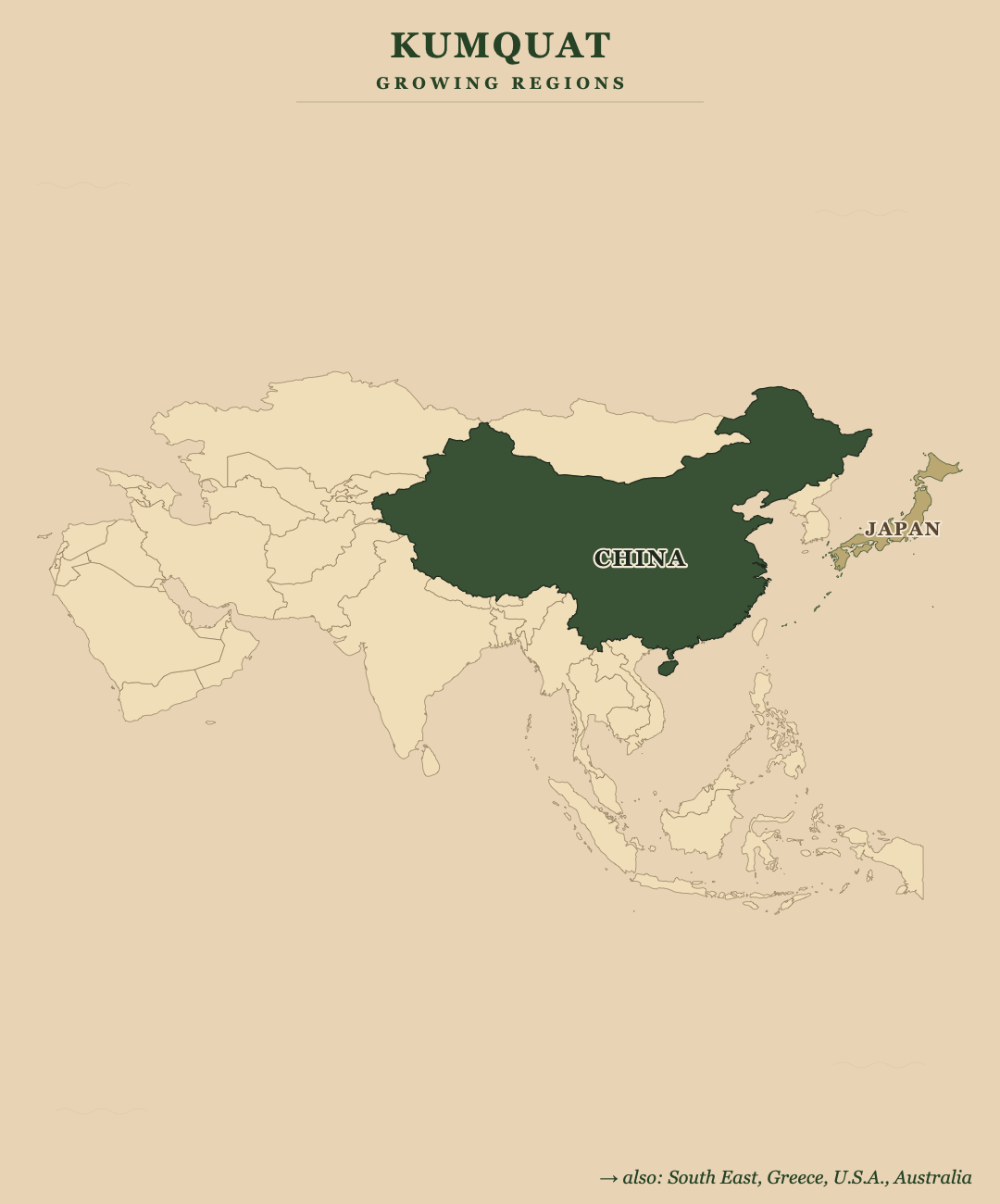
Kumquat is primarily cultivated in China, with secondary growing regions in Japan, Southeast Asia, Greece (Corfu), United States (Florida), Australia.
Spice Story
The kumquat has been treasured in southern China for the best part of a thousand years — it appears in Chinese literature from at least the 12th century. [source] Its very name is a fragment of Cantonese carried whole across the world: gam-gwat, "golden orange". [source] The fruit reached Europe in 1846, brought back by Robert Fortune, the plant-hunter and tea-secret thief collecting for the London Horticultural Society; the segregate genus Fortunella was later named in his honour. [source] From China it spread to Japan, the Mediterranean — Corfu still trades on its kumquat liqueurs — and to Florida and Australia. [source] Like a miniature still-life painted in citrus, it carries warmth and prosperity, and is hung up for luck at Lunar New Year.
Gin Creativity
Kumquat is a rare citrus you can distil whole — no separating zest from pith, because the peel is the sweet part. A full sachet builds a bright, bittersweet marmalade-citrus heart; a partial amount lifts a juniper-forward gin with rounded orange warmth. It loves company: pair with Orange Peel and Coriander Seed for a classic citrus spine, or contrast with Pink Pepper and Cinnamon for a spiced winter gin.
Blending Science
Main flavour compounds
 Limoneneclean citrus lift
 Myrcenegreen, hoppy body
 Citronellyl acetate—
 Citronellyl formate—
Pairs well with
- Juniper
- Coriander Seed
- Orange Peel
- Lemon Peel
- Cinnamon
- Pink Pepper
Limonene dominates kumquat peel oil at around 94%, carrying the clean, fresh, unmistakably-citrus body. [source] Myrcene sits behind it with a soft, resinous-sweet lift. But the signature is not the bulk monoterpenes: researchers single out two trace esters, citronellyl acetate and citronellyl formate, as the characteristic odour notes that make kumquat smell like kumquat rather than generic orange. [source] Limonene is volatile and alcohol-soluble, so a gentle, brief maceration protects those delicate rosy-floral esters; long, hot contact flattens them toward plain citrus.
Food Partners
- Marmalade and candied-citrus desserts: kumquat's sweet peel is built for sugar and slow cooking.
- Duck and rich poultry: its bittersweet acidity cuts fat cleanly.
- Dark chocolate: bitter-sweet against bitter-sweet.
- Soft cheeses: a kumquat preserve lifts brie or goat's curd.
- Ginger and warm spice: the citrus oils sit naturally with warmth.
Cocktails To Try

- Kumquat Bee's Knees: the honey-and-lemon classic given a marmalade heart — muddle a halved kumquat in with the honey syrup before you shake, and the sweet peel and tart flesh make the whole drink taste of bittersweet candied citrus.
- Kumquat Tom Collins: a long, sparkling Collins of gin, lemon, sugar and soda, with muddled kumquat folded through — the result reads like a grown-up marmalade soda, bright and bittersweet over ice.
- Golden Aviation: the violet-tinged classic of gin, maraschino, crème de violette and lemon, swapping in a little kumquat juice for the lemon — the rounded orange warmth softens the floral edge into something jewel-like.
Release The Flavour
- Heat: keep it gentle — high heat flattens the delicate citronellyl esters toward plain citrus.
- Alcohol: limonene is alcohol-soluble, so it gives readily into a strong macerate.
- Time: brief contact protects the rosy-floral top notes; long steeping pushes bitterness from the pith.
- Water: dilute slowly post-distillation — too fast and the citrus oils can louche and dull.
Discover more
From the same region

Pairs well with
Same flavour family
Surprise me

Sources & Citations
- scientific_name (Citrus japonica Thunb., Rutaceae, ACCEPTED):GBIF Backbone Taxonomy, usageKey 3831801 (Citrus japonica...
- synonyms (Fortunella japonica / margarita):en.wikipedia.org/wiki/Kumquat
- origin (southern China; first in Chinese literature from at least the 12th century):en.wikipedia.org/wiki/Kumquat
- history (introduced to Europe 1846 by Robert Fortune, London Horticultural Society; genus Fortunella named for him):en.wikipedia.org/wiki/Kumquat
- etymology (Cantonese gam-gwat, "golden orange"):en.wikipedia.org/wiki/Kumquat
- plant_form (2.5–4.5 m, thornless, glossy leaves, olive-sized fruit, sweet peel + acidic flesh eaten whole):en.wikipedia.org/wiki/Kumquat
- production_centres (Corfu Greece, Dade City Florida) + uses (marmalade, preserves, liqueurs):en.wikipedia.org/wiki/Kumquat
- peel_oil_limonene_94_myrcene_1.8 + characteristic odour = citronellyl formate & acetate (F. japonica peel oil):Choi, 'Characteristic Odor Components of Kumquat (Fortune...
- limonene_dominance_corroboration (F. crassifolia peel oil: limonene 74.79%, myrcene 7.11%):Chemical Composition and Antimicrobial Activity of the Es...
- pubchem_cids (limonene 440917, myrcene 31253, citronellyl acetate 9017, citronellyl formate 7778):PubChem — pubchem.ncbi.nlm.nih.gov/compound/D-Limonene ; ...
- named_gin (Cape Byron 'Shirl the Pearl', 650 bottles, Australian kumquats, NSW):www.theaureview.com/travel/food/cape-byron-distillery-has...
- named_gins (Bimber Kumquat Gin London; Copperfish Looe Gin fresh kumquat botanical blend):www.bimberdistillery.co.uk/product-page/kumquat-gin ; cop...
- hero_image:iStock royalty-free licence (asset 515234304)
