
JALAPENO CHILLI

- Botanical name
- Capsicum annuum 'Jalapeño'
- Also known as
- Jalapeño pepper, Cuaresmeño, Xalapeño (Spanish — "from Xalapa")
- Main flavour compound
- Capsaicin
- Part used
- Dried whole or sliced ripe pepper (green or red), or smoked-dried form (separately catalogued as chipotle)
- Method of cultivation
- Medium-sized chili pepper cultivar of *Capsicum annuum*, native to Mexico, particularly the state of Veracruz (the city of Xalapa is the origin of the name). The plant is a low bushy annual, with the pendulous green fruits 5–10 cm long that turn red when fully ripe. Commonly picked green for fresh consumption; ripe red jalapeños are usually smoked to make chipotle.
- Commercial preparation
- For the dried-chilli trade, ripe red jalapeños are picked and sun- or kiln-dried to brittle. The Scoville rating typically falls between 4,000 and 8,500 units, considered medium-heat — significantly less than cayenne (25,000–50,000) but more than poblano (1,000–2,000).
- Non-culinary uses
- Largely culinary; jalapeño is the dominant fresh chili in Mexican-American and Tex-Mex cuisine.
Jalapeño — Capsicum annuum 'Jalapeño' — is a medium-heat chili cultivar named after the Mexican city of Xalapa (capital of Veracruz state), where the variety was originally commercially developed. The plant is a low bushy annual rarely more than half a metre tall, with pendulous fruits 5–10 cm long and 25–38 mm wide that hang down from the branches. [source] Most commonly harvested while still green (the fully-mature unripe stage), the same fruit also ripens to deep red, orange or yellow if left on the plant; ripe red jalapeños are usually smoke-dried to make chipotle (see Chipotle entry).
Whole dried pepper
The standard form — crush gently to expose seeds and flesh.
Flakes
Faster extraction, mixes flesh and seed heat.
Region of cultivation
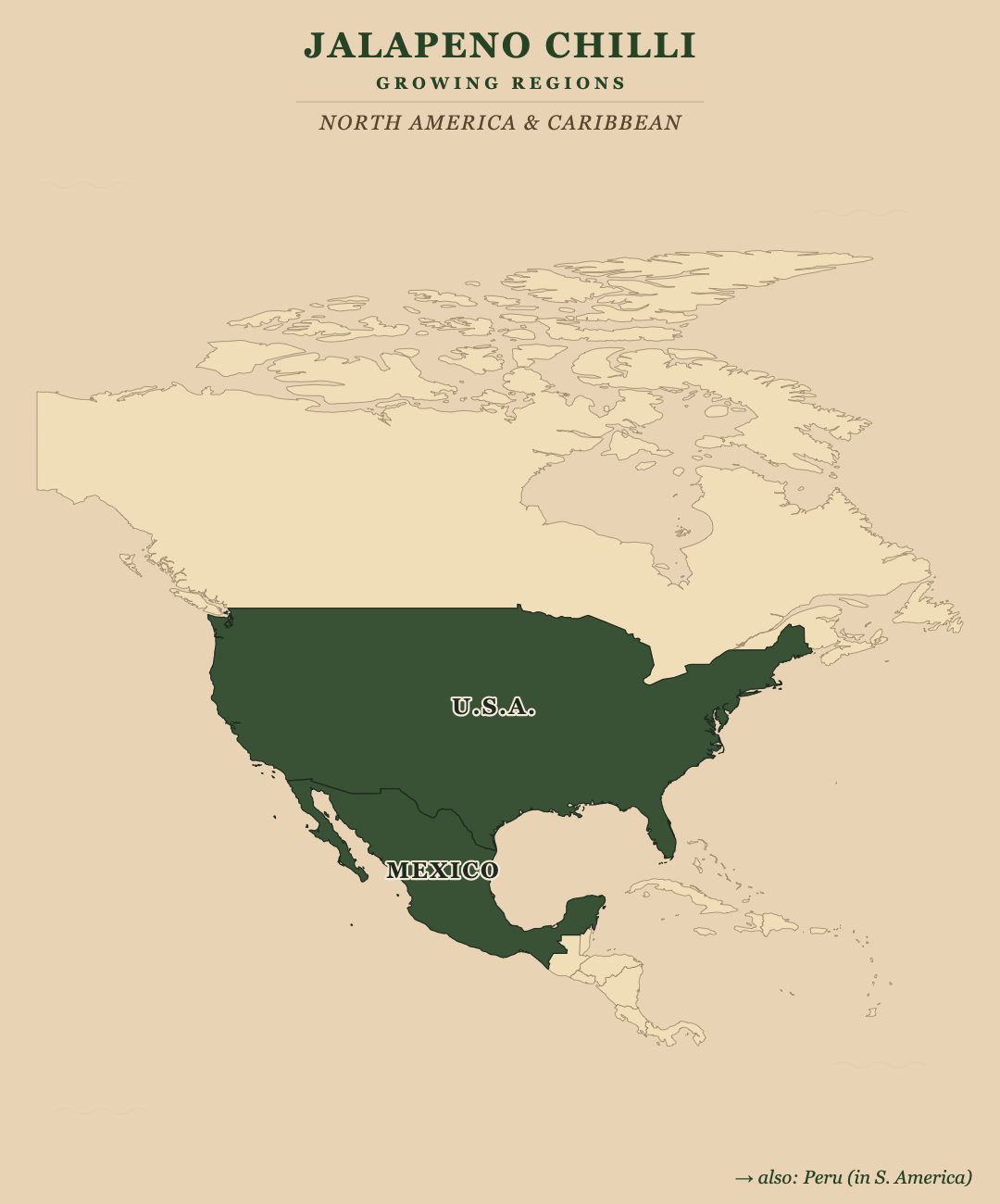
Jalapeno Chilli is primarily cultivated in Mexico (Veracruz especially), USA (Texas, Southwest), China, with secondary growing regions in Spain, Peru, Australia (limited).
Spice Story
Jalapeño was one of the chillies cultivated by the Aztecs and other indigenous Mesoamerican peoples for thousands of years before Spanish contact. The Aztecs used jalapeños in fresh, smoked and dried forms — the same range of uses that survive today. The city of Xalapa was a regional commercial centre, and the chilli named after the city became one of Mexico's foundational culinary peppers. Modern global commercial production is dominated by Mexico, the USA (Texas and the south-west) and China. In gin, jalapeño appears as a contemporary medium-heat botanical providing chilli warmth and bright green-vegetal character.
Gin Creativity
Jalapeño is medium heat — more accessible than cayenne but with more character than mild bell pepper. A full sachet pushes a gin firmly into spicy Mexican territory; a half-sachet adds gentle heat and bright pepper character. Pair with lime peel and coriander for a classic Mexican gin profile, or with cacao nibs and cumin for a mole-leaning blend.
Blending Science
Main flavour compounds
 Capsaicin—
 Dihydrocapsaicin—
 Pyrazine compounds (green vegetal notes)roasted, nutty
Pairs well with
Capsaicin is the dominant heat compound, present at concentrations that put jalapeño in the 4,000–8,500 Scoville range — medium heat. [source] Dihydrocapsaicin contributes the slower-building back-of-throat warmth. Pyrazine compounds (especially 2-methoxy-3-isobutylpyrazine) contribute the characteristic green-vegetal note that distinguishes jalapeño from purely hot chillies. The capsaicinoids are alcohol-soluble and heat-stable; the pyrazines are more volatile and heat-sensitive. Cool extraction preserves the vegetal brightness; warm extraction emphasises the heat.
Food Partners
- Mexican salsas — salsa verde with jalapeño, lime and coriander.
- Pickled jalapeño — Mexican escabeche.
- Stuffed pepper dishes — chiles rellenos.
- Hot sauces — green jalapeño hot sauces.
- Tequila-style cocktails — jalapeño and tequila are inseparable.
Cocktails To Try

- Spicy Margarita (gin) — jalapeño gin, lime, agave, salt rim.
- Cucumber-Jalapeño Gimlet — jalapeño gin, cucumber juice, lime.
- Mexican Mule — jalapeño gin, lime, ginger beer.
Release The Flavour
- Cool extraction — preserves the green pyrazine character.
- Brief contact — 30 minutes to 2 hours captures heat and brightness.
- Strain quickly — heat builds with prolonged contact.
- Match preparation to use — green for vegetal, red for sweeter heat.
Discover more
From the same region

Pairs well with
Same flavour family
Surprise me

Sources & Citations
- scientific_name (Capsicum annuum 'Jalapeño'):en.wikipedia.org/wiki/Jalape%C3%B1o
- name_origin (Xalapa, Veracruz, Mexico):en.wikipedia.org/wiki/Jalape%C3%B1o
- scoville_range (4000-8500 SHU):en.wikipedia.org/wiki/Jalape%C3%B1o
- physical_characteristics (5-10cm, hangs pendulous):en.wikipedia.org/wiki/Jalape%C3%B1o
- green_vs_red_ripening:en.wikipedia.org/wiki/Jalape%C3%B1o
- main_flavour_compounds (CSV-sourced):inputs/source.csv — Jalapeno Chilli row
