
CUBEB


- Botanical name
- Piper cubeba
- Also known as
- Tailed pepper, Java pepper, Indonesian pepper, Kemukus
- Main flavour compound
- Cubebene
- Part used
- Dried unripe fruit (with characteristic stalks/tails still attached)
- Method of cultivation
- Climbing tropical vine of the Piperaceae family — the same family as black pepper, white pepper and long pepper. Native to Java and Sumatra in Indonesia. The vine grows up supporting trees, producing small unripe green fruits that are picked early, dried with their stalks (the "tails") intact, and sold as a distinctive resinous peppercorn-like spice with a stalk attached.
- Commercial preparation
- Fruits are gathered while still unripe (before they turn red), dried gently in the shade to preserve the volatile oil content, and sold whole. The dried product looks like a black peppercorn with a small stalk, giving rise to the common name "tailed pepper". Production remains largely small-scale and Indonesian; Java and Sumatra still account for nearly all commercial supply.
- Non-culinary uses
- Traditional Ayurvedic and Indonesian medicine for respiratory complaints, urinary infections, and as a digestive tonic; the essential oil is occasionally used in perfumery for warm-spice accords; was widely used in 19th-century European pharmacy and cigarette flavouring.
Cubeb — Piper cubeba — is a tropical climbing vine of the pepper family, endemic to Java and Sumatra in Indonesia. The vine climbs through forest understory, producing small green fruits that are picked before they ripen and dried with their distinctive stalks ("tails") still attached — which is what gives the spice its alternative names: "tailed pepper" and "Java pepper". [source] The dried fruit looks like a slightly larger, wrinklier black peppercorn with a small stalk sticking out, and the flavour is unmistakably different from any other commercial pepper — more resinous, more bitter, with a distinctive medicinal-camphor edge.
Whole dried berry with tail
The standard form — bruise lightly to release the resinous oils before use.
Cracked
Faster extraction but loses volatile character within months.
Region of cultivation
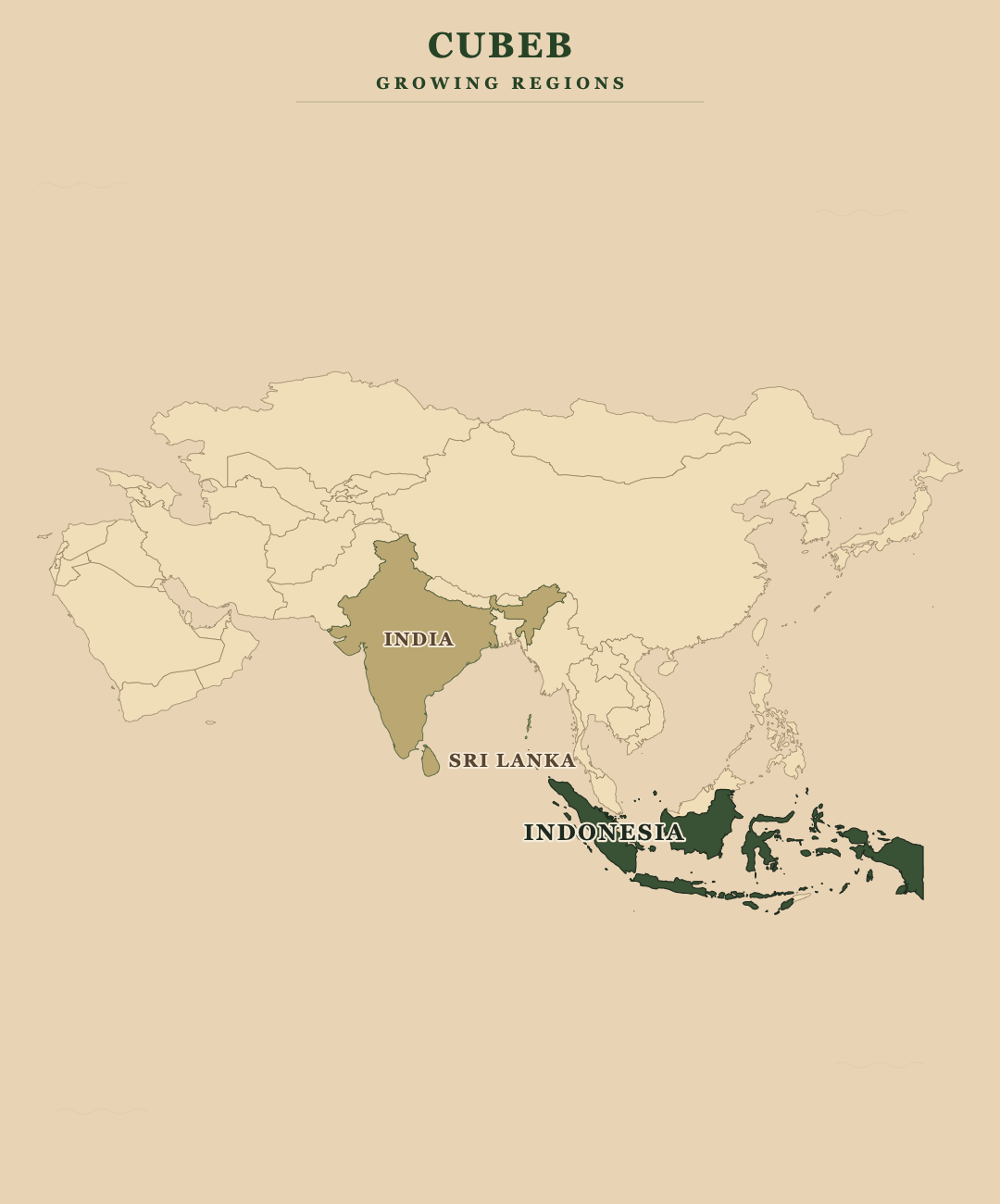
Cubeb is primarily cultivated in Indonesia (Java, Sumatra), with secondary growing regions in Sri Lanka, India (limited).
Spice Story
Cubeb is one of the great forgotten spices of the medieval European pantry. Arab traders carried it from Java to India by the 11th century, and from India onward to Europe and Africa, where it became one of the highly valued spices of medieval cookery — used in meat sauces, mulled wines, and as a perfumery ingredient. The name comes from the Arabic kabāba, by way of Old French quibibes. [source] In 1640, the king of Portugal famously prohibited the sale of cubeb to promote the cheaper, more abundant black pepper from Portuguese Asian colonies — a commercial decision that effectively erased cubeb from European cooking within a generation. It survived in two niches: traditional Indonesian and Indian medicine, and the European gin trade. Cubeb was one of the most common botanicals in 17th and 18th-century European gin production, and it remains a signature botanical of Bombay Sapphire, whose 1761 recipe is the basis for the brand launched in 1987. [source]
Gin Creativity
Cubeb is one of the most distinctive supporting botanicals available — it pushes a gin into a clearly 18th-century, slightly old-fashioned spice register that no modern peppercorn can match. A full sachet adds a clear resinous-pepper backbone with a faint medicinal lift; a half-sachet provides quiet old-style spice depth that pairs beautifully with juniper for a traditional London Dry. It works particularly well with grains of paradise (the two share the 18th-century gin tradition) and with orange peel and coriander for a classic Bombay-style profile. Avoid pairing with very bright, juicy fruit botanicals — cubeb's medicinal character can clash with sweet fruit.
Blending Science
Main flavour compounds
 Cubebene—
 Cubebol—
 Sabinenepepper, warming
 Beta-Caryophyllenewarm woody, peppery
Pairs well with
Cubeb's chemistry is dominated by sesquiterpene hydrocarbons rather than the alkaloid piperine that defines black pepper. Cubebene is the characteristic compound — named after the spice itself and present in significant concentration here but not in black pepper. Cubebol is a related sesquiterpene alcohol contributing the resinous-cool character. Sabinene adds a sharp peppery edge that bridges cubeb to juniper. Beta-caryophyllene layers a warm woody depth. The absence of piperine means cubeb has none of the slow-building heat of black pepper or long pepper — instead it provides a complex aromatic depth without significant pungency. Both vapour and warm maceration work; long extractions develop the full resinous depth.
Food Partners
- Old-style spiced meat dishes: Medieval European cookery still survives in some regional traditions.
- Heavy game stews: Cubeb's resinous depth supports venison and wild boar beautifully.
- Apricot and stone-fruit jams: A surprising medieval pairing — try cubeb-gin in a poaching syrup for apricots.
- Mulled wine: Cubeb in place of (or alongside) some of the black pepper in a traditional blend.
- Dark chocolate desserts: The bittersweet character lifts chocolate.
Cocktails To Try

- Bombay-style Gin & Tonic: Cubeb-rich gin with traditional tonic — a classical pairing.
- Old-style Martini: Cubeb-heavy gin, dry vermouth, lemon twist.
- Medieval Mulled Gin: Cubeb, cinnamon, clove, orange peel — warm gentle infusion.
Release The Flavour
- Bruise lightly: Cracks the berry, exposes the volatile sesquiterpenes.
- Heat-tolerant: Both vapour and warm maceration work.
- Time: 24–48 hours for full development.
- Pair with juniper: Cubeb supports rather than competes — use alongside juniper for full effect.
Discover more
From the same region
Pairs well with
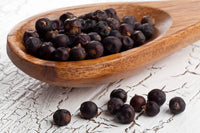
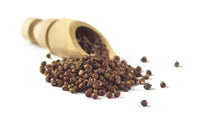
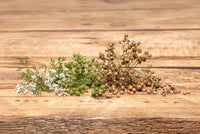
Same flavour family
Surprise me

Sources & Citations
- scientific_name and family (Piper cubeba, Piperaceae):en.wikipedia.org/wiki/Piper_cubeba
- native_origin (Java, Indonesia):en.wikipedia.org/wiki/Piper_cubeba
- name_etymology (Arabic kabāba):en.wikipedia.org/wiki/Piper_cubeba
- medieval_european_use (highly valued spice; 1640 Portuguese ban to favour black pepper):en.wikipedia.org/wiki/Piper_cubeba
- gin_use (17-18th c.; Bombay Sapphire 1761 recipe):www.craftginclub.co.uk/ginnedmagazine/20161024botanicals-...
- characteristic_tailed_appearance (stalks attached):en.wikipedia.org/wiki/Piper_cubeba
- main_flavour_compounds (CSV-sourced):inputs/source.csv — Cubeb row
