
STRAWBERRY

- Botanical name
- Fragaria × ananassa
- Also known as
- Garden Strawberry, Dessert Strawberry, Cultivated Strawberry, Pineapple Strawberry
- Main flavour compound
- Furaneol
- Part used
- Fruit (fresh, or freeze-dried)
- Method of cultivation
- A low, spreading perennial of the rose family (Rosaceae), grown commercially as a field or polytunnel crop and propagated by runners rather than seed. The plants throw out trailing stolons that root to form new clones, fruiting from late spring into summer. Botanically the red "berry" is not a berry at all but an accessory fruit — the swollen, fleshy receptacle — while the true fruits are the tiny achenes (the "seeds") studded across its surface.
- Commercial preparation
- Picked ripe and sold fresh, frozen, or freeze-dried. For distilling and flavouring, fresh fruit is steeped (macerated) or freeze-dried fruit is used for a concentrated, shelf-stable form; many commercial pink gins are built on natural strawberry flavouring rather than whole fruit.
- Non-culinary uses
- Natural flavouring and colourant across confectionery, beverages and dairy; the fruit and leaf appear in cosmetics and folk preparations.
Strawberry — Fragaria × ananassa — is a low, spreading perennial of the rose family that runs along the ground on trailing stolons, rooting as it goes to form new plants. [source] The familiar red fruit is botanically a sleight of hand: it is an accessory fruit, the swollen fleshy receptacle of the flower, while the true fruits are the tiny achenes — the "seeds" — dotted across its surface. [source] You'll find it in field rows and polytunnels, fruiting from late spring into summer.
Fresh fruit
Hull and halve, then macerate in spirit — a few days for a light blush, two to four weeks for a deep infusion.
Freeze-dried
Concentrated and stable; crumbles into a maceration and dissolves its colour and aroma quickly.
Region of cultivation
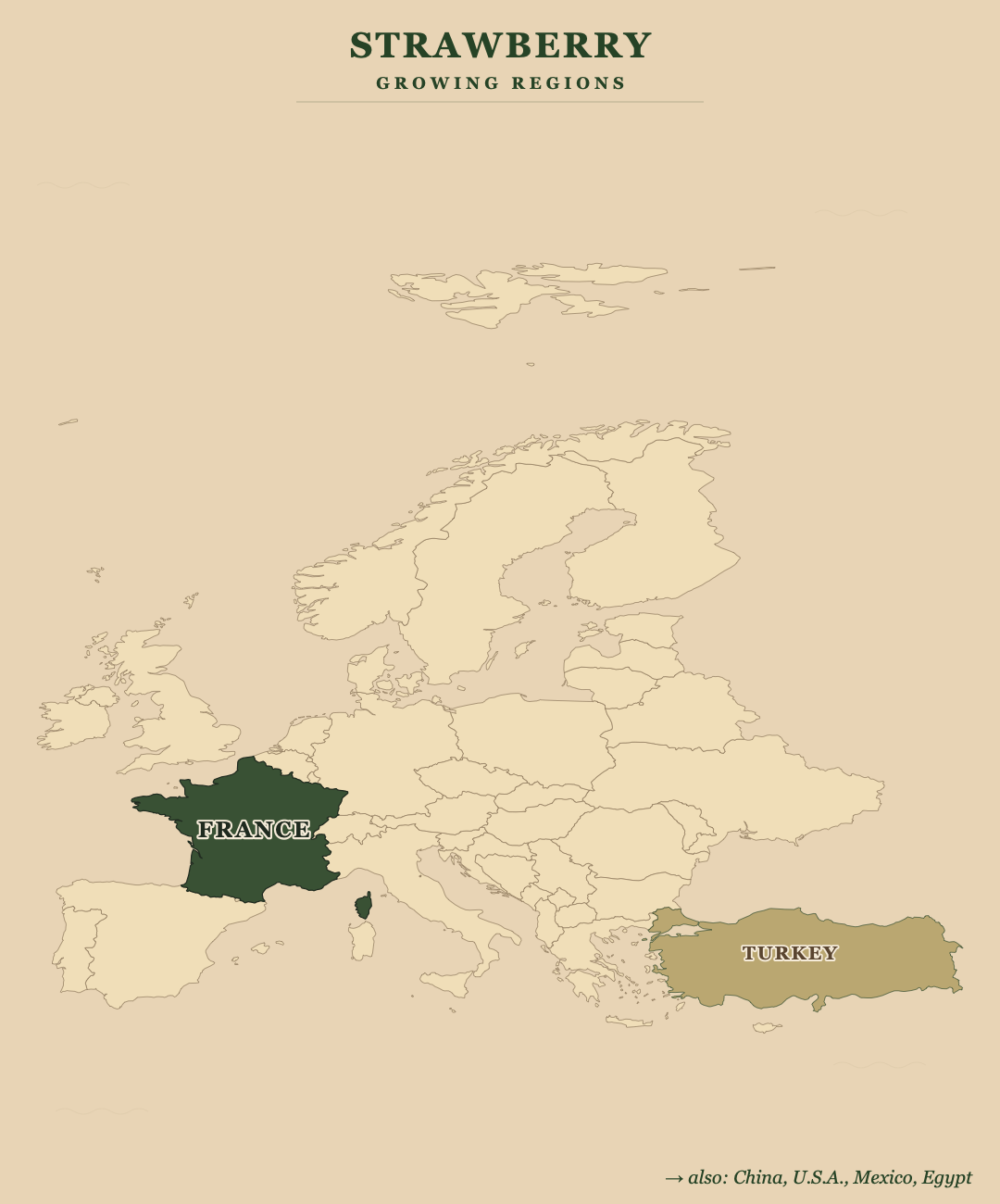
Strawberry is primarily cultivated in France — Brittany (hybrid origin), with secondary growing regions in China (world's largest producer), United States, Egypt, Mexico, Turkey.
Spice Story
The strawberry on your plate is barely 270 years old — a happy accident of empire and the garden. Through the 1750s, French gardeners in Brittany were growing the large-fruited Chilean strawberry, Fragaria chiloensis, brought back across the Atlantic, but found it bore only female flowers and set little fruit. [source] Planted alongside the aromatic Virginia strawberry, F. virginiana, from eastern North America, the two crossed — and the modern garden strawberry was born, most famously around Plougastel in Brittany. [source] In 1766 the botanist Antoine Nicolas Duchesne, working in the gardens at Versailles, recognised this new fruit as a hybrid of the two imported species — one of the first hybrids ever traced to its parents. [source] Two and a half centuries on it is a global crop: world production reached 10.7 million tonnes in 2024, with China alone growing 4.1 million tonnes — some 38% of the total. [source]
Gin Creativity
Strawberry is a soft, generous botanical — it gives colour as readily as flavour. A full sachet pushes a gin into ripe, jammy, pink-gin territory; a partial amount lends a quiet red-fruit sweetness that sits behind the juniper rather than over it. Steep fresh or freeze-dried fruit by maceration. [source] Pair with rhubarb for tartness, basil and black pepper for a savoury edge, or rose to amplify the floral side.
Blending Science
Main flavour compounds
 Furaneol—
 Ethyl butanoate—
 Linaloolfloral, soft
 gamma-Decalactone—
Pairs well with
Strawberry's aroma is mostly esters — in one study they made up around 57% of total volatiles, led by methyl and ethyl butanoate, the bright "fruity" top notes. [source] The signature comes from furaneol (DMHF), the furanone that gives that sweet, caramel-strawberry depth. [source] Linalool adds a floral lift and gamma-decalactone a peachy, creamy roundness. [source] The volatile esters are delicate, so cool, gentle maceration protects them — hard heat blows off the fruity top notes and leaves a flatter, jammier base. Pair with rose to push the floral linalool side, or rhubarb to contrast the sweetness with acid.
Food Partners
- Cream and meringue: The classic Eton-mess axis — fat and sugar carry strawberry's esters beautifully.
- Basil and black pepper: A savoury, peppery foil that makes the fruit read fresher, not sweeter.
- Dark chocolate: Bitter cocoa against ripe red fruit — a long-standing pairing.
- Aged balsamic: A few drops sharpen and deepen strawberry's jammy side.
- Sparkling wine: Strawberry and fizz is a built-in romance; the acidity lifts the fruit.
- Rhubarb: Tart and astringent — the natural sweet-sour partner in a glass or on a plate.
Cocktails To Try

- Beefeater Pink Strawberry: A London Dry recipe infused with natural strawberry flavouring at 37.5% ABV, launched in 2018. [source]
- Gordon's Pink: The pink-gin wave's breakout — it became the UK's sixth bestselling gin within months and over £17m in value sales, the launch Beefeater Pink was built to rival. [source]
- Strawberry G&T: A strawberry gin over plenty of ice, premium tonic, and a fresh halved berry and basil leaf to garnish.
- Strawberry Gin Smash: Muddled strawberries, gin, lemon and mint over crushed ice — summer in a glass.
Release The Flavour
- Heat: Keep it cool. Strawberry's fruity esters are volatile — gentle maceration preserves them where hard heat flattens them.
- Alcohol: Spirit pulls both the red colour and the aroma; a higher-proof base extracts deeper, faster.
- Time: A few days gives a light blush; two to four weeks gives a deep, jammy infusion. [source]
- Form: Freeze-dried fruit gives a more concentrated, stable result than fresh and releases colour quickly.
Discover more



Same flavour family
Surprise me

Sources & Citations
- scientific_name (Fragaria × ananassa, Rosaceae):GBIF Backbone Taxonomy, usageKey 3029912 (Fragaria × anan...
- hybrid_origin (F. virginiana × F. chiloensis, Brittany, 1750s; Duchesne 1766):en.wikipedia.org/wiki/Strawberry
- hybrid_origin_detail (Brittany / Plougastel; Duchesne identified hybrid 1766 at Versailles):en.wikipedia.org/wiki/Fragaria_%C3%97_ananassa
- botany_accessory_fruit (receptacle is the flesh; achenes are the true fruits):en.wikipedia.org/wiki/Strawberry
- production_2024 (10.7 Mt world; China 4.1 Mt / 38%, US 1.5 Mt, Egypt 0.9 Mt, Mexico 0.7 Mt, Turkey 0.6 Mt):en.wikipedia.org/wiki/Strawberry
- commercial_preparation (fresh maceration / freeze-dried; pink gins on natural flavouring):www.craftginclub.co.uk/ginnedmagazine/how-to-make-homemad...
- gin_production_methods (maceration vs vapour infusion):www.masterclass.com/articles/how-is-gin-made
- beefeater_pink_strawberry (London Dry recipe + natural strawberry flavouring, 37.5% ABV, launched 2018):www.theginguild.com/ginopedia/gin-brands/beefeater-pink-s...
- beefeater_pink_launch_2018 (rivals Gordon's pink):www.thegrocer.co.uk/news/beefeater-takes-on-gordons-with-...
- gordons_pink (UK 6th bestselling gin within months, £17m value sales):www.thegrocer.co.uk/news/beefeater-takes-on-gordons-with-...
- compounds_esters_57pct_terpenes_16_lactones_5 (volatile classes; methyl/ethyl butanoate dominant; furaneol caramel-strawberry; linalool floral; gamma-decalactone peach):www.frontiersin.org/journals/plant-science/articles/10.33...
- key_impact_odorants (furaneol, gamma-decalactone, ethyl butanoate, ethyl hexanoate, linalool as KVCs by GC-O):pubmed.ncbi.nlm.nih.gov/22646744/
- pubchem_cids (furaneol 19309, ethyl butanoate 7762, linalool 6549, gamma-decalactone 12813):PubChem name->CID lookups — e.g. pubchem.ncbi.nlm.nih.gov...
- hero_image:iStock royalty-free licence (asset 1498666120)
