
PINE

- Botanical name
- Pinus sylvestris
- Also known as
- Scots Pine, Scotch Pine, Pine Buds, Pine Shoots
- Main flavour compound
- alpha-Pinene
- Part used
- Needles, young shoots and buds (the distiller's part); resin also used. "Pine" is a category — Scots pine is representative.
- Method of cultivation
- An evergreen coniferous tree of the pine family (Pinaceae), growing to around 35 metres with a long, bare, straight trunk topped by a rounded crown, scaly grey-brown bark below and a distinctive flaky orange bark on the upper trunk and branches. It is the most widely distributed pine on Earth, native right across Eurasia from Scotland and Spain to eastern Siberia, and is long-lived — normally 150–300 years, with the oldest Lapland specimens over 760 years.
- Commercial preparation
- For gin the green parts — fresh needles, young spring shoots and buds — are the prize. Fresh needles are commonly vapour-infused (suspended in the still's vapour path) rather than steeped, which lifts the volatile, uplifting top notes while avoiding a heavy, oily extraction; resin and bark are used more sparingly because they can turn harsh or bitter.
- Non-culinary uses
- Scots pine needle oil (INCI "Pinus Sylvestris Leaf Oil") is widely used in fragrance, soaps, bath products and aromatherapy for its fresh, clean, coniferous scent.
Pine, in the gin world, is best understood as a category rather than a single plant — distillers reach for "pine," "pine buds," "pine shoots" and "Scots pine resin" drawn from several different Pinus species. The representative one, and our reference here, is Scots pine, Pinus sylvestris: an evergreen conifer of the pine family that grows to around 35 metres on a long, bare, ramrod-straight trunk crowned with a rounded mass of foliage, its lower bark scaly and grey-brown while the upper trunk and branches flake away in that unmistakable warm orange. [source] It is the most widely distributed pine on the planet, native right across Eurasia from Scotland and Spain to the far east of Siberia, and a slow, patient liver — three centuries is ordinary, and the oldest trees in Lapland have stood for more than 760 years. [source]
Fresh needles / shoots
The classic distiller's form — best vapour-infused to capture the bright, resinous lift without heaviness.
Buds (spring tips)
Soft new growth, sweeter and gentler than mature needles; macerate briefly or vapour-infuse.
Resin
Intensely piney and concentrated — use a whisper; over-extraction reads as harsh, oily or bitter.
Region of cultivation
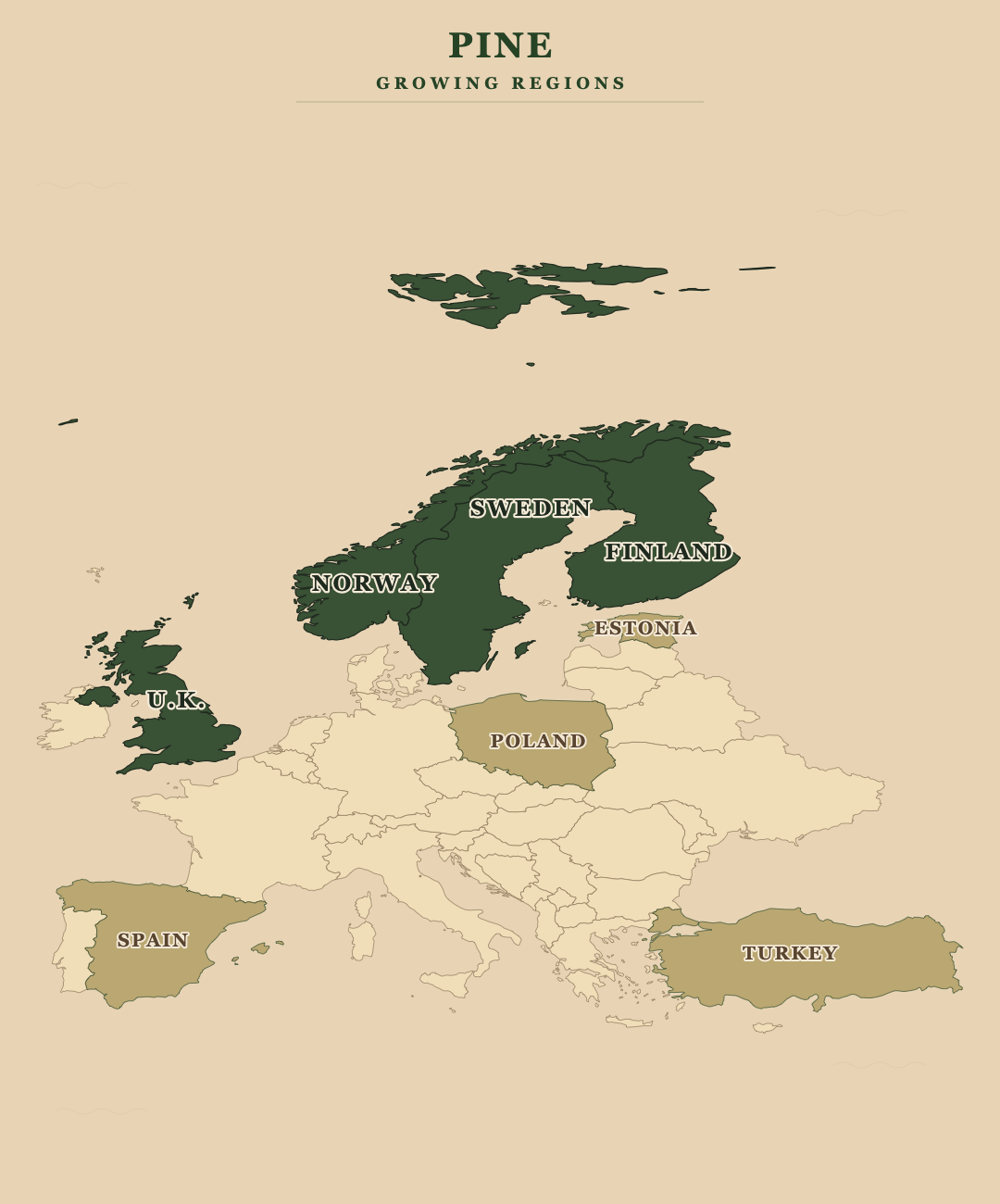
Pine is primarily cultivated in United Kingdom, Sweden, Norway, Finland, with secondary growing regions in Spain, Poland, Estonia, Turkey.
Spice Story
Pine is the scent of the cold forest — the resinous, green, faintly sweet air of a northern wood after rain. The green parts a distiller wants are the fresh needles, the soft spring shoots and the buds, all of them carrying that clean coniferous lift, with sticky resin held in reserve for those who want to push the woodiness further. [source] Different pines speak with different accents: Scots pine gives a clean, sharp freshness, while a species like Eastern white pine is softer and slightly sweet. [source] Beyond the still, Scots pine needle oil — listed in cosmetics as Pinus Sylvestris Leaf Oil — has long been a fixture of soaps, bath oils and fragrance for exactly the same bracing, clean-forest character. [source]
Gin Creativity
Pine is juniper's wilder cousin. Where juniper already lays down a piney spine, a handful of pine needles, shoots or a touch of resin deepens and broadens that coniferous heart into something properly woodland — think alpine air, forest floor, sap on the fingers. It is a botanical for gins that want to tell a story of place: a winter gin, a mountain gin, a gin that tastes of standing among the trees. Lean on it for atmosphere, not volume — a little pine reframes the whole spirit; too much turns it into furniture polish.
Blending Science
Main flavour compounds
 alpha-Pinenefresh pine, top note
 delta-3-Carene—
 beta-Pinenefresh pine, top note
 Limoneneclean citrus lift
Pairs well with
Pine needle and shoot oil is built almost entirely from monoterpene hydrocarbons, which is why it reads as so clean, sharp and resinous. [source] alpha-Pinene is the signature — the fresh, sappy, unmistakably pine note, and usually the largest single fraction in the oil, though its share swings wildly with region, season and tree (published Scots-pine needle figures run anywhere from about 7% to nearly 70%). [source] Alongside it sit beta-pinene, cooler and drier, and delta-3-carene, which brings a sweet, turpentine-resin edge and is one of the major needle-oil constituents (often around 5–14%). [source] A minor lick of limonene adds a bright citrus-pine lift on top. [source] These volatile terpenes are fragile, which is exactly why fresh needles are best vapour-infused rather than steeped — gentle vapour captures the uplifting top notes and leaves the harsh, oily, bitter compounds behind. [source]
Food Partners
- Game and venison: pine's resinous edge is made for dark, rich woodland meat.
- Roast pork: the fat carries the green, sappy note beautifully.
- Smoked fish: clean coniferous freshness cuts through the smoke.
- Hard mountain cheeses: alpine cheese and alpine pine, a natural pairing.
- Dark chocolate: the cool resin contrasts the deep cocoa.
Cocktails To Try

- Pine Fitzgerald: the bittered gin sour — gin, lemon, sugar and a few dashes of Angostura — built on a pine-forward gin and finished with a twist of grapefruit, which the resin loves; bracing, woody and clean, like mountain air in a glass. [source]
- Forest Gimlet: the clean gin-and-lime-cordial classic, given a pine gin and a sprig of rosemary — the sappy green resin and the sharp lime cut against each other for something that tastes of a walk in the woods after rain.
- Last Word in the Woods: the equal-parts gin, green Chartreuse, maraschino and lime classic, built on a pine gin — the coniferous lift amplifies Chartreuse's herbal complexity into a properly wild, alpine version of the cocktail.
Release The Flavour
- Heat: go gentle — vapour infusion protects the fragile resinous top notes; hard, hot extraction drags out the harsh, oily, bitter end of pine.
- Alcohol: a strong solvent for pine's terpenes and resin, so it works fast — taste often when macerating.
- Time: keep contact short for fresh needles and shoots; long steeping turns clean pine heavy and bitter.
- Less is more: pine is a high-impact botanical that builds on juniper — use it to set the scene, not to dominate the stage.
Discover more
From the same region
Pairs well with
Surprise me

Sources & Citations
- scientific_name (Pinus sylvestris L., Pinaceae):GBIF Backbone Taxonomy, usageKey 5285637 (Pinus sylvestri...
- plant_form (evergreen conifer to ~35 m, long bare trunk, orange flaky upper bark, lifespan 150–300 yr, oldest Lapland >760 yr):en.wikipedia.org/wiki/Pinus_sylvestris
- native_range (most widely distributed pine; native across Eurasia, Scotland/Spain to eastern Siberia, Arctic Circle to Anatolia/Caucasus):en.wikipedia.org/wiki/Pinus_sylvestris
- gin_use_pine_category (pine = resinous/aromatic gin botanical; Scots pine clean & sharp, Eastern white pine softer/sweeter; needles best vapour-infused not steeped; resin can turn harsh/bitter; pairs with grapefruit/rosemary/black pepper/juniper):www.theginguild.com/ginopedia/gin-botanicals/pine-buds/
- needle_oil_monoterpenes (P. sylvestris needle oil led by monoterpenes; alpha-pinene ~20–50%, beta-pinene ~15–35%, plus limonene and delta-3-carene):www.specialchem.com/cosmetics/inci-ingredients/pinus-sylv...
- needle_oil_GCMS_ranges (monoterpene hydrocarbons dominant; alpha-pinene 7.0–16.1% and delta-3-carene 5.2–14.3% in one set; another set 69.5% alpha-pinene, 14.9% camphene, 9.1% beta-pinene, 2.8% limonene — strongly region/tree dependent):Comparative Phytochemical Analysis of Hydrodistilled Esse...
- inci_leaf_oil (Pinus Sylvestris Leaf Oil used in fragrance/cosmetics):www.specialchem.com/cosmetics/inci-ingredients/pinus-sylv...
- gin_ironton_ponderosa (Ironton Distillery Ponderosa Gin — onsite hand-harvested ponderosa pine needles, vapour/maceration; pine carries to palate):www.irontondistillery.com/ponderosa-gin
- compound_cids (PubChem):PubChem CIDs — alpha-pinene 6654, beta-pinene 14896, delta-3-carene 26049, limonene 22311
- hero_image:iStock royalty-free licence (asset 1248142124)
