
PASSIONFRUIT

- Botanical name
- Passiflora edulis
- Also known as
- Passion fruit, Purple granadilla, Maracujá, Gulupa
- Main flavour compound
- Ethyl butanoate
- Part used
- Fruit (pulp and aril juice)
- Method of cultivation
- A fast-growing perennial climbing vine of the Passifloraceae, native to southern Brazil, Paraguay and northern Argentina. It is grown on trellises in tropical and subtropical climates; the purple form (f. edulis) favours cooler subtropics while the yellow form (f. flavicarpa) prefers true tropics. In Australia, vines are often the grafted 'Nellie Kelly' type, bred to resist root disease.
- Commercial preparation
- The fruit is halved and the aromatic seed-coated pulp scooped or pulped out, then strained into juice. Most of the global crop is processed into pulp, juice and frozen concentrate rather than sold as whole fresh fruit; Brazil dominates world production, with Ecuador and Colombia major juice exporters.
- Non-culinary uses
- The flower (passion flower) has a long history in herbal preparations; the seeds yield a cosmetic oil rich in linoleic acid. Ornamentally, the vine is prized for its elaborate flower.
Passionfruit — Passiflora edulis — is a vigorous climbing vine, native to the warm river country of southern Brazil, Paraguay and northern Argentina. [source] It scrambles up trellises with glossy three-lobed leaves and the most theatrical flower in the garden: a fringed corona of purple-and-white filaments. The fruit is a hard-shelled berry, the purple form (f. edulis) roughly egg-sized and richly aromatic, the yellow form (f. flavicarpa) larger and tarter. [source] Inside, golden pulp clings to dark seeds in an intensely fragrant jelly.
Fresh fruit
Scoop the pulp straight in — the brightest, most complete aroma.
Frozen pulp or purée
Year-round consistency; thaw and use as you would fresh.
Juice / concentrate
Convenient and intense, but loses the most volatile top notes.
Region of cultivation
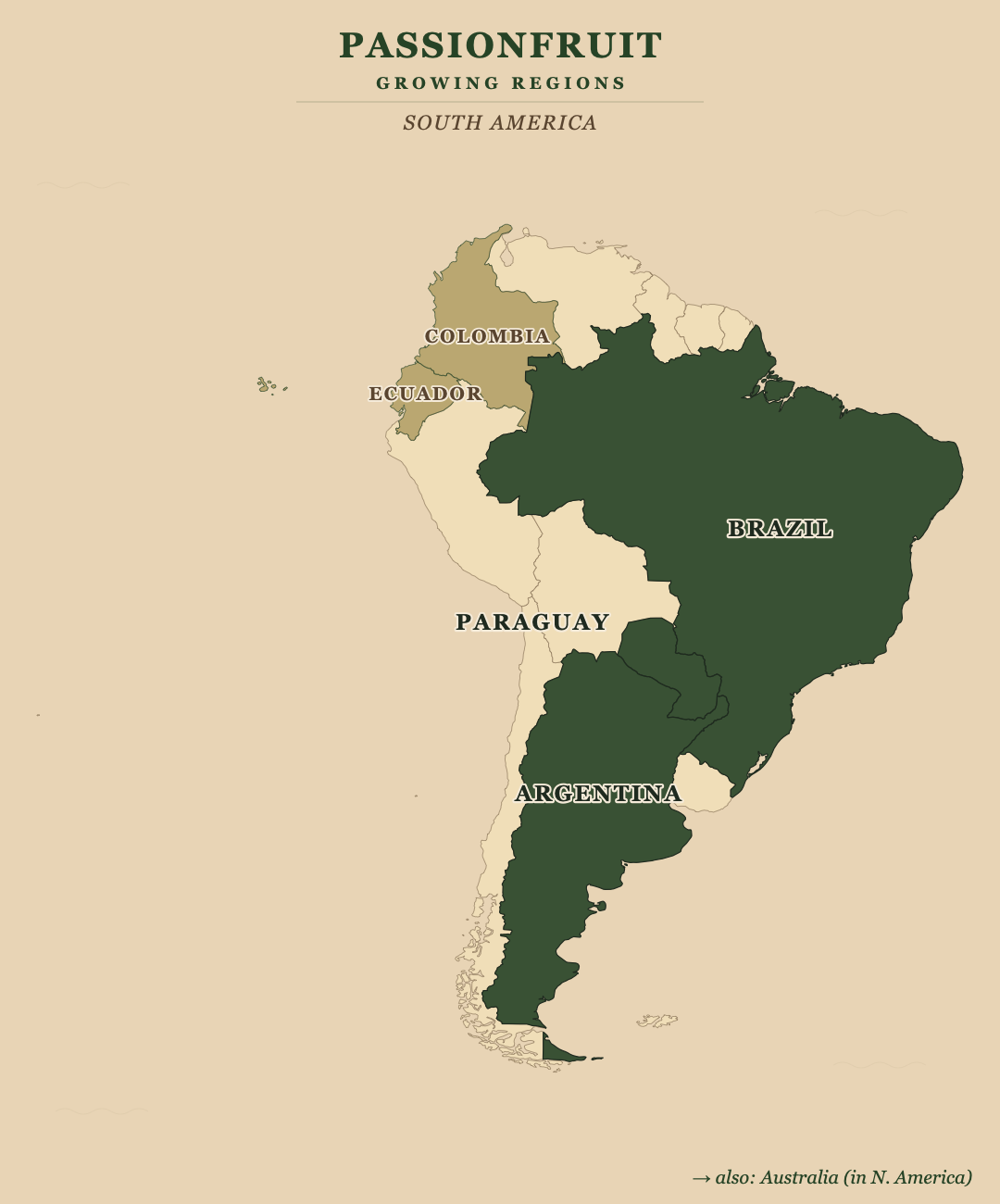
Passionfruit is primarily cultivated in Brazil, Paraguay, Argentina, with secondary growing regions in Australia, Ecuador, Colombia.
Spice Story
The flower gave the fruit its name long before anyone thought to drink it. Around 1700, Spanish missionaries in Brazil read the elaborate bloom as a diagram of the Crucifixion — the corona as Christ's crown, the five anthers as five wounds — and called it the flower of the five wounds. [source] The vine travelled with empire: passionfruit was being exhibited in Sydney by 1843 and sold in the city market by 1847, and had partly naturalised along coastal Queensland before 1900. [source] Australia's love affair was sealed in 1921, when Melbourne nurseryman Clarence Kelly grafted the black passionfruit onto a hardier rootstock to beat root disease — the vine he trademarked in 1958 as 'Nellie Kelly'. [source] Today Brazil leads the world's crop, with Ecuador and Colombia feeding the global juice trade. [source]
Gin Creativity
Passionfruit is a loud, generous botanical — a full sachet pushes a gin firmly into tropical territory, all sweet-tart fruit and a musky tail. Used at half, it lifts and rounds a more classic juniper spine without taking over. It loves the company of Lime and Lemon Myrtle for a sun-drenched citrus-tropical gin, while a whisper of Vanilla rounds off its tartness. Keep Juniper present so the gin still reads as gin, not cordial.
Blending Science
Main flavour compounds
 Ethyl butanoate—
 Ethyl hexanoate—
 beta-Ionone—
 2-Methyl-4-propyl-1,3-oxathiane—
Pairs well with
The signature "passionfruit" smell is built mostly from fruity esters: ethyl butanoate and ethyl hexanoate carry the highest odour-activity values in the purple fruit, throwing sweet, tropical, apple-pineapple top notes. [source] beta-Ionone adds a floral, violet warmth underneath. The character that makes passionfruit unmistakable, though, is sulfur: 2-methyl-4-propyl-1,3-oxathiane is a character-impact compound detectable down near 3 parts per billion, lending the musky, tropical, slightly "catty" edge. [source] Those esters are fragile and volatile — gentle, cool extraction protects them; heat and long maceration flatten the fruit and can coarsen the sulfur note.
Food Partners
- Tropical fruit salads: Passionfruit's tartness sharpens mango, pineapple and melon.
- Pavlova and meringue: The classic Australian pairing — acidity cuts the sweetness.
- Grilled white fish: A passionfruit dressing brightens delicate flesh.
- Cheesecake: Tart pulp balances rich, creamy dairy.
- Dark chocolate: Fruity-acidic against bitter cocoa is a natural contrast.
- Spirit-forward sorbets: Passionfruit holds its perfume even when frozen.
Cocktails To Try

- Pornstar Martini: The defining modern passionfruit cocktail — vanilla, passionfruit and a Champagne sidecar.
- Passionfruit G&T: A tropical-gin pour over tonic, garnished with a half shell of fresh fruit.
- Newy Distillery Passionfruit Gin: A Newcastle, NSW dry gin infused with local passionfruit — a real-world template for fruit-forward Australian gin. [source]
- Tropical Gimlet: Passionfruit gin, fresh lime and a touch of sugar.
Release The Flavour
- Heat: Keep it low. The fruity esters are delicate — gentle warmth or a cool infusion preserves the bright top notes.
- Alcohol: Spirit pulls the sulfur and ester character readily; a short steep is often enough.
- Time: Less is more — long maceration dulls the fruit and over-extracts the seeds.
- Water: A splash on serving opens the perfume and softens the tartness.
Discover more
From the same region
Pairs well with
Same flavour family

Surprise me

Sources & Citations
- scientific_name (Passiflora edulis Sims, Passifloraceae):GBIF Backbone Taxonomy, usageKey 2874190 (Passiflora edul...
- native_range (southern Brazil, Paraguay, northern Argentina):en.wikipedia.org/wiki/Passiflora_edulis
- purple_vs_yellow_forms (f. edulis cooler subtropics ~35g; f. flavicarpa tropics, larger):en.wikipedia.org/wiki/Passion_fruit
- name_origin (Spanish missionaries ~1700, "flower of the five wounds"):en.wikipedia.org/wiki/Passion_fruit
- australia_history (exhibited Sydney 1843; sold Sydney market 1847; naturalised coastal QLD pre-1900):www.hort.purdue.edu/newcrop/morton/passionfruit.html
- nellie_kelly (Clarence Kelly grafted onto hardier rootstock 1921; trademark registered 1958):australianfoodtimeline.com.au/nellie-kelly-passionfruit-d...
- commercial_production (Brazil world's foremost producer; Ecuador & Colombia major juice exporters):www.freshplaza.com/latin-america/article/9555122/brazil-i...
- key_odorants (ethyl butanoate, ethyl hexanoate, beta-ionone — highest OAV in gulupa/purple P. edulis):Conde-Martinez, Jimenez, Steinhaus et al., 'Key aroma vol...
- ethyl_butanoate_cid:PubChem CID 7762 — pubchem.ncbi.nlm.nih.gov/compound/7762
- ethyl_hexanoate_cid:PubChem CID 31265 — pubchem.ncbi.nlm.nih.gov/compound/31265
- beta_ionone_cid:PubChem CID 638014 — pubchem.ncbi.nlm.nih.gov/compound/63...
- oxathiane (2-methyl-4-propyl-1,3-oxathiane — character-impact sulfur compound, threshold ~3 ppb):Flavor Bites: 2-Methyl-4-propyl-1,3-oxathiane, Perfumer &...
- sulfur_thiols (3-mercapto-1-hexanol first isolated from passion fruit, tropical character impact):pubs.acs.org/doi/10.1021/bk-2011-1068.ch001
- named_gin (Newy Distillery Passionfruit Gin — Newcastle NSW, est. 2018, dry gin infused with local passionfruit):newydistillery.com.au/products/passionfruit-gin
- hero_image:iStock royalty-free licence (asset 1438956363)
