
NEROLINA (LARRUK)

- Botanical name
- Melaleuca quinquenervia
- Also known as
- Broad-leaved Paperbark, Nerolina (specific high-linalool/nerolidol chemotype), Larruk
- Main flavour compound
- Linalool
- Part used
- Dried leaf and twig
- Method of cultivation
- Small-to-medium tree of the Myrtaceae family, native to the coastal regions of eastern Australia from near Sydney up to Cape York Peninsula, with naturalised populations in southern New Guinea and parts of New Caledonia. The tree is recognisable by its thick papery grey-cream bark (the "Broad-leaved Paperbark" common name). "Nerolina" is a specific high-linalool/nerolidol chemotype of the species — chemically distinct from the high-cineole chemotype used to make Niaouli essential oil from New Caledonia and Madagascar.
- Commercial preparation
- Leaves and small twigs of the Nerolina chemotype are gently steam-distilled or sold as dried leaf for the natural cosmetics and aromatherapy market. Australian production is small-scale.
- Non-culinary uses
- Aromatherapy (a softer alternative to common tea tree); natural cosmetics; some traditional Indigenous medicinal use; ornamental garden tree across temperate and subtropical Australia.
Nerolina — Melaleuca quinquenervia — is a small-to-medium evergreen tree of the Myrtaceae family, native to the eastern Australian coast from near Sydney up to Cape York Peninsula. The tree is most easily recognised by its thick, papery grey-cream bark, which peels in large soft sheets — this is the Broad-leaved Paperbark of Australian wetlands and coastal forests. [source] "Nerolina" specifically refers to the high-linalool/nerolidol chemotype of the species, chemically distinct from the high-cineole chemotype used to make Niaouli essential oil from cultivation in Madagascar.
Whole dried leaf and twig
Crumble lightly to release the oils.
Cracked
Faster extraction.
Region of cultivation
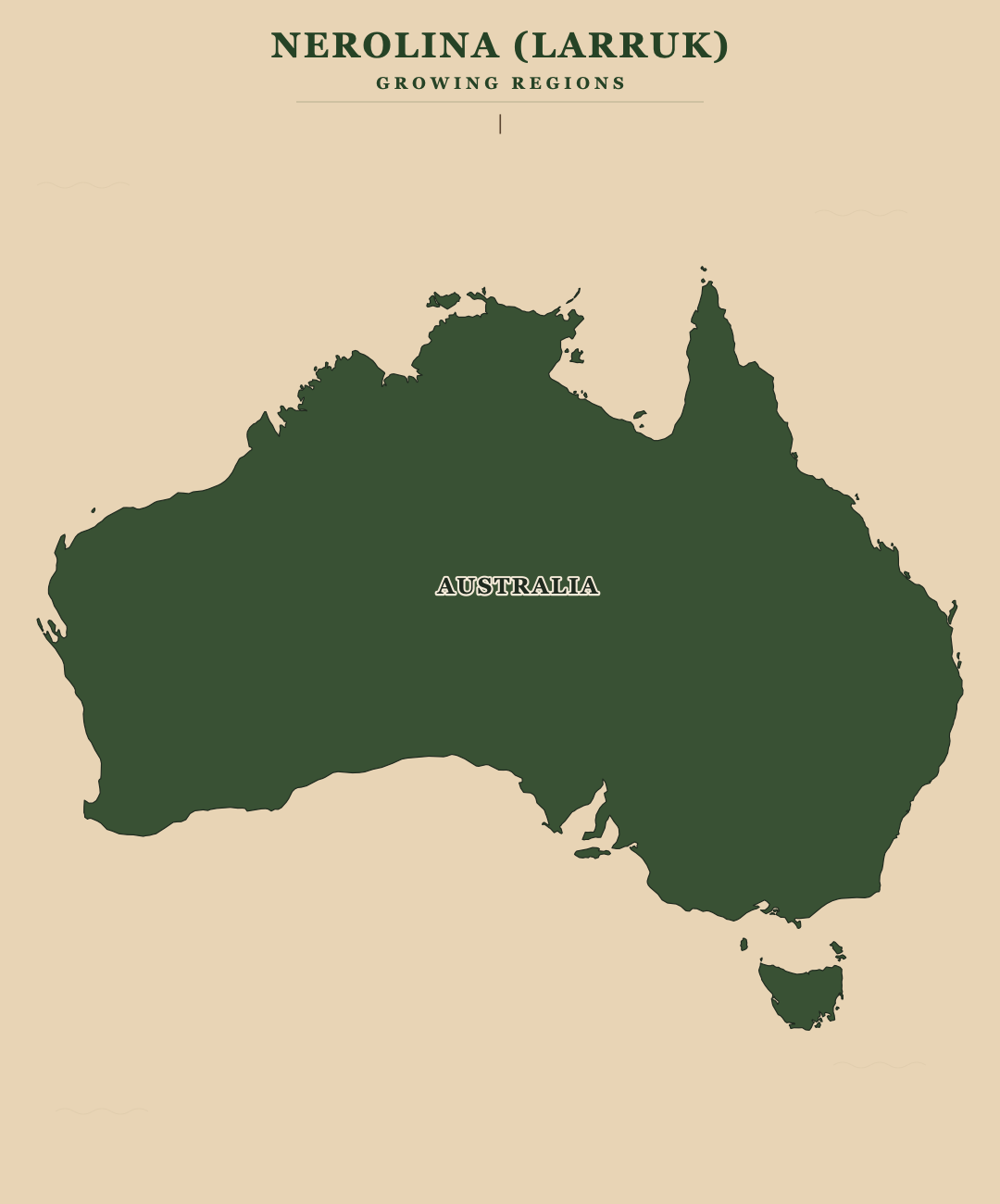
Nerolina (Larruk) is native to Australia, Australia — eastern coast (Sydney to Cape York Peninsula), with secondary growing regions in Naturalised in New Caledonia, southern New Guinea, parts of Madagascar (for Niaouli oil). |
Spice Story
Melaleuca quinquenervia has been used by Aboriginal peoples across its long eastern Australian native range for thousands of years — the soft papery bark was used as bandages, blankets and infant cradles; the leaves were used in traditional medicine. The species was introduced to Madagascar and New Caledonia during the colonial period, where it has become a significant commercial essential-oil crop (the Niaouli oil that is now better known internationally than the Australian Nerolina). The Nerolina chemotype has emerged as a separate Australian commercial product over the past two decades, distinguished by its high linalool and nerolidol content — providing a sweet floral character very different from the medicinal cineole-heavy Niaouli. In gin, Nerolina is a relatively recent contemporary Australian native botanical.
Gin Creativity
Nerolina brings soft floral character with a clean tea-tree freshness, less medicinal than common tea tree. A full sachet pushes a gin firmly into floral-tea-tree territory; a half-sachet provides quiet floral depth that integrates with juniper. Pair with Lemon Myrtle for added citrus, or with Honey Myrtle and Lavender for a layered floral blend.
Blending Science
Main flavour compounds
 Linaloolfloral, soft
 Nerolidolfresh rose, sweet
 1,8-Cineoleeucalyptus, cool
Pairs well with
Linalool is the dominant compound (giving the Nerolina chemotype its name, alongside its other defining compound) — providing the soft floral character familiar from coriander and lavender. Nerolidol is the secondary signature compound — a sesquiterpene alcohol contributing sweet-floral depth (and giving the chemotype its other name component, nerol). 1,8-Cineole is present in smaller amounts than in the Niaouli chemotype. Cool extraction preserves the bright floral top.
Food Partners
- Native floral cocktails — Nerolina with honey myrtle and lemon myrtle.
- Honey-floral desserts — Nerolina syrup over panna cotta.
- Cool summer drinks — Nerolina cordial.
- Soft cheese with honey — chèvre with Nerolina honey.
- Floral teas — Nerolina as a tea ingredient.
Cocktails To Try

- Native Floral G&T — Nerolina gin, floral tonic, fresh native garnish.
- Bush Spritz — Nerolina gin, prosecco, soda.
- Honey-Floral Sour — Nerolina gin, honey, lemon, egg white.
Release The Flavour
- Cool extraction — preserves the bright linalool.
- Crumble gently — releases the volatile oils.
- Time — 24 hours for full development.
- Source matters — verify the Nerolina chemotype rather than the Niaouli chemotype.
Discover more
Pairs well with
Same flavour family
Surprise me

Sources & Citations
- scientific_name (Melaleuca quinquenervia, Myrtaceae):www.nativeoilsaustralia.com.au/nerolina-essential-oil/
- native_range (eastern Australia, Sydney to Cape York):www.nativeoilsaustralia.com.au/nerolina-essential-oil/
- nerolina_chemotype_high_linalool_nerolidol:www.nativeoilsaustralia.com.au/nerolina-essential-oil/
- distinct_from_niaouli_cineole_chemotype:aliksir.com/en/products/nerolina-ct-nerolidol-melaleuca-q...
- paperbark_thick_bark:www.nativeoilsaustralia.com.au/nerolina-essential-oil/
- main_flavour_compounds (CSV-sourced):inputs/source.csv — Nerolina (Larruk) row
