
MANGO

- Botanical name
- Mangifera indica
- Also known as
- Common Mango, Indian Mango, Bowen Mango (AU), Kensington Pride (AU cultivar)
- Main flavour compound
- (E)-β-Damascenone
- Part used
- Fruit
- Method of cultivation
- A large evergreen tropical tree growing to 30–40 metres tall with a broad spreading crown. [source: https://en.wikipedia.org/wiki/Mango] Native to the northeastern Indian subcontinent — present-day Bangladesh, northeast India and Myanmar — it has been cultivated in South and Southeast Asia since ancient times, producing two distinct lineage groups: Indian and Southeast Asian types. [source: https://en.wikipedia.org/wiki/Mango] Fruit develops as a drupe (stone fruit) with a fleshy mesocarp surrounding a single flat oblong stone; shape and colour vary enormously across the 500-plus named cultivars.
- Commercial preparation
- Fruit is harvested by hand when mature (colour, density and sap tests guide timing) and sold fresh, or processed into purée, juice, dried slices, and powder. India dominates global production at 26.2 million tonnes — 43% of the 61.1 million tonne world crop (2023). [source: https://en.wikipedia.org/wiki/Mango] In Australia, Queensland produces approximately 22,000 tonnes per year (43% of national output), concentrated in the Mareeba/Dimbulah and Bowen/Burdekin districts. [source: https://www.business.qld.gov.au/industries/farms-fishing-forestry/agriculture/crops/fruit-veg/mango/industry] The dominant Australian cultivar, Kensington Pride (the 'Bowen mango'), accounts for over 80% of the Australian commercial market. [source: https://en.wikipedia.org/wiki/Kensington_Pride]
- Non-culinary uses
- Mango leaves and flowers are used in Hindu worship rituals, and the tree is planted for shade and timber in tropical regions. Kernel oil from the seed is used in soap and cosmetics; bark, leaves and unripe fruit appear in traditional Ayurvedic medicine. [source: https://en.wikipedia.org/wiki/Mango]
Mango — Mangifera indica — is a large evergreen tree of the tropical canopy, growing to 30–40 metres tall with a wide, dome-shaped crown. [source] The fruit is a drupe: a stone fruit with a fleshy yellow-orange mesocarp wrapped around a single flat seed. [source] Wild forms are native to the northeast corner of the Indian subcontinent — where present-day Bangladesh, northeast India and Myanmar meet — where the species has been shaped by cultivation for longer than almost any other tropical fruit. [source] Over 500 named cultivars exist today, ranging from the small, intensely aromatic Indian types to the large, mild Florida-bred varieties.
Fresh ripe fruit
Richest aromatic character; purée or muddle directly into spirit for full tropical depth.
Dried mango slices
Concentrated sweetness — soak in neutral spirit first; watch for added sugar in commercial brands.
Mango purée (frozen)
Consistent quality year-round; cell walls ruptured on freeze-thaw release juice and esters fast.
Region of cultivation
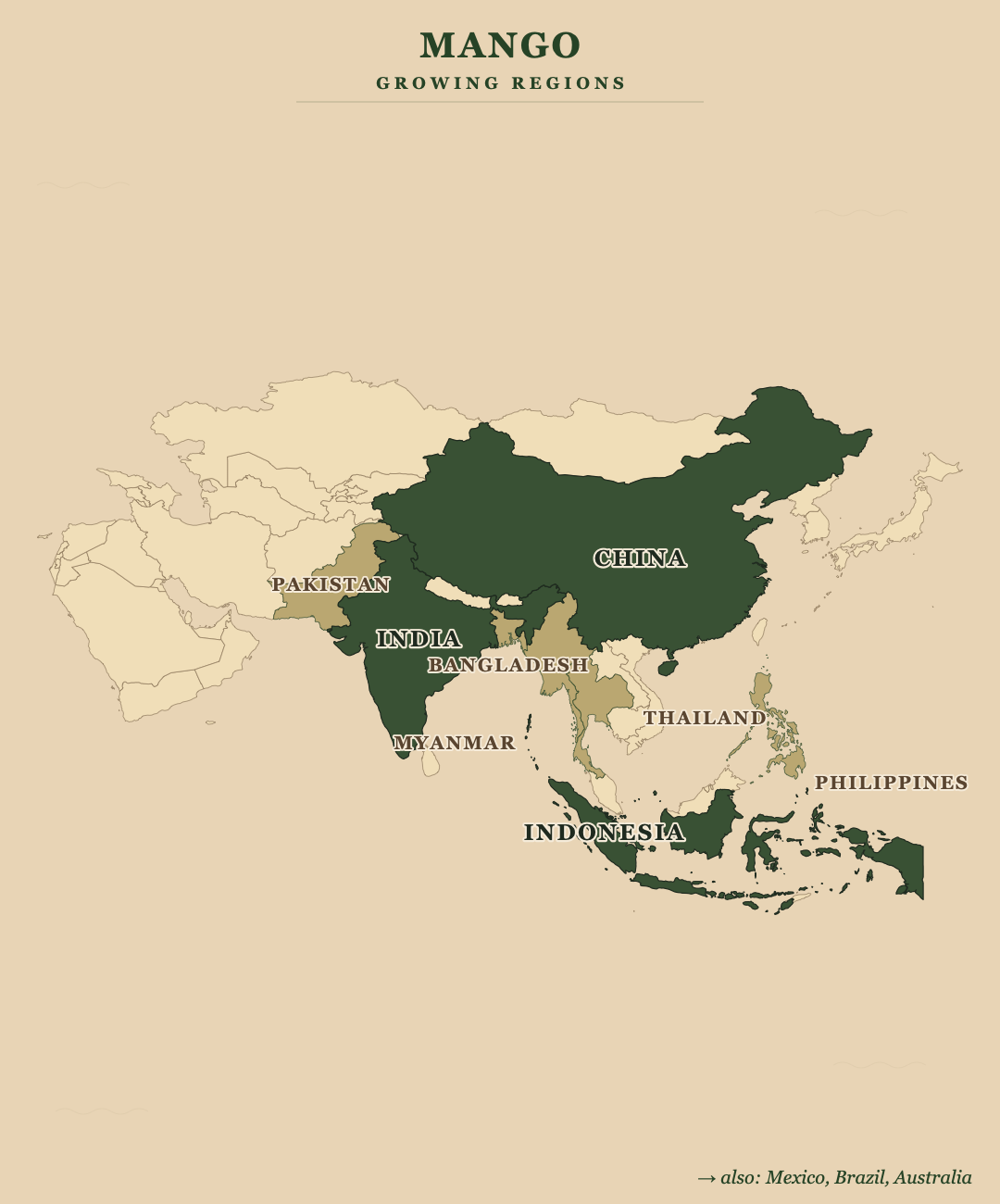
Mango is primarily cultivated in India, Indonesia, China, with secondary growing regions in Bangladesh, Myanmar, Thailand, Philippines, Mexico, Brazil, Pakistan, Australia.
Spice Story
Few fruits carry as much cultural weight as the mango. It is the national fruit of India, Pakistan and the Philippines, and sits deep in the symbolic vocabulary of the subcontinent: mango flowers and leaves appear in Hindu rituals, and the Mughal emperor Akbar is said to have planted an orchard of 100,000 trees near Darbhanga in Bihar in the sixteenth century. [source] From India the Portuguese carried it outward — from their colony at Goa to East and West Africa, then on to Brazil — weaving mango through the global tropics over the sixteenth and seventeenth centuries. [source] In Australia, the story lands in Queensland: the Kensington Pride, better known as the Bowen mango, emerged in the 1880s in Bowen and now accounts for more than 80% of Australia's commercial mango market. [source] Queensland produces around 22,000 tonnes per year, with the Mareeba–Dimbulah corridor and the Bowen district carrying most of the crop. [source]
Gin Creativity
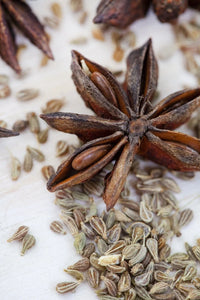
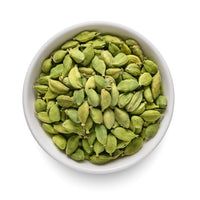
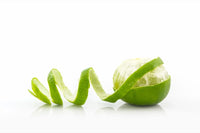
Mango is a botanical that fills space. A full sachet builds a gin with unmistakable tropical presence — golden, lush, sun-warmed — that pairs beautifully with floral tonics and citrus garnishes. A partial amount works as a soft, fruity mid-note sitting beneath the juniper line without dominating. Try pairing with cardamom and coriander seed for an Indo-tropical profile, or lean on lime peel and lemongrass for a lighter, high-acid Southeast Asian style. Chilli adds a surprising complementary warmth that echoes the way fresh mango is eaten across South Asia.
Blending Science
Main flavour compounds
 (E)-β-Damascenone—
 Ethyl butanoate—
 Terpinolene—
 δ-3-Carene—
Pairs well with
Mango's aroma complexity punches above its weight because of two extraordinarily potent odorants. (E)-β-Damascenone — present at an odour activity value (OAV) of around 5,000 in the Corazón cultivar — is the real driver: a compound with a cooked-apple, rose-hip and tobacco depth that registers at tiny concentrations. [source] Ethyl butanoate (OAV ~4,000) delivers the bright tropical-fruity pineapple-strawberry pop that you recognise immediately as "mango"; it's confirmed as a top-four odorant in both Corazón and Haden cultivars. [source] Terpinolene (OAV 230) brings a fresh piney-citrus lift — its contribution varies by cultivar, stronger in Indian and Asian types — while δ-3-carene (OAV 80) adds a sweet, slightly resinous underlay. [source] Because the ester compounds (ethyl butanoate) are volatile and heat-sensitive, cold maceration is best; the damascenone backbone is more robust and develops with gentle warmth.
Food Partners
- Sticky rice and coconut cream: the classic Southeast Asian pairing — coconut fat rounds out mango's floral-fruity edge into something unctuous.
- Soft white cheeses: brie or fresh ricotta provide a milky canvas that amplifies the tropical fruitiness without competing.
- Cured and smoked fish: the sweet acidity of ripe mango cuts through the salt and fat — a natural pairing across Indo-Pacific cuisines.
- Spiced lamb and pork: mango's depth works against richly spiced meats the way a chutney does — contrasting sweet-floral against savoury-smoky.
- Dark chocolate: β-damascenone's rose-and-tobacco note echoes cacao's bitter complexity in an unexpected but satisfying way.
- Thai green curry: the floral-herbal compounds in mango echo the aromatic profile of the curry paste — lime, lemongrass, galangal all speak the same language.
Cocktails To Try

- Mango Collins: gin, mango purée, fresh lemon and soda — a tropical riff on the classic Tom Collins template that's refreshing and easy to adjust for sweetness. [source]
- Hunchy Hills Mango Gin: a Queensland craft gin built on locally sourced caramelised mangoes with wild peach, lime and old man saltbush — a ready-made G&T base with AU character. [source]
- Mango G&T: mango-forward gin, elderflower or citrus tonic, and a sliver of fresh mango — the simplest expression of the botanical's tropical-floral register.
Release The Flavour
- Heat: avoid hard heat — ethyl butanoate and terpinolene are volatile esters and monoterpenes that blow off quickly; gentle cold maceration for 24–48 hours captures the most intact aroma.
- Alcohol: a mid-strength spirit (40–50%) pulls both the fruity esters and the fat-soluble damascenone; higher proof can over-extract tannin from the skin and stone.
- Time: ripe fresh or frozen mango gives its best in 24–48 hours; dried mango needs longer (3–5 days) and benefits from a brief warm soak first to rehydrate.
- Water: dilution on the palate opens up the damascenone floral depth — this botanical reveals more in a G&T than neat.
Discover more
From the same region


Pairs well with
Same flavour family

Surprise me

Sources & Citations
- scientific_name (Mangifera indica L., ACCEPTED, Anacardiaceae, GBIF 3190638):GBIF Backbone Taxonomy, usageKey 3190638 — www.gbif.org/s...
- origin_region (northeast India / Bangladesh / Myanmar):Wikipedia 'Mango' — en.wikipedia.org/wiki/Mango
- ancient_cultivation (South and Southeast Asia, two lineage groups):Wikipedia 'Mango' — en.wikipedia.org/wiki/Mango
- tree_height (30-40 metres, crown radius 10-15 m):Wikipedia 'Mango' — en.wikipedia.org/wiki/Mango
- stone_fruit_drupe:Wikipedia 'Mango' — en.wikipedia.org/wiki/Mango
- national_fruit_india:Wikipedia 'Mango' — en.wikipedia.org/wiki/Mango
- Akbar_orchard_Darbhanga (said to have planted 100,000 trees near Darbhanga, Bihar, 1556-1605):Wikipedia 'Mango' — en.wikipedia.org/wiki/Mango
- Portuguese_spread_from_Goa:Wikipedia 'Mango' — en.wikipedia.org/wiki/Mango
- world_production_2023 (61.1 million tonnes; India 26.2 M / 43%):Wikipedia 'Mango' — en.wikipedia.org/wiki/Mango
- Queensland_production (22,000 tonnes/year, 43% national; Mareeba/Dimbulah 55%, Bowen/Burdekin 33%):Business Queensland 'Mango industry in Queensland' — www....
- Kensington_Pride (over 80% Australian market, originated Bowen QLD 1880s, sometimes called Bowen mango):Wikipedia 'Kensington Pride' — en.wikipedia.org/wiki/Kens...
- compounds_all_four_OAV (β-damascenone OAV 5000, ethyl butanoate OAV 4000, terpinolene OAV 230, δ-3-carene OAV 80 — Corazón cultivar, simultaneous distillation-extraction, GC-FID/GC-MS, AEDA):Pino et al., 'Odour-active compounds in mango (Mangifera ...
- ethyl_butanoate_cross_check_Haden (OAV 980, 4th highest compound in Haden SIDA study):Steinhaus et al., 'Insights into the Key Aroma Compounds ...
- terpinolene_carene_Chinese_cultivars (OAV 1.05–5.80 and 0.55–2.07 across 5 Chinese varieties, HS-SPME/GC-O):PMC7023010 — Aromatic Characterization of Mangoes (Mangif...
- pubchem_cids (beta-damascenone 5366074; ethyl butanoate 7762; terpinolene 11463; delta-3-carene 26049):PubChem compound lookup — pubchem.ncbi.nlm.nih.gov/
- named_gin_Hunchy_Hills (Mango Gin, 38% ABV, Qld distillery, locally sourced caramelised mangoes, wild peach, lime, old man saltbush):hunchyhillsdistillery.com.au/products/mango-gin
- named_gin_Newy (Mango Gin Liqueur, 25% ABV, Newcastle, fresh mango infused with dry gin):newydistillery.com.au/products/mango-gin-liqueur
- mango_collins_recipe (gin, mango purée, lemon, soda):Difford's Guide Mango Collins — www.diffordsguide.com/coc...
