
LIMETREE FLOWERS (LINDEN)

- Botanical name
- Tilia cordata
- Also known as
- Linden flowers, Small-leaved lime, Tilleul (French), Tila (Spanish)
- Main flavour compound
- Farnesol
- Part used
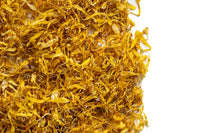
- Dried flower (with the characteristic leaf-like bract often attached)
- Method of cultivation
- Large deciduous tree of the Malvaceae family (formerly Tiliaceae), native to Europe and western Asia. Trees reach 20–30 metres tall, growing in temperate forests and parks. Small fragrant creamy-white flowers appear in early summer in spreading clusters with a distinctive narrow leaf-like bract attached; these flowers are the foundational source of European linden honey. Cultivation is mostly forestry-based; commercial flower harvest is small-scale.
- Commercial preparation
- Flowers (typically with attached bract) are hand-picked in early summer at peak bloom and air-dried gently to preserve the volatile aromatics.
- Non-culinary uses
- Traditional European herbal tea (*tilleul* in France, *tila* in Spain) — used for sleep, stress and minor cold complaints; linden honey is one of Europe's most prized monofloral honeys; the wood is used in traditional carving and instrument-making.
The Limetree — Tilia cordata, also called Linden or Small-leaved Lime (not related botanically to citrus lime) — is a large deciduous tree native to Europe and Western Asia. The tree grows 20–30 metres tall, with broad heart-shaped leaves and small creamy-white flowers in early summer that release a strong honey-sweet fragrance. Each flower cluster has a distinctive narrow leaf-like bract attached to the flower stem — a botanical signature you can recognise instantly. [source]
Whole dried flower with bract
The standard form — visually distinctive, slow extraction.
Loose dried
Faster extraction; common in tea blends.
Region of cultivation
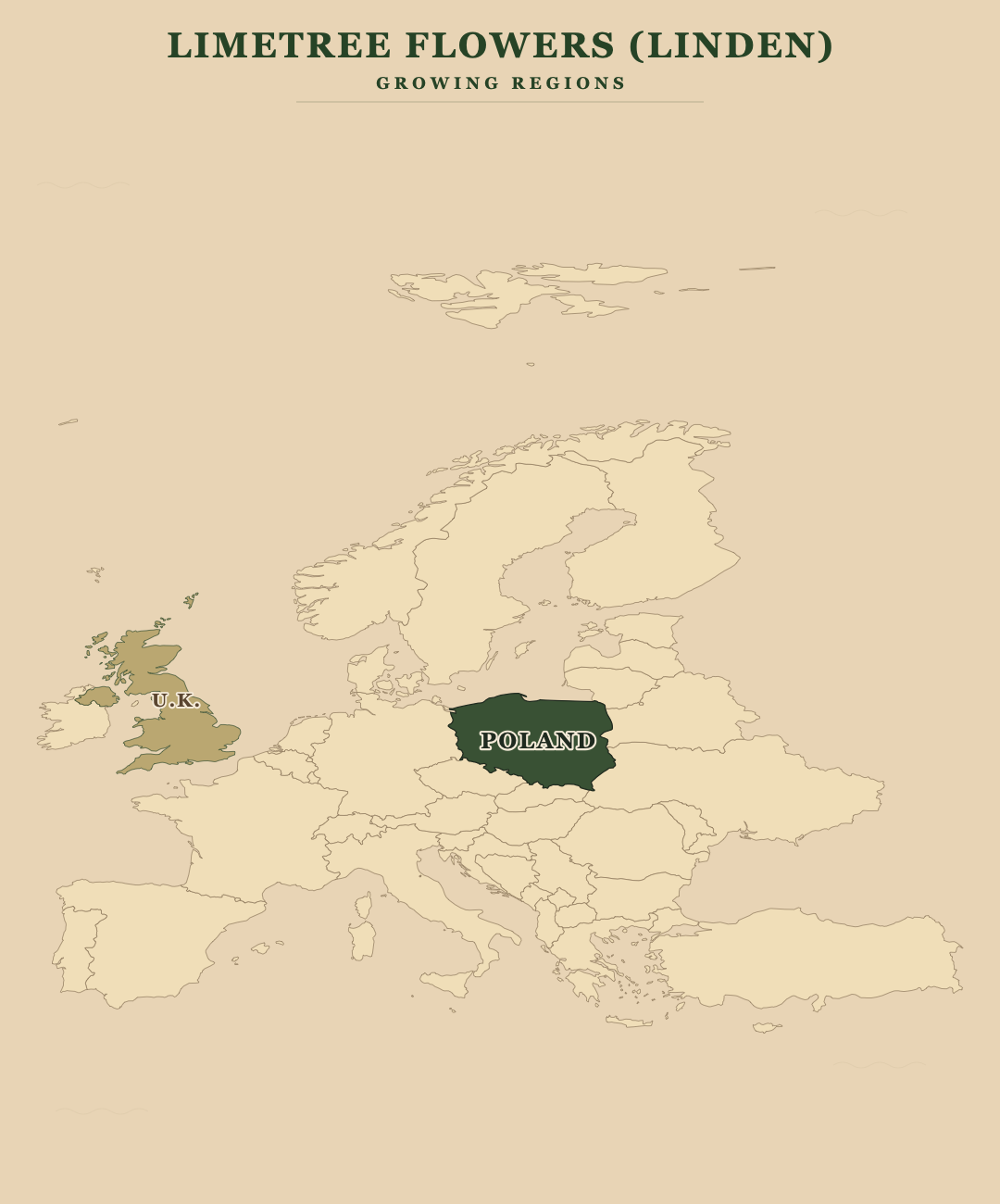
Limetree Flowers (Linden) is primarily cultivated in Central, Northern and Eastern Europe, with secondary growing regions in Western Asia, UK, USA — naturalized in some regions.
Spice Story
Linden has been one of Europe's most important honey-producing trees for centuries — linden honey is highly prized monofloral honey across central and northern Europe. The flowers themselves have been used in traditional herbal medicine across Central, Southern and Western Europe for sleep, stress and minor cold symptoms — tilleul in France, tila in Spain, lime-flower tea in Britain. In gin, linden flowers provide a soft honey-floral note that integrates beautifully with other delicate florals — particularly chamomile and elderflower.
Gin Creativity
Linden flowers bring soft honey-floral character with a hay-like background. A full sachet pushes a gin into clearly herbal-tea territory; a half-sachet provides quiet floral depth. Pair with chamomile and elderflower for a tisane profile, or with honey and lemon balm for a soothing-tonic blend.
Blending Science
Main flavour compounds
 Farnesol—
 Linaloolfloral, soft
 Eugenolclove-like, warming
 Volatile esters—
Pairs well with
Farnesol is one of the dominant aromatics — contributing soft sweet-floral character. Linalool adds the familiar coriander-and-bergamot lift. Eugenol (in small amounts) provides quiet warm-spice depth. Volatile esters contribute the honey-sweet body. Cool extraction preserves the bright floral top.
Food Partners
- Linden honey desserts — natural pairing.
- Cool summer salads — linden vinaigrette.
- Soft cheeses with honey — chèvre and ricotta.
- Light fruit jellies — apple-and-linden, pear-and-linden.
- Herbal-tea-infused cream — linden cream in panna cotta.
Cocktails To Try

- Linden Bee's Knees — linden gin, honey, lemon.
- Garden Spritz — linden gin, prosecco, soda.
- Floral Negroni — linden-and-chamomile gin, Campari, vermouth.
Release The Flavour
- Cool extraction — preserves bright floral aromatic.
- Brief contact — 1–4 hours captures honey character.
- Whole flowers — visual appeal in compound gins.
- Source matters — central European linden flower is the gold standard.
Discover more
From the same region
Pairs well with
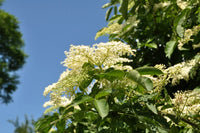
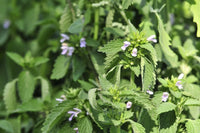
Same flavour family
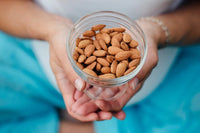
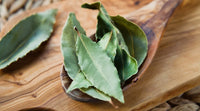
Surprise me

Sources & Citations
- scientific_name (Tilia cordata):en.wikipedia.org/wiki/Tilia_cordata
- native_range (Europe, western Asia):en.wikipedia.org/wiki/Tilia_cordata
- linden_honey_tradition:en.wikipedia.org/wiki/Tilia_cordata
- european_traditional_herbal_tea (tilleul, tila):en.wikipedia.org/wiki/Tilia_cordata
- main_flavour_compounds (CSV-sourced):inputs/source.csv — Limetree Flowers (Linden) row
